
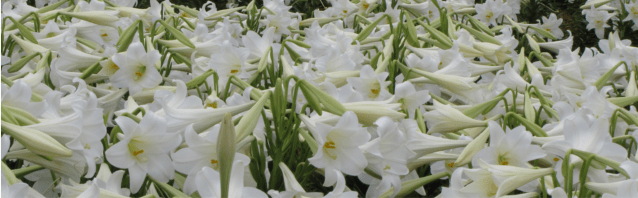
 Do a quick google search on traditional flowers for Easter and you’ll find what comes up are lots of florists websites telling you about the “Easter Lily” and while other flowers such as daffodils and tulips are suggested too it’s lilies that seem to predominate. So I thought I’d investigate further and discover the story of the “Easter Lily”, the florist’s name for what botanists call Lilium longiflorum, and the market traders in London’s Columbia Road Flower Market shout out more simply as ” Lonjee lilies”

We are told by one popular website, they are “symbolic of the resurrection of Jesus Christ… Churches of all denominations, large and small, are filled with floral arrangements of these white flowers with their trumpet-like shape on Easter morning. The flower is frequently represented in stained glass windows either in memory of someone or to signify hope, purity and life everlasting. The importance of the Easter lily is a time-honoured tradition that includes both ancient mythological and Biblical history.”

I’m afraid most of that came as something of a surprise [actually a shock!] to me as did the later discovery that the world has an Easter Lily Capital, which used to be in Okinawa, then moved to Bermuda but is now in the northernmost part of California. What on earth is going on?
 One of my favourite garden writers is Beverley Nichols, and the other day I discovered this wonderful quote about him and his work: If Bertie Wooster and Gertrude Jekyll had a son, surely he would have been Beverley Nichols. Today’s post is proof of that.




 The Garden History Blog
You must be logged in to post a comment.