London nurseries in the 1690s

Did you know there were cacti and bananas growing in London at the end of the 17thc?  Or that there were vineyards and commercial winemaking?  Or that the king rarely paid his bills?   Following on from last week’s post about the grander gardens of London that were visited by Sir John Gibson in 1691,  today I’m going to look at the commercial nurseries he visited – and a couple that he didn’t.

Although a few probate inventories detail the contents of a small number of nursery grounds, there are no plans, no accounts and very few letters or other documentary sources about them. Gibson’s descriptions provides some very useful information to form a fuller picture of what they were like, and even suggest that some were quite like modern garden centres, with lots of attractions other than plants.


Continue reading

Posted in Uncategorized | Tagged , , | Leave a comment

A Trip Advisor’s Guide to London Gardens……… in the 1690s

In the United Kingdom, garden visiting is an extremely popular occupation. In 2021 Kew had 1.25 million visitors  and RHS Wisley  nearly a million, while Westonbirt, Attingham and Edinburgh Botanic Gardens all also featured in top 20 visitor attractions in Britain.  Thousands of gardens open for the National Gardens Scheme and it’s been clear for years that garden tourism is big business. These days its relatively easy to  find information about where to visit but it hasn’t always been so.

That’s why a certain J. Gibson, a Yorkshire landowner who visited London in  December 1691, decided he’d help his friends and acquaintances by writing a “trip advisor” review of the major gardens round London. It wasn’t printed but instead circulated in hand-written form. Then it was lost, except for one copy which about a hundred years later ended up in the hands the Reverend Dr James Hamilton…

And thank goodness it did…

Continue reading

Posted in Uncategorized | Tagged , , , , , | Leave a comment

Babylonstoren : Beyond the Kitchen Garden

I don’t often write more than one post on a garden. But then few gardens are quite as extraordinary as Babylonstoren. After last week’s look at  the 8 acre formal kitchen garden I’m going to look at the rest of the estate.

This is  equally impressive and very  diverse. It includes areas devoted to individual plant families, several greenhouses, ecological and wilder zones, water gardens, and even, believe it or not, a garden inside a snake!


Continue reading

Posted in Uncategorized | Tagged , , , , | Leave a comment

Babylonstoren: an historic garden in the making

Back in September I was in South Africa and taken to see Babylonstoren, an impressive  “new” garden about an hour north of Cape Town.
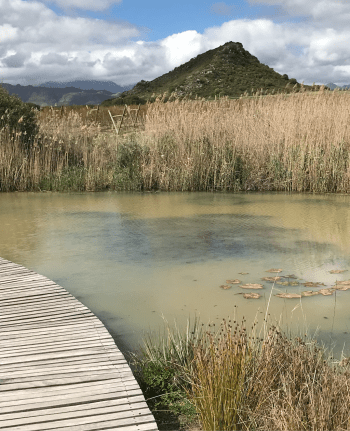
The 200-hectare estate lies at the foot of the  Simonsberg mountain range near Franschhoek in the heart of the Cape Winelands, and it has one of the grandest – and probably most productive  – kitchen gardens in the world.  Even though it was only the very beginning of spring there it was obviously somewhere you could spend days wandering and not feel satisfied that you’d seen enough.  As one other visitor put it  “clearly, no money has been spared on its creation and ongoing maintenance, but nothing is over-done, nothing feels pretentious, it all just feels exquisitely, tastefully ‘right’.”

Babylonstoren is garden history in the making. Read on to find out why…

Aerial view with the Simonsberg Mountains and the koppie [small conical hill] on the left

Continue reading

Posted in Uncategorized | Tagged , , , | Leave a comment

Painting the Gardens of History with Eleanor Fortescue Brickdale

What’s in a name? Eleanor Fortescue Brickdale sounds like an escapee from a Victorian 3-volume bodice-ripper or maybe the wicked governess in a  1920s girls comic – well that’s what I thought when I first saw her name.  That will teach me to be prejudiced and  judge a book by its cover or somebody by their name.

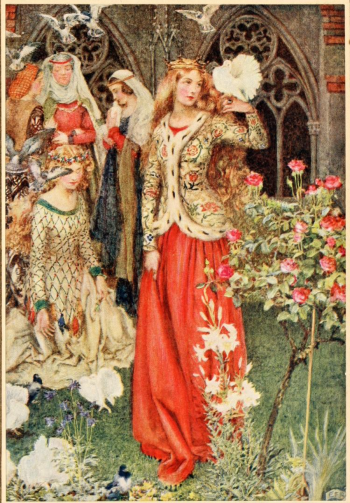
In fact she was one of the most popular artists in Britain at the turn of the 19th and 20th centuries. She specialised in historical and legendary scenes often incorporating gardens into her work. Her work later fell from popular favour as tastes changed, and she was according to her obituary The Times  “the last survivor”  of the pre-Raphaelites. That may explain why after her death in 1945 her work largely  disappeared from sight.   That is, as I hope you’ll agree when you’ve read the post and seen some of her work, a great pity.

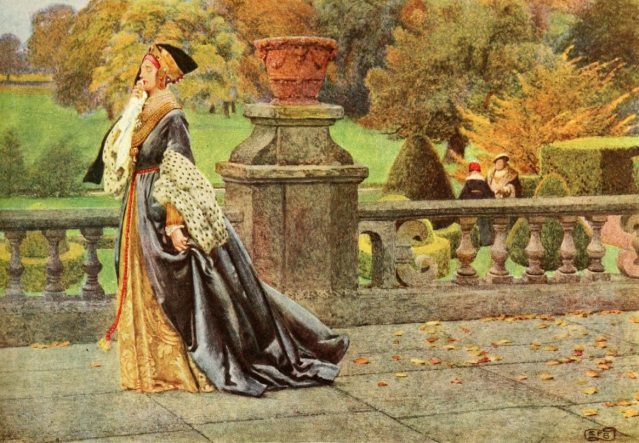
Queen Katherine – with Henry lurking in the background

Continue reading

Posted in Uncategorized | Tagged , , , , , , | Leave a comment