
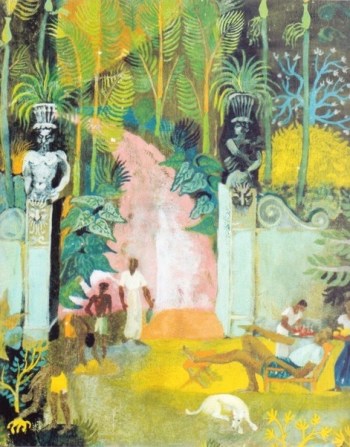
Bevis Bawa supervising work by the gates of Brief. Pianting by Donald Friend, image from David Robson’s Bawa
Let’s start with some not very good [actually pretty awful] poetry because it gives a flavour of today’s subject:
In the land where the jaggery grows
And the skies are raucous with crows
Years ago on a pastoral hill
Which was left to him in a will
A young man was heard to declare
“I will build my kingdom here
And proclaim myself its chief
As the one and only
Bawa of Brief”

Bevis Bawa by himself from Bevis Bawa’s Brief ed by Neville Weereratne. 2011
The “kingdom” was never particularly large, and the “chief” gave much of it away during his lifetime but there’s no doubt that what was left – the “one and only” Brief which is an unexpectedly wonderful garden.


 On the way to a family wedding last weekend I stopped off at Harlaxton near Grantham in Lincolnshire. Like John Claudius Loudon before me I “had heard much of this place from various architects and amateurs for several years.”


 The Garden History Blog
You must be logged in to post a comment.