
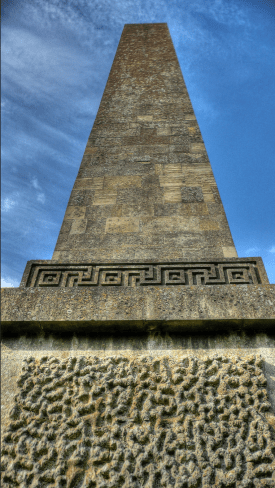
Where do I start in trying to describe Holkham? And it’s not just me. Historic England’s Register of Parks and Gardens of Special Historic Interest says : ” Because of the complexity of this site, the standard Register entry format would convey neither an adequate description nor a satisfactory account of the development of the landscape” and then proceeds to give a 2300 word brief summary of one of the the largest and most significant landscapes parks in the country.
The Holkham Hall estate is on the north Norfolk coast, near Wells-next-the-Sea and is enormous to put it mildly. The scale almost has to be seen to be believed. The walled park around the house stretches about 3km east to west and 4 km north to south, and covers an area of over 1200 ha. While its landscape of pasture, woods and water look entirely natural they are largely a creation of the 18th and 19th centuries. Indeed the estate’s development much of which is recorded in Holkham’s extensive archives reads like a roll-call of the great and good in garden and architectural history.
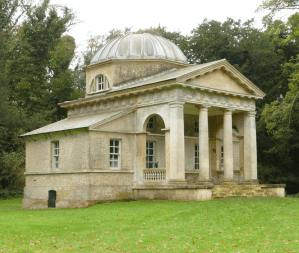
It was laid out between the 1720s and 1760s by Thomas Coke, [later earl of Leicester] with the help or advice of Lord Burlington, William Kent, Colen Campbell and Matthew Brettingham. Later Lancelot Brown, William Emes, Samuel Wyatt and Humphry Repton, all had associations with the site whilst in the mid-19thc more work was carried out by William Burn, William Andrews Nesfield, Samuel Teulon and Thomas Sandys.
So a trip to see Holkham was bound to be eye-opening!


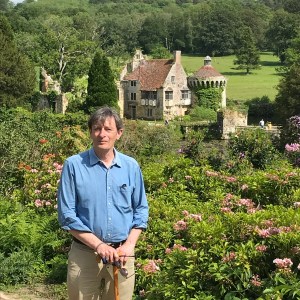 I’m sure, like me, you’ve often coveted a garden that you’ve visited. Maybe it’s a grand estate with sweeping vistas, or a beautiful garden building that takes your eye or perhaps somewhere that has wonderful planting. What wouldn’t we do to live there? Then, coming down to earth with a bump, we think of the upkeep, the worry, the expense and the crowds. But there’s one place where I think it would all be worthwhile, so if one day you hear that the National Trust announce that the original Scotney Castle has been stolen you’ll know it was me.
 Who wouldn’t fall in love with Scotney at first sight? I did within minutes of my first view of the castle across the moat donkey’s years ago and I’ve done so all over again on every subsequent visit, although the last time was probably 8 or 10 years ago. So when to came to choosing somewhere to visit for a birthday treat last weekend Scotney was top of the list, and luckily we managed to get timed tickets.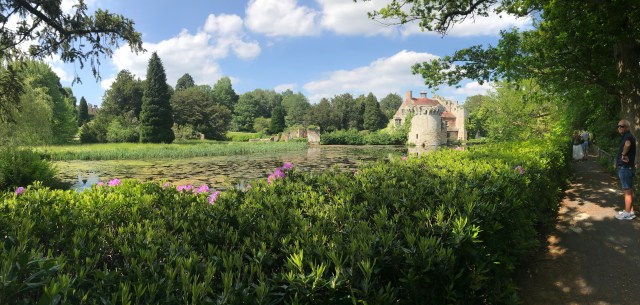

 My partner recently had a serious attack of Pteridomania! As a consequence there’s hardly a corner of 0ur tiny back garden that doesn’t show signs of this terrible ailment. There is evidence of this not only out in the open but also hidden away underneath other things, and its even affected the bathroom. The problem is that the disease is contagious so unless I’m careful I’ll succumb too and I don’t think that Pfizer or Astra Zeneca have produced a preventative vaccine yet. But luckily it isn’t a physical complaint and doesn’t require medication just the occasional quick misting or another surreptitious addition to the garden.


 The Garden History Blog
You must be logged in to post a comment.