A Young Man Among Roses

I’m sure that you’ll recognise this picture.   Its custodian, the V&A, says it “is perhaps the most famous of English miniatures. It epitomises the romantic Elizabethan age and is a masterpiece of miniature paintings by its greatest exponent, Nicholas Hilliard. The large elongated oval shape of this miniature was never repeated in Hilliard’s work and must relate to the now unknown purpose of the object. Possibly it was incorporated into an expensive object such as a looking-glass.”

It’s a portrait of young man in fashionable court dress leaning against a tree behind a thicket of roses. What is there one can possibly say about it that isn’t that obvious.  As anyone who’s ever looked closely at paintings of this period will tell you, there’s an awful lot! So here are  some questions. Who is he?  Why is dressed as he is?  Why is he posed in this way? Are the roses significant?  and what does the inscription mean – did you even notice the inscription?

Continue reading

Posted in Uncategorized | Tagged , , , , , , , , | Leave a comment

Pteridomania

My partner recently had a serious attack of Pteridomania!  As a consequence there’s hardly a corner of 0ur tiny back garden that doesn’t show signs of this terrible ailment. There is evidence of this not only out  in the open but also hidden away underneath other things, and its even affected the bathroom.     The problem is that the disease is contagious so unless I’m careful I’ll succumb too and I don’t think that Pfizer or Astra Zeneca have produced a preventative vaccine  yet.  But luckily it isn’t a physical complaint and doesn’t require medication just the occasional quick misting or another surreptitious  addition to the garden.  


We’d have been at home in mid-Victorian Britain when Pteridomania first became a common complaint, but at least we don’t do what the Victorians did and  pillage the countryside for a quick fix.

As I’m sure you realised you won’t find Pteridomania in the NHS book of transmissible diseases. In fact as a malady it was only invented by Charles Kingsley, more famously author of ‘The Water Babies’, in his book ‘Glaucus’ in 1855.  He used it to describe a form of mania that swept through Britain in the mid-19thc and that he claimed mainly affected young women…

Continue reading

Posted in Uncategorized | Tagged , , , , , , | 3 Comments

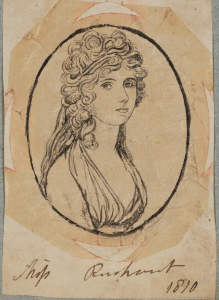
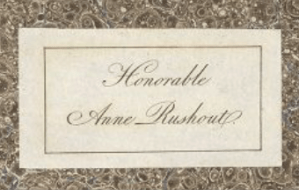
Anne Rushout

Sometimes one stumbles across interesting people by pure chance. Today’s post is one such serendipitous discovery. I was looking for images for another post and found an interesting watercolour painting of a landscape by a woman I’d never heard of, but who seemed  interesting enough to do a quick search to see if she’d done any other paintings of interest.

She had.


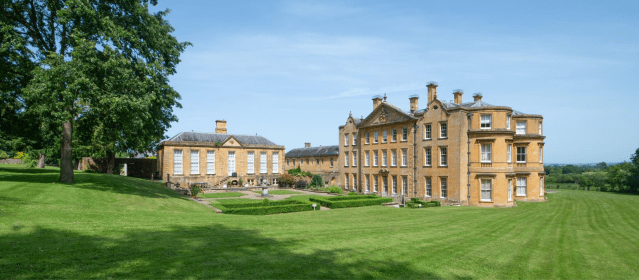
So let me introduce you to Anne Rushout of Northwick Park and Wanstead Grove.


Continue reading

Posted in Uncategorized | Tagged , , , , , , , , , , , , , , | 4 Comments

Cottage Gardens – Cabbages and Chocolate boxes

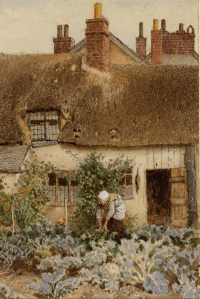
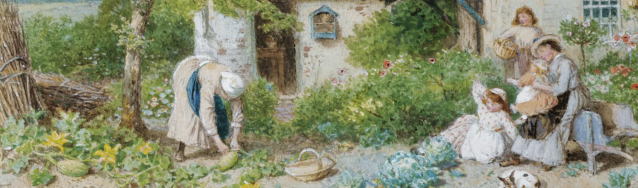
I wrote a couple of weeks back about the origin of the cottage garden,  and today I want to take the story forward and look at how by the middle of Queen Victoria’s  reign  rural cottages and their gardens had become both a cause for social reformers and at the same time  a rich subject for  artists.  But while one group saw only the poverty, squalor and daily grind,  the other managed to romanticise what they saw and create idealised chocolate box versions of reality.

Guess which side won in the public perception both then and, I suspect,  even today?

Continue reading

Posted in Uncategorized | Tagged , , , , | 1 Comment

The Cottage Garden and its origins

We all know what a cottage garden looks like don’t we?  We might even be able to describe its main features, although a short  definitive account is quite elusive. So where does the phrase come from? When is it first used? I confess to being stumped when someone asked me recently. You’d think the answer was obvious but actually it isn’t.

I’m sure you knew there is a Cottage Garden Society – large and flourishing – so I thought they’d know if anyone does – but no. Their website doesn’t have  a definition of what constitutes a cottage garden, although there’s a lot about what are nowadays known as cottage garden plants.

So it was off to  Collins Dictionary which defines it as an informal style of garden which has beds planted with a great variety of traditional flowers. Michael Symes in his handy little Glossary of Garden History says it’s “a garden attached to a cottage where the planting is informal, apparently artless crowded with flowers, vegetables and fruit trees, with trailers climbers and creepers on the woodwork.”    It’s the “apparently artless” which gives away the fact that nowadays a cottage garden is another form of horticultural artifice.

It remains an aspiration for many. “What everyone wanted, from the Lady of the Manor to the humblest suburbanite, was a romantic cottage garden, a private bucolic retreat that would provide an escape from modern world.” (Penelope Hobhouse/ Ambra Edwards in The Story of Gardening).  But was it always so?  I suspect that most people wouldn’t aspire to it if they knew what it used to mean…

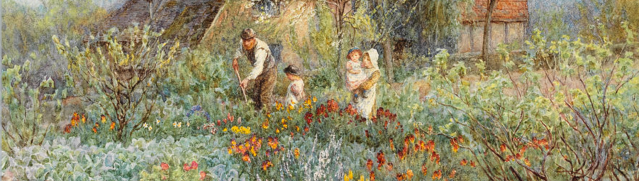
A Cottage Garden by Helen Allingham – but where does this style originate?

Continue reading

Posted in Uncategorized | Tagged , , , , , , , , | 13 Comments