Before the Square


I’m often asked to talk about the history of London’s squares and I always wonder what causes this almost endless fascination.  Of course there’s no doubt that, as the London Gardens Trust says,  “squares are one of the defining features of London. Like other European cities, London has its grand civic spaces, but no other city has developed the garden square in quite the same way.”

They have survived changes in taste and style, war and reconstruction and all the vicissitudes of finance and management problems. I suspect that is largely due to their spatial integrity which has  largely remained intact despite  the street scene changing drastically over the past 400 years.  We have seen buildings refaced, redeveloped or replaced, trees, shrubs, paths, lighting, and railings have come and gone,  but despite everything the successful combination of architecture and horticulture has somehow survived.

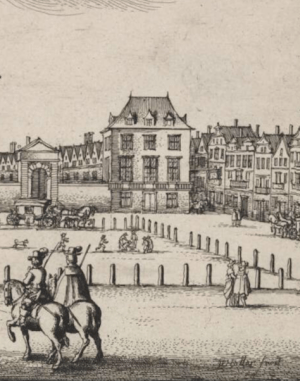
Over the next few weeks I’m going to look at London squares and their history beginning today with  “where did the idea for a square come from?”

Continue reading

Posted in Uncategorized | Tagged , , , , , , , , , , | 1 Comment

Kensington goes Italian

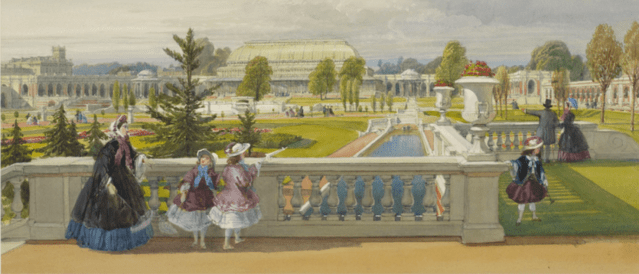
Last week I wrote the background story of the Royal Horticultural Society’s magnificent but short-lived gardens in South Kensington, and today I want to follow up with an account of the gardens themselves designed by William Andrews Nesfield.

When I sat down to write this I wasn’t sure where to start or how to go about describing such an enormous space that was at once doubly simple and complex. Simple in that the overall design is visible almost  in a glance, but complex in that each section is very elaborate in detail,  and while simple in terms of planting  it is complex in its overall content.

Continue reading

Posted in Uncategorized | Tagged , , , , , , , , , , , , | Leave a comment

Andrew Murray & the Lost Gardens of Kensington

Who was Andrew Murray I can hear you asking and how did he lose a garden, especially one in Kensington?  Well, of course he didn’t actually personally  lose the garden, but he did record it before it was lost.  A Scottish lawyer and natural historian Murray  held a variety of posts before becoming the assistant secretary of the Royal Horticultural Society between 1860 and 1865. Although its quite hard for us to imagine, the RHS was once thought incapable of running a garden, or at least of running a garden that didn’t lose money hand over fist.

The lost garden of the title – more than 22 acres of prime real estate in Kensington – was planned to be their financial salvation  and it opened  to great acclaim in 1861 with an extraordinary collection of buildings, canals, statuary and embroidered parterres. However it didn’t solve the society’s money problems or even pay its way, so after some acrimonious court cases the RHS was evicted and the gardens built over less than 40 years later.

Continue reading

Posted in Uncategorized | Tagged , , , , , , , , | Leave a comment

Hollyhocks


Some flowers – like tulips, peonies or roses – are important or famous enough  to have their stories told in books that make the best seller list. But while some others have champions who’ve written about them, or are the subject of serious monographs there are some other well-known flowers that don’t seem to have attracted that much attention.  One of them is that stalwart of the cottage garden the hollyhock.

Do you even know where they come from?  When they arrived in Britain?  Why was Darwin interested in them?  Do they actually have  a history that’s worth knowing?   And why did Emma Townsend, writing in the Independent call them  “the Laura Ashley curtains of the gardening world, dangerously blowsy and 10 years out of date.”  and say “you certainly won’t catch anyone using them in a garden at oh-so-modern Chelsea.”

Read on to find out…

Continue reading

Posted in Uncategorized | Tagged , , , , , , , , , | 2 Comments

The M9 and rhizotrons


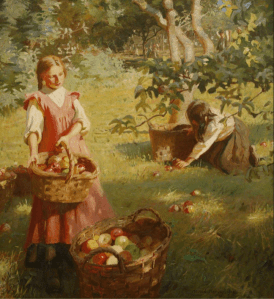
Last week as I was picking  fruit from some small apple trees I noticed how badly grafted one of them was.   It reminded me  that a few weeks ago I wrote about the history of grafting and prompted me to  take that  story into the 20thc and talk about the M9.

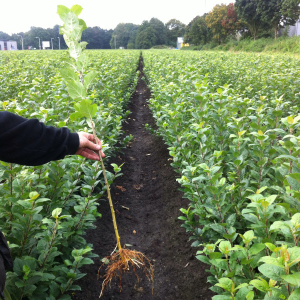
By that I don’t mean the motorway from Edinburgh to Dunblane but a dwarfing rootstock for apples developed, along with many others, at East Malling Research station.

So read on if you’ve ever wondered  what all those strange codes and numbers are on the labels of  fruit trees in garden centres and nurseries? Who, for instance,  is St Julien? Gisela 5?  And what does M27 or MM9 actually mean?   How has M9  reshaped the global landscape and the economics of apple production?

And finally do you know what an apple trees roots look like? If you don’t, you might need a rhizotron…so read on to find out what that is!

Continue reading

Posted in Uncategorized | Tagged , , | Leave a comment