Winifred Walker: “The most famous of all flower painters”

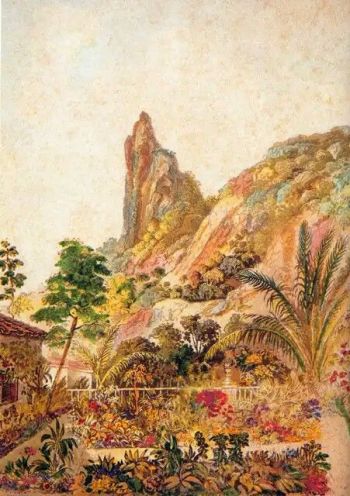
Trusses of hybrids: R. ‘Hugh Wormold’ at top, ‘Mrs Lindsay Smith’ at right and ‘Rosamund Millais’ at left. from JG Millais ‘s Rhododendrons(1924).

If I ask you to name the most famous of all flowers painters I very much doubt you’d reply Winifred Walker,  yet that’s how she was described by a national newspaper a century ago in 1919. The description might be a bit of an exaggeration but there’s no doubt she was certainly  a more than accomplished painter who illustrated seed and nursery catalogues and gardening books as well as being an “official” artist for the Royal Horticultural Society.

Bodgers’ Zinnias by Winifred Walker, from  American Bulb Company catalogue, 1930

Yet her story confirms one of the things I learned quite early on writing this blog, and indeed doing garden history research more generally, that it’s often more difficult to track down information about the comparatively recent past than it is about the 18th or 19th centuries. It also shows how difficult it can be to trace the lives of many of the botanical artists who figure in the story, even if they are significant, and it’s usually doubly difficult if they are women.

Continue reading

Posted in Uncategorized | Tagged , , , | 2 Comments

The Eighth Wonder of the World?

Last week’s post was about Salomon de Caus’s career in England. It ended when James I’s daughter, Princess Elizabeth, who de Caus was tutoring, married Frederick, the Elector Palatine in 1613 and moved to Heidelberg.  This might have been a disaster for de Caus but it turned out to be a great opportunity and led to his grandest commission.

Instead of being left looking for a new patron in England de Caus was invited to Heidelberg, and  by July 1614 he had been appointed “Ingenieur et architecte de son Altesse Palatine Electorale” and asked to redesign the palace gardens for the happy couple.

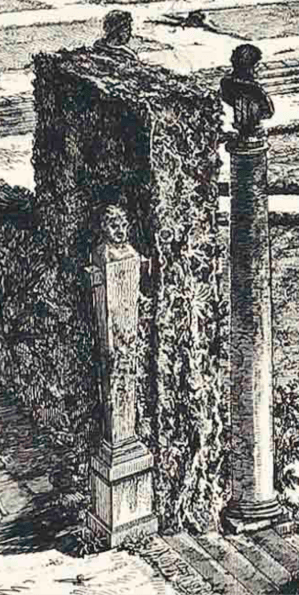
These have become one of the most celebrated gardens of the early modern period.  They were on an extremely  difficult site, but extensive in scale, almost ludicrously elaborate in conception, and possibly with all sorts of mystical overtones.  They were immortalised in a much-reproduced painting and  engraving, and in considerable detail in de Caus own book about them, the Hortus Palatinus.  Yet it’s almost as much about their theoretical appearance and meaning as their actual existence, because they were unfinished, and even those parts  which were completed did not last long because of the ravages of war.

In short the Hortus Palatinus is as much  a legendary garden as a real one

Continue reading
Posted in Uncategorized | Tagged , , , , , , , , , , | Leave a comment

Solomon de Caus in England

Design for a grand figure representing Mount Imolus, from De Caus Raisons des Forces mouvantes 1615

Roy Strong in The Renaissance Garden asserts, quite rightly, that early writers on garden history seem to have overlooked the huge part played in garden design in the late 15th to early 17thc by engineers.  The Renaissance humanist mind saw no boundaries  between academic and practical disciplines of any kind, and proof of that can be seen perfectly in the life and career of Salomon de Caus.

De Caus was an engineer, architect, mathematician and musical theorist who also studied hydraulics and optics amongst many other things. He combined broad practical skill with theoretical understanding  in all these fields, and also had a significant role in early modern garden design. 

De Caus worked on several important sites in Jacobean Britain, as well as others in mainland Europe, most famously at Heidelberg.  He also wrote a series of books which show his breadth of intellect and interests, and which, particularly because of their wonderful illustrations, continue to be a major source of information notably on early modern engineering and gardens.  
Today’s post is a look at his impact on gardens in England
Posted in Uncategorized | Tagged , , , , , , , , , , , , , , , | 1 Comment

The Prince and the Tomato

La Bourdaisière is just one  small chateau  in the Loire Valley among dozens and dozens of others.  It sits on a rise dominating its immediate surroundings, and in the middle of its parc classé [the equivalent of a registered historic park in Britain] and a 90 hectare estate.  In itself that does not mark it out much from the other chateaux in the region. Its history is, like its architecture, nothing particularly special.  Yet it is has become a remarkable place for one reason and that is its large kitchen garden,  and what now goes on inside its walls.  And that’s all down to a Prince and his tomatoes…

Continue reading

Posted in Uncategorized | Tagged , , , , , , | Leave a comment

The Harcourt Arboretum or how to become a millionaire by growing pine trees

In the Harcourt Arboretum

I’m at the Gardens Trust conference in Oxford this weekend and thought it would be nice to blog about something related to our proceedings.  So I obtained an advance copy of the conference brochure which is, as always, packed with first-class background information on the sites we are visiting and the things we’re hearing about.  Unfortunately for me every subject I had vaguely thought would be interesting to write about was already well covered by others far more knowledgable than me, but, since we are to due to visit the Oxford University’s Harcourt Arboretum I thought I could get away with a general background piece on the history of arboretums.

Then I noticed that the University Arboretum had been started in 1835 when Archbishop Harcourt commissioned  William Sawrey Gilpin to design a pinetum for his growing collection of conifers, which were newly fashionable.  So instead I decided to be a bit more specific and investigate when and where  this craze for conifers began : in other words to investigate the history of the pinetum.

After a few minutes of looking through early 19thc gardening books and magazines I saw another reference and serendipity  kicked in…

All images come from the website of the Harcourt Arboretum unless otherwise stated.

Continue reading

Posted in Uncategorized | Tagged , , , , , , , | Leave a comment