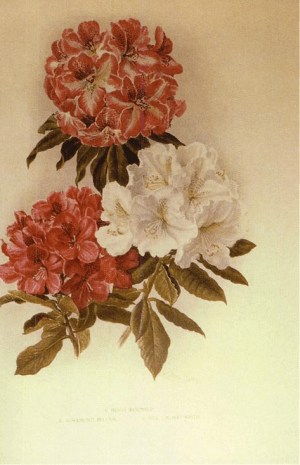
Trusses of hybrids: R. ‘Hugh Wormold’ at top, ‘Mrs Lindsay Smith’ at right and ‘Rosamund Millais’ at left. from JG Millais ‘s Rhododendrons(1924).
If I ask you to name the most famous of all flowers painters I very much doubt you’d reply Winifred Walker, yet that’s how she was described by a national newspaper a century ago in 1919. The description might be a bit of an exaggeration but there’s no doubt she was certainly a more than accomplished painter who illustrated seed and nursery catalogues and gardening books as well as being an “official” artist for the Royal Horticultural Society.

Bodgers’ Zinnias by Winifred Walker, from American Bulb Company catalogue, 1930
Yet her story confirms one of the things I learned quite early on writing this blog, and indeed doing garden history research more generally, that it’s often more difficult to track down information about the comparatively recent past than it is about the 18th or 19th centuries. It also shows how difficult it can be to trace the lives of many of the botanical artists who figure in the story, even if they are significant, and it’s usually doubly difficult if they are women.


 La Bourdaisière is just one small chateau in the Loire Valley among dozens and dozens of others. It sits on a rise dominating its immediate surroundings, and in the middle of its parc classé [the equivalent of a registered historic park in Britain] and a 90 hectare estate. In itself that does not mark it out much from the other chateaux in the region. Its history is, like its architecture, nothing particularly special. Yet it is has become a remarkable place for one reason and that is its large kitchen garden, and what now goes on inside its walls. And that’s all down to a Prince and his tomatoes…


 The Garden History Blog
You must be logged in to post a comment.