Mechanical Landscapes: The Eidophusikon

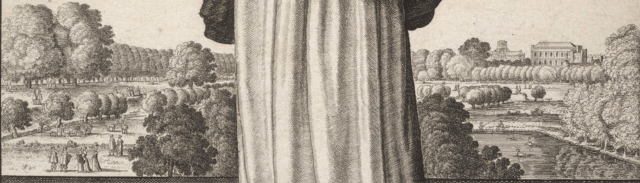
detail from a sketch of the Eidophusikon by Edward Burney, British Museum

Last weekend I went to see a modern version of something that in 1776  gripped London like a fever.  But rather than a  medical crisis it was an all-embracing visual  experience: a series of stories that involved  landscape… & not static views of the countryside  rather landscape that moved.

The story begins with the staging by the Swiss father and son team Pierre and Henri-Louis Jaquet-Droz,  of their Spectacle mechanique in Covent Garden.  Originally  watchmakers they had branched out into building other mechanical devices and then travelled Europe exhibiting 4 pieces of their work.   It was to inspire a Frenchman living  and working in London  to develop of one of the strangest of many strange 18thc inventions: the Eidophusikon.

Continue reading

Posted in Uncategorized | Tagged , , , , , | Leave a comment

A Walk Around the World

The first modern public sign of Biddulph’s importance was when it was chosen as the garden to represent the 19thc on commemorative stamps in 1983

Last week’s post on the Geological Gallery at Biddulph was, I hope, something of an insight in to the mindset of James Bateman its creator in the mid-19thc.  Today’s is designed to look at the gardens he created there, partly because both he and his wife were passionate about plants but partly as  a reinforcement of his belief in a divine creator or as modern parlance would have it, an intelligent designer.

photo by Edward Moss

Biddulph  was intended to reveal not just the variety of creation across the globe but also its variety through time. The Batemans reshaped the landscape  to suggest the geological processes which had formed the plants native environments, and then presented the earth’s story from the days of Creation – using fossilised tree ferns in the garden for example – to the rise of the civilizations of Egypt, China and western Europe.

One of the main reasons this was possible was the Wardian case, which, because it allowed live plants to be carried safely and securely on long sea voyages,  had opened up the world to western plant collectors.  Working with Edward Cooke, the Batemans turned 15 acres [6 hectares] of poor quality land  into a showcase for this vast range of newly introduced plants. The result was an extraordinary complicated confection of spaces and planting that defies any simple description. Continue reading

Posted in Uncategorized | Tagged , , , , , , , , , , , , | Leave a comment

Orchids, Ferns, Fossils and the Great Flood

We often hear that grand gardens cost money: it’s as true as the old cliché which says “money talks.” But there is a world of difference between a grand garden and a great one.  Great gardens develop when that money meets vision, enthusiasm, knowledge – and a gardener. In the garden I’m going to talk about today and next week there was plenty of all those elements plus a great deal of persistence and more latterly of luck.

Sea Horse Roof finial             National Trust

It is a very special place in many senses and when I was thinking about how to begin describing it here I recalled what John Sales, the former head of gardens for the National Trust said about his first visit in the mid-1970s. “I was totally overwhelmed – in turns amazed, intrigued, excited, baffled and lost in the mixture of styles, moods and plants… here was something entirely different.”

Continue reading

Posted in Uncategorized | Tagged , , , , , , , , , , , | 4 Comments

Ready to go Miss?

Today’s post is about the result of a conversation in the very late 19thc between Miss J.S. Turner “a fellow of the Royal Horticultural Society and a well-known trainer and lecturer in horticulture” and Mrs Evelyn Cecil, who is probably better known as Alicia Amherst the pioneer garden historian.

The discussion concerned  the training of women in horticulture, but unlike the settlement at Bredon’s Norton which I wrote about a few weeks back, it was not aimed at women who wanted to earn their living as Independent gardeners, but at those who wanted to emigrate.[ And that’s before Brexit]

Mrs Cecil suggested that “one of the great wants of our colonies was well-trained  lady-like girls who would make good wives.” Miss Turner’s “idea of a way out of the difficulty was to establish a training school where ladies could be made familiar with the old-fashioned farmhouse life.”  And early in 1907 their efforts resulted in the opening of Arlesey House Country and Colonial Training School for Ladies.

From The Girl’s Realm, 1907

Continue reading

Posted in Uncategorized | Tagged , , , , , | 2 Comments

The View from Room 35….

View from the window
Pushkin Museum Moscow

Last week’s post about finding a display of Barbie dolls in  an historic Spanish garden was a good indication of how varied garden history can be, and today’s is another. In fact today’s is hardly about gardens at all in the conventional sense, but don’t let that put you off.

The Garden Trust has as its tagline or motto “Research Campaign Conserve”.  To highlight  the research aspect of our work we offer two real opportunities to showcase new findings.   One is a new research symposium and the other an essay prize. Over the years they’ve covered places and people in Britain but have increasingly been international in outlook.

 [Entries welcome for this year – for details follow the links above. Closing date May 5th]

As I arrived at the posh hotel I was staying in [bargain winter break prices I hasten to add] I was reminded of  new work  from each of those forums.  At our 2015 conference we heard a paper about villa gardens on the Ligurian coast of Italy, and recently there was an essay prize entry on the  exotic  gardens created for new grand hotels along the French Riviera in the late 19th.   As it happens I wasn’t in either France or Italy although there is a strong French influence, as you will have realised if you’ve worked out who did the painting and inspired the pattern that was  on part of my  bedroom wall and ceiling.

The pattern on part of the wall and the ceiling

So…. today’s starter for 10 is, apart from guessing the artist, is to guess where I wrote the draft of this post   Continue reading

Posted in Uncategorized | Tagged , , , | 1 Comment