William Burchell and St Helena

“The American Aloe on St Helena” 17th Feb 1807, including a self-portrait by William Burchell, from Burchell’s Travels [full ref at end]

St Helena is one of the most remote places on Earth, 4,000 kilometres (2,500 miles) east of Rio de Janeiro and  almost 2000 kilometres (1,210 miles) from the nearest bit of  the African coast.  It’s probably most famous for being Napoleon’s place of exile.  Until the weekly air service started in 2017 it took 6 days by boat to Cape Town, which you might think was a long time, until you consider that  it took the ex-emperor ten weeks to get there on a ship from Britain.

But it ought to be more famous for its extraordinary plant life, and probably would have been if it hadn’t all been driven to the extinction or the very verge of it by man…and his goats!

The first person to attempt an inventory of its natural history  was William Burchell, a Londoner, who emigrated there in the early 19thc and tried to establish a botanic garden, before moving on to South Africa and becoming  probably  “the most prolific collector of botanical and zoological specimens” the world had then known.

Continue reading

Posted in Uncategorized | Tagged , , , , | 2 Comments

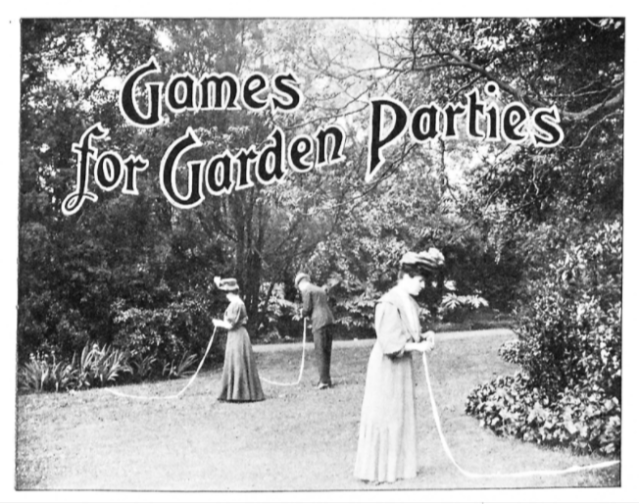
Garden Party Games – Edwardian style

from Chatterbox magazine, 1915

It was my birthday recently but unfortunately the weather wasn’t quite suitable for organising a garden party to celebrate. Nevertheless  with the weather warming up again I thought I would offer some tried and tested seasonal advice about using your garden to entertain but please remember “one of the most important features of successful entertaining is that guests be kept so well employed in enjoying themselves that the time never has a chance to drag.”

“In order to ensure this happy state of things it is a wise plan to arrange for some really good games beforehand, especially when there are young folk to be included in the invitations. The more original the plan of amusement the better, for novelty is always pleasing. Therefore, a few suggestions adaptable for a garden party may perhaps be welcome to readers in search of something fresh in this direction.”

I can’t say I’ve ever tried any of these activities but they were apparently all the rage for “young people”  in 1907!

from The Girl’s Realm, 1907

Continue reading

Posted in Uncategorized | Tagged | 1 Comment

Hollar’s Fashionable Landscapes

Wenceslaus Hollar, Self-portrait, 1647 University of Toronto

It’s strange how much of our visual knowledge of what mid-17thc England was like comes through the work of non-English artists, like Van Dyke  and Wenceslaus Hollar.  Whereas most people have heard of Van Dyke  I’m not so sure if the same is true of Hollar. This is partly because Van Dyke painted large flashy canvases portraying  the court and aristocratic world before the Civil War whereas Hollar usually worked on a miniature scale. Yet he  created prints and drawings of amazing accuracy and detail even if they  require careful study to appreciate his talent.  His work also required great technical skill but, because  printmaking smacks of artisanry rather than artistry, it has traditionally been considered a lesser art form.

However Hollar was the greatest engraver and print maker of the 17thc, indeed, arguably amongst the greatest of all time, and his work tells its own story. His range of interests and output was vast, and about 400 drawings 3000 different etchings and many sketches  and watercolours also survive. Between them they provide an amazing insight into 17thc life.

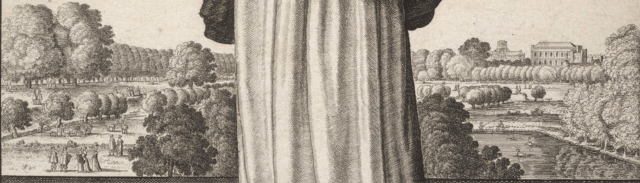
Todays’ post is a look at some of his  fashion prints, particularly a series of four full length figures he produced in  1643 and 1644, one for each season, and before you wonder why it sounds as if I’m intending to tell you about 17thc women’s clothes on a garden history blog take a look at the backgrounds… Continue reading
Posted in Uncategorized | Tagged , , , | 2 Comments

Lord & Lady Penzance show their breeding…

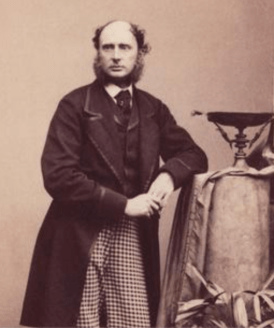
Todays post is about a senior Victorian divorce and ecclesiastical court judge who  was a fellow of the Royal Geographical and Anthropological Societies,  and, believe it or not,  a member of the Cannibal Club.  He also thought that Francis Bacon wrote Shakespeare and apparently had more than a passing interest in pornography.  So perhaps not the sort of person you’d expect to read about here, and especially not over your breakfast on a Saturday morning.  But today’s star turn was all of those things and more – and in particular  he was a keen gardener.

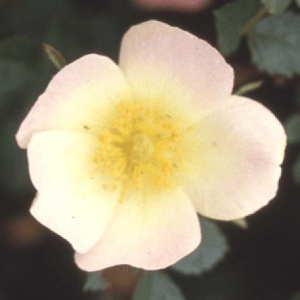
He was Lord Penzance and you might recall his name from nursery catalogues in connection with rampant thorny roses.

Lord Penzance

So read on to discover more about his interest in the queen of flowers but not the other things. [ However I’ve added some  references at the end  if you want to pursue them further under your own steam.]

Lady Penzance


Continue reading

Posted in Uncategorized | Tagged , | Leave a comment

A Very British Revolution

The front cover of the guide book

51 years ago in May and June 1968 there was  a revolution  in Britain.  It did not include  rioting students on the streets as in Paris but  took place in the grounds of one of Britain’s grandest stately homes, Syon Park in Middlesex.   55 acres of the Duke of Northumberland’s  estate was set aside “for the establishment of a National Centre for Gardening, where all that is best in British horticulture will be on permanent display.” It was Britain’s first garden centre.

Plans for this had been announced in 1965 when the 10th Duke went into partnership with ICI.  They were soon joined in this venture by Percy Thrower, “known to millions of people in Britain as a broadcaster and writer on gardening topics” who became  a director of The Gardening Centre Ltd, and by Roy Hay, gardening correspondent of The Times, who chaired the advisory committee to set it up.  Continue reading

Posted in Uncategorized | Tagged , , | 1 Comment