The Glastonbury Thorn

One of the 1986 Christmas stamps

One of the things that historians like to boast about is their devotion to evidence.  Facts without corroboration are merely assertions. Good stories without witness statements or documentary support are just that: good stories.  The further back in time one goes the harder it is to prove anything really, so legend and history often battle it out. And legend often has a firmer grip on the imagination than the hard reality of historical fact.

The tree flowers twice a year, at Easter and Christmas Credit: ITV News

That’s certainly the case  for the story of  the Glastonbury Thorn.  There, fact and fiction clash nicely, with historical truth being a lot less romantic than the accretions of good storytelling, so maybe we should just read into it whatever we like and wish that it was true….  which we’re used to doing at this time of year anyway!

Merry Christmas!

Continue reading

Posted in Uncategorized | Tagged , , , , , , , , , , , , , , , | 4 Comments

A Novel Club for Country Loving Girls

I had to stifle laughter in the hallowed silence of the Rare Books Reading Room at the British Library when I first began leafing through the magazine that inspired this post. I was searching for an interview with the Victorian painter E.A.Rowe for last week’s post  in, of all places, The Girl’s Realm for 1907.

The 4 thick volumes were unindexed so I had to turn thousands of pages and in the process was both intrigued and amused by the wealth of other stuff thought suitable for teenage girls in the Edwardian era. Some  I would have expected: serial stories, celebrity interviews and profiles, cookery, pets, travel, arts and crafts but there were also some unexpected articles  which might have widened vision  such as pieces on girls caving and mountaineering.. and who could resist looking at “What a girl does with breadcrumb” – [the answer might surprise you so since its really not connected with garden history  I’ve added it at the very end of this post.]  There were also outlines of the careers of women in all fields – swimming, singing, writing, science, farming…. and even horticulture.

from The Girl’s Realm 1909

So I started to investigate a bit further and discovered Victoria Woodhull Martin  and the story behind The Novel Club for Country Loving Girls … Continue reading

Posted in Uncategorized | Tagged , , , , , , , , , | 1 Comment

Ernest Arthur Rowe: Painting the Old English Garden

The Artist’s House and Garden at Rusthall, Kent

I’ve been surprised over the five years I’ve been writing this blog how much people enjoy reading about obscure [to the modern day at least]  artists from the great golden age of gardening and garden painting. Posts on Beatrice Parsons and George Elgood still get read regularly and so when I saw some pictures by  their contemporary E.A.Rowe  and heard how “he spent his life in passing from one garden beautiful to another to capture in each a vision of loveliness and mirror it on canvas.” I decide to investigate further…

Luckily Rowe was  meticulous about keeping a record of almost everything he did. There are large numbers of his diaries, letters and notebooks still extant, held by his descendants and they reveal how tough it was or could be  if you were a painter who specialised in gardens.

Continue reading

Posted in Uncategorized | Tagged , , , , , , , , , , | 6 Comments

Gardeners in London Street Cries…


Listening to the stallholders in  Columbia Road Flower Market  crying their wares the other day struck a sad note. It’s the last gasp of a centuries old sales technique used round  much of the rest of the world, reminding us that most goods and services used to be sold  by hawkers walking the streets. These days it’s really  only markets where traders try to catch the attention of potential buyers like this.

The cries themselves, often simple rhymes or short bursts of song, are the equivalent of advertising jingles performed to a live audience.  They are first documented in England by John Lydgate, the 14thc poet,  although they do not appear in print form in England until the early 17thc when they and the traders who used them became popular subjects for a new genre of print.   It was the beginning of a tradition that evolved from prints into children’s books and then collections for adults and were even printed on cigarette cards, and which  lasted well into the 20thc.

Images  like  that of  “John Honeysuckle, the industrious gardener” give an insight into the way gardeners and gardening were perceived. He is described as  “with a myrtle in his hand, the produce of his garden. He is justly celebrated for his beautiful bowpots and nosegays all round the country.”   Other images show the range of food stuffs and flowers available, and the ways in which they were sold.

The inspiration for this post came from the blog Spitalfields Life whose author has carried out a huge amount of research into street cries, many of which he has uncovered in the library of the Bishopsgate Institute in London.  I am indebted to him for permission to draw on his research for this week’s piece.

Continue reading

Posted in Uncategorized | Tagged , , , , , | 3 Comments

With Torrington to Tintern…

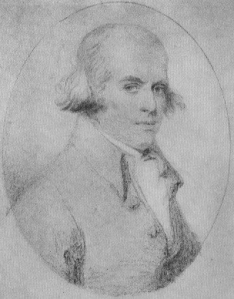
Colonel the Honourable John Byng was just another  younger son of another not-very-well-known 18thc aristocratic family. He followed the normal route for younger sons, choosing the army over the navy or church and ended up as a minor government tax official. All uneventful and hardly the stuff of great novels or a way to get  an obituary in the Times.

John Byng by Ozias Humphry, 1796 from The Torrington Diaries

Although in the last days of his life he succeeded to a peerage he was not particularly well known in his lifetime and  apart from one thing would have been long forgotten and just another name in small print in Burke’s peerage.

But that one thing was  fascinating.

It was his his pre-occupation with travel, or more particularly his decision to  keep a detailed account of his tours around Britain between 1781 and 1794. This  fills twenty seven manuscript volumes totalling over 2,500 hand-written pages illustrated by his own sketches.  The manuscripts  were kept, virtually unknown, within the family and were not finally transcribed and published until 1934.  From them we get an 18thc gentleman’s insights into the British landscape, its great houses and gardens and so much more… Continue reading

Posted in Uncategorized | Tagged , , , , , , , , , , , , , , , | 1 Comment