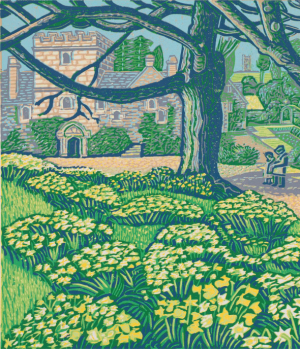
detail from “Cotehele House with daffodils on the Bowling Green”, by Rena Gardiner, National Trust
I realised what it was like to be an aristocratic landowner when I visited Cotehele in Cornwall the other day. There were no pesky visitors and apart from one or two staff scurrying rapidly from building to building my partner and I had the place completely to ourselves. Admittedly it was immediately the site opened on a Tuesday morning in February but the main reason for the apparent lordly solitude was the fact that it was raining. And when it rains in Cornwall it rains. And when it wasn’t raining hard it was drizzling steadily through the thick and clinging mist. It was a case of water, water everywhere. But whereas I normally would be sensible and stay at home I was on holiday and determined to see the place…and suprisingly the weather didn’t matter, particularly when I recalled a letter about a garden visit that I’d read written by the Dowager Countess of Mount Edgcumbe in the summer of 1862: “Unluckily it began to pour (at Tavistock – where you know Charles II said it always rained) – & we walked about the charming gardens under umbrellas.”

Your intrepid hero…there is a view across the Tamar and some beautiful gardens behind me- honestl!
 And it certainly wasn’t as bad as June 1872 when she wrote:” We had a great thunder-storm last Tuesday – with rain really like ramrods. …The rain came thro’ the ceiling of Ernestine’s room, & through the floor, into the Housekeeper’s room below – wetting her books, & soaking some clothes in a drawer. The carpet was taken up as quickly as possible, & hung up to drain – & the rain from the quadrangle ran down 2 steps into the lobby – & 3 buckets full of water had to be taken up before they could lift off the matting on the floor.”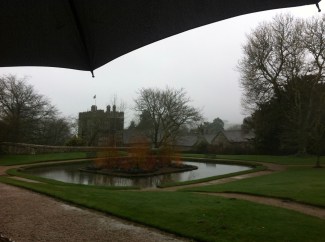
So seeing Cotehele in the mist and rain is nothing out of the ordinary and just meant walking complete with a mac, wellies and an umbrella…and, even at such an inhospitable time of the year, the grounds which she helped create are so stunning it would been worth walking around even without them! Continue reading →

 I looked a few weeks ago at the techniques that Repton used in his Red Books, particularly his trademark flap or overlay to show his proposed improvements. This week I want to turn to another aspect of the Red Books and his printed works which rarely attracts much comment… and that is only marginally to do with flaps and slides. It’s the way that Repton uses the double-page spread to show the full extent of a landscape. Is that significant? Why did he do it?
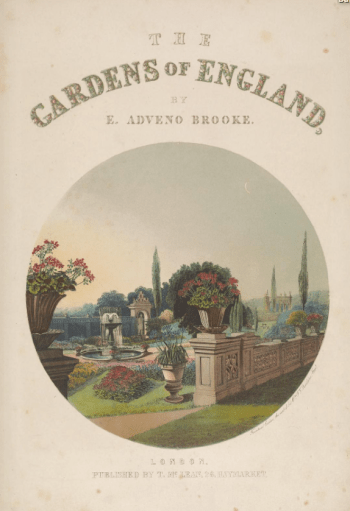 One of my favourite places to work and take students is the Lindley Library, part of the Royal Horticultural Society. It’s interesting when taking groups there noticing how different things attract and appeal to different people. One book however always causes an intake of breath and a look of amazement: The Gardens of England by Edward Adveno Brooke.


 On Tuesday I suddenly realised that it was Easter this weekend, before then quickly realising that I had completely forgotten about writing a special festive blogpost. I could have chickened out but I eggspect you’ll have guessed by now what I decided to dooodle do.


 The Garden History Blog
You must be logged in to post a comment.