Anthony Devis: Georgian topographical artist

No it’s not a repeat. It’s true there was a post about the 18thc artist  Arthur Devis a few month ago but this one is about his half-brother Anthony.  While Arthur specialised in conversation piece portraits Anthony turned to topography and became one of the country’s first successful landscape painters.

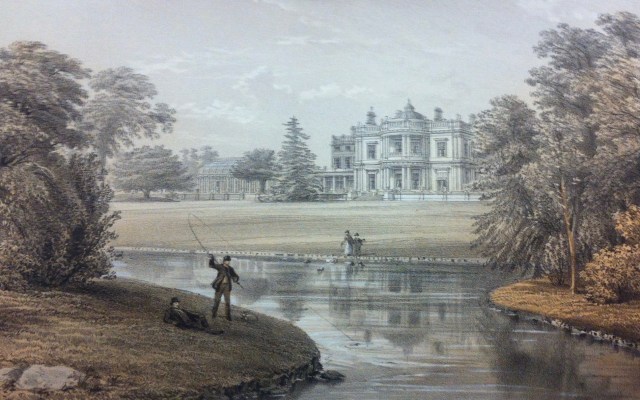
The Old Hall from the Park, TableyHouse, Cheshire.  

Anthony’s career spanned more than 60 years and unlike his half-brother he managed to adapt his style to changing Georgian taste and fashion both in painting and appreciation of landscape.  Read on to discover how his works  give us an insight into the changing perception of nature and the countryside in the 18thc.

Continue reading

Posted in Uncategorized | Tagged , , , , , , , , , , , , , , , , , , , | Leave a comment

On Don and Don and Don and Don…

I know Monty may be the only Don you’ve heard of but this is not  a post about him. Instead its about some of his 18th and 19thc ancestors who were also well-known horticulturists and botanists.  The family came from the county of Angus, then known as Forfarshire, in eastern Scotland where George Don had a nursery and what he called a botanic garden,  before rather unexpectedly ending up as Superintendant of the Royal Botanic Gardens in Edinburgh.

He had five sons who all followed him into gardening, and two of whom became celebrated in their day. The eldest, George junior, went plant hunting for the  Royal Horticultural Society  before becoming a botanical writer.  David, the second eldest, after working in a nursery became the Librarian at the Linnean Society  and then Professor of Botany at Kings College. 

Read on to find out more about this extraordinary family and their legacy.

George Do's signature from http://linnean-online.org/64852/

George Don’s signature  Linnean Society


Continue reading

Posted in Uncategorized | Tagged , , , , , , , , , , | Leave a comment

“Fresh Air & Fun”: Ada Salter and the Beautification of Bermondsey

Ada Salter

London is a city of great surprises and has many hidden corners and almost unknown treasures. I thought I knew it fairly well but there are always surprises and I’ve just found two of them in the same patch.  Did you know, because I certainly didn’t,  that  the remains of one of Edward III’s favourite country houses still survive on the banks of the Thames?   Perhaps the reason I didn’t know it is because it’s in a district which long had a reputation for slums and poverty, and being more than a bit rough around the edges.

The remains of Edward III’s Manor House on Bermondsey Wall, David Marsh May 2017

Of course over recent years nowhere in London is safe from gentrification and this area is no exception.  A new tube station and proximity to central London – that’s an understatement since its within a few minutes walk of Tower Bridge – have led to massive amounts of redevelopment.  So I finally corrected my ignorance of Bermondsey  by going on a guided London walk with Sue McCarthy of Capital Walks. [Highly recommended – and no she’s not paying me to say that!]  You can read a short photo report of what the walk covers here.

The view from Ada’s statue which stands just across the road from Edward III’s manor house.

It focussed on the life and work of Ada Salter, a pioneer of ethical Socialism  who was elected the first woman mayor in London, and first Labour woman mayor in Britain.  Sue’s commentary inspired me to go and find out more about Ada Salter’s radical – and successful – campaign to improve health and housing, provide gardens and beautify Bermondsey.

Continue reading

Posted in Uncategorized | Tagged , , | Leave a comment

Boys Toys and Shanks’s Ponies

What on earth is this? And what’s it got to do with cutting the grass?

Sitting on the terrace overlooking my garden a few weeks back in the heat wave I was watching the lawn go yellow and then brown, except of course for all the pesky weeds which continued to grow cheerfully and provided a bit of height and colour. Now autumn has arrived it’s all change and I’m sitting at my desk  watching the rain pour down for the third day running and watching the lawn turn green again, with all the pesky weeds looking even happier. So as soon as it stops it will be time to cut the grass again…

Trust John Claudius Loudon to be the first to notice  the solution that will save me having to get out the scythe…

from The Gardener’s Magazine 1831, p.611


So today’s post is an as-little-technical-jargon-as-possible look  at one of the first “boys toys”: Edwin Budding’s  lawn mower  and some of  its descendants… Continue reading

Posted in Uncategorized | Tagged , , , , | 2 Comments

Coleton Fishacre: The Garden by the Sea

detail from A Bird’s-Eye Map View of the Kingswear Peninsula by by George Spencer Hoffman.  © National Trust Images

Imagine sailing gently along the coast of Britain and spotting a nice little steep-sided valley running down to the sea…no buildings in sight, just a few sheep and wizened wind-battered trees… deciding that would make a good place for a house… buying the land and building a mansion.  These days it would be impossible, even the idea would be laughable.

fom Country Life, May 31st 1930

If I told you it had happened you might think  it must have been in the dim and distant past – perhaps when some marauding baron was looking for a defensive site after the Norman Conquest.  In fact it happened less than a hundred years ago in Devon and it wasn’t a marauding baron but the son of a London theatre impresario and hotelier. The result was the wonderfully romantic Coleton Fishacre.

A Bird's-Eye Map View of the Kingswear Peninsula with a Wind Dial by George Spencer Hoffman © National Trust Images

A Bird’s-Eye Map View of the Kingswear Peninsula with a working Wind Dial, which is over a fireplace in the house. by George Spencer Hoffman.  © National Trust Images

Coleton Fishacre, said Christopher Hussey in Country Life in May 1930, “belongs to the sea… here is a retreat from land-sickness, a spot where hurries and worries and work do not come.”

Read on to find out about one of the great houses and gardens of the age [now listed Grade 2], and the people who built it…. Continue reading

Posted in Uncategorized | Tagged , , , , | Leave a comment