Who gives a Fig…especially in Sussex?

We had a bit of a fight on our hands yesterday. Sophia, Dorothy, Blanche and Rose were arguing  in our courtyard.  Then they started to argue with us too.  It was a row about figs. We have a beautiful small fig tree against a south facing wall and this year for the first time it is covered with pale green ‘White Marseilles’ figs.

The girls have developed a taste for them and have been eating those which have fallen or which they can reach but I was determined they weren’t going to have any more.  Luckily I’m bigger than them so I won in the end. HURRAY!

At this point I should explain that I’m not a sexist bully and that they are chickens who are already extremely well fed.  The fig tree is in their run and they’ve made a den underneath it and were clearly enjoying the windfalls before I turned up to harvest the rest… there was a lot of squawking when they realised I was taking them away rather than picking the fruit for them!

So what is it about figs that makes them so desirable – even to chickens? And what’s their history in our gardens? And what’s it all got to do with Sussex? Continue reading

Posted in Uncategorized | Tagged , , , , , , , | 2 Comments

Batty goes Gothick…

A Gothick Pavilion from Gothic Architecture

Batty  Langley was an engaging self publicist with an eye to an opening in the market coupled with a  need to make a living. Last week’s post looked at  New Principles of Gardening published in 1728, his first important book. This week I want to look at the rest of his work.

He carried on with his gardening and garden writing but gradually switched emphasis more and more to architecture. Apart from his own not very successful attempts at being an architect, he wrote design books, a string of manuals and pattern books for builders  and books on freemasonry, as well making artificial stone for garden ornaments and buildings. Its difficult to know how influential he was  although the term “Batty Langley Gothic” is still  regularly used to day and ensures that his name lives on.

Garden House at Goldney, Bristol based on a Langley design. Photo from Global Gardeners notebook

Continue reading

Posted in Uncategorized | Tagged , , , , , , , , , | 1 Comment

Batty’s arti-natural Principles

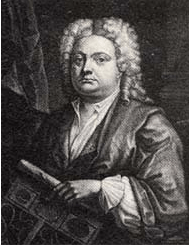
mezzotint portrait by J Carwitham published in 1741, Twickenham Museum

The wonderfully named Batty Langley was a gardener’s son who followed in his fathers footsteps and then turned surveyor, landscape gardener, artificial stone maker, would-be architect and garden designer, as well as prolific author.  Well  he had to do something to earn money to feed his wife and 14 children!  Batty was a man of many talents and trades but probably master of none.

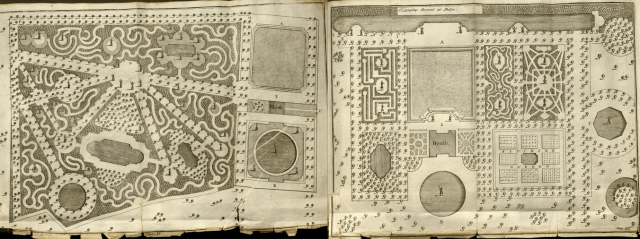
Although often ridiculed, even during his lifetime, Langley is a significant figure because he was  one of the earliest writers to promote and popularise both  the Gothic style of architecture and   the “irregular”  garden, that halfway stage between the formal geometric gardens of the baroque and the later more naturalistic landscape movement. He first summed up his ideas in his New Principles of Gardening in 1728.

Two Garden Designs from New Principles of Gardening, 1728

Continue reading

Posted in Uncategorized | Tagged , , , , , , , , , , , | Leave a comment

Recording Britain

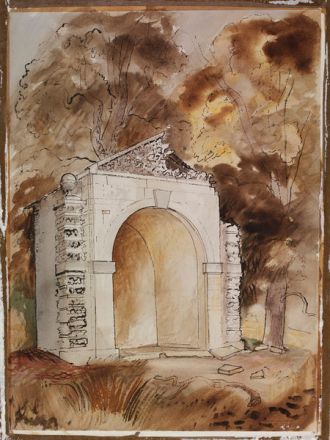
The Duck House in the Park of Buckland House near Faringdon, John Piper

War inspires artists,or rather requires artists, to produce propaganda, and many governments have used war artists to record a different take on what is going on to newscasts and documentary films.  Usually this is strident, but on other occasions much more gentle, but even so you wouldn’t think that war would inspire landscape or architectural painting.

Kenneth Clark, by Howard Coster, 1937, NPG

In fact there is a very significant body of work  made by artists on the home front between 1940 and 1943 organized by the Committee for the Employment of Artists in Wartime, part of the Ministry of Labour and National Service. It was the brainchild of Kenneth Clark [later Lord Clark of Civilisation fame], who was then the Director of the National Gallery, and ran alongside the official War Artists’ Scheme, which he also devised, to create an artistic record of the British landscape.

Richmond Golf Club, Sudbrooke Park, Ham, Surrey, John Sanderson-Wells

Posted in Uncategorized | Tagged , | Leave a comment

Peter Smithers: Plantsman, Politician & Floral Pornographer

Sir Peter Smithers, in 2003. Credit Karl Mathis/Keystone, via Associated Press

Sir Peter Smithers [1913-2006] was an intelligence officer, a Tory politician, diplomat and above all a great gardener.

“I regard gardening and planting as the other half of life, a counterpoint to the rough and tumble of politics,” he wrote.

During his lifetime he laid out several gardens, notably Colebrook House in Winchester in the 1950s and 60s, and  then from 1970 onwards Vico Morcote in Switzerland. He was also responsible for much of the tree planting in the cathedral close at Winchester.   Photography was another lifelong passion and after his retirement he became an extremely successful as, in his own words,  “a floral pornographer”.

All the quotes come from his memoirs unless otherwise credited. So read on more to find out more about this unsung, generous and outstanding horticulturist.

Continue reading

Posted in Uncategorized | Tagged , , , , , , , , | Leave a comment