
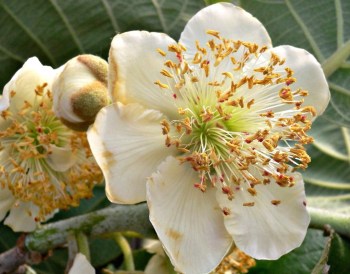
 If you are a regular reader of this blog you may well be expecting a follow-upto last week’s post about Thomas Fairchild. Unfortunately I have had technical problems but should appear next week. Instead…
Our parks and gardens in Britain are full of plants that originated elsewhere in the world… so many that many have become completely assimilated into what we think of as an ordinary part of our normal horticultural options but occasionally there are things that stand out as a little different.  There’s a vigorous almost rampant woody-stemmed climber growing against one of the walls in my garden. It has large heart-shaped slightly hairy leaves and at the moment it has a profusion of beautiful creamy white scented flowers. I’d guess that most readers won’t recognize it from the photo but would almost certainly recognize the fruit that follows in the autumn.
If I tell you it originates in the mountains and forests of central and southern China but didn’t reach Britain until the mid 19thc, and wasn’t taken into large-scale cultivation outside China until less than 50 years ago, but now is a successful commercial crop in countries as diverse as Italy, Chile and New Zealand, then maybe you can guess what it is. But if not read on ….



 After last week’s post about the early history of strawberries its time to look at how the various wild species were transformed into garden and commercial varieties by an 18thc botanist and a handful of 19thc nurserymen.

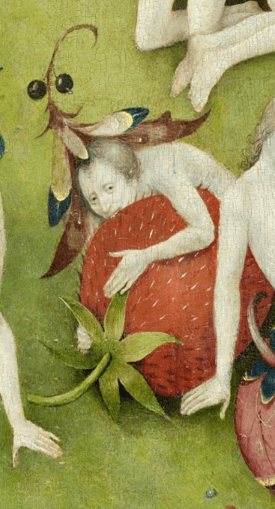

 But strawberries have always had more than just food appeal. In the Middle Ages they were one of the more revered symbols of the Virgin Mary but they also had another more erotic and voluptuous side to them as well.


 The Garden History Blog
You must be logged in to post a comment.