
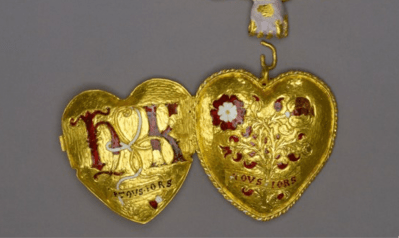
I’m sure many of you saw the news earlier this year of the discovery in a Warwickshire field of this golden locket dating from the 16thc. While the front has the initials of Henry VIII and his first wife Katherine of Aragon, the back is more interesting being decorated with a red and white Tudor rose motif entwined with a pomegranate bush.
 But why a pomegranate? If you mention them to most people today, or ask about its symbolism and use, you’ll probably get something of a blank look or a comment about how difficult the fruit is to eat or that its just a posh ingredient used in Ottolenghi or Waitrose recipes. And almost no-one seems to know what they look like in flower or realises that they’ve been grown in England [ok not very successfully until recently!] since the 16th century.
Read on for the back story of this extraordinary fruit and the locket…and to discover how and when pomegranates featured on English coins
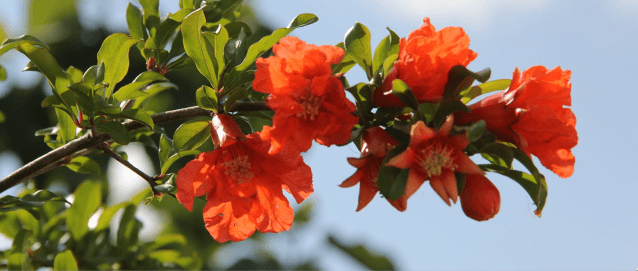
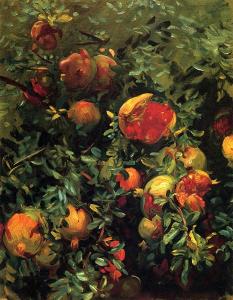
Pomegranates are attractive large shrubs/small trees, with glossy foliage, lots of spines and funnel-shaped, orange flowers that last throughout summer. They are self-fertile and fruits form at the base of the flowers ripening in autumn. While typically associated with warmer climates, there are now around a thousand different varieties, a few of which are hardy down to -15Cº, so it’s possible to grow them in the UK. However, as they thrive in areas with cool winters and long, hot summers, they may need to be grown in a greenhouse or poly tunnel to encourage them to fruit successfully. There’s even advice from Suttons Seeds and Gardeners World on how to do it.
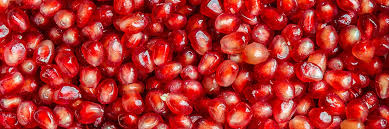
Originating from the mountains of Iran eastwards into northern India pomegranates are one of the oldest known food plants, but also had a major role in pre-modern medicine. The root, bark, blossom, rind, seed, and even the aril (the juicy scarlet seed coverings) were all widely used, [sometimes for the most surprising things] and catching up with the ancients, modern science has found chemicals in pomegranate that do indeed have a huge range of useful properties. For more on all that – in gory detail – see Pomegranate and the Mediation of Balance in Early Medicine by A. R. Ruis in Gastronomica, Vol. 15.
Their name derives from two Latin words – pomum meaning apple and granatum meaning seeded, although the Romans themselves called them Punicum malum, or “Phoenician apple” probably because they were introduced to Italy from Carthage, which was originally a Phoenician colony. Elsewhere the Phoenician trading and colonising network had spread them round the Mediterrannean, including Sicily, the Iberian Peninsula and North Africa, during the first millennium BC.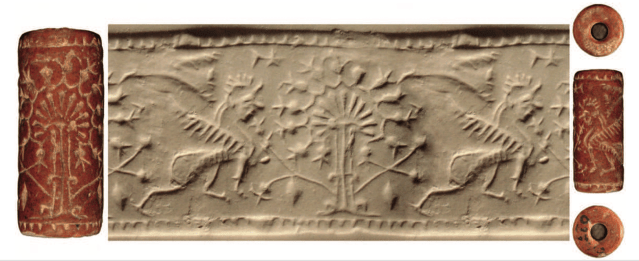


However, it’s thought the tree was first domesticated from about 10,000 years in Iran with more archaeological evidence in the form of seeds surviving from 5000 years ago at sites like Jericho and Nimrud and in Egyptian tombs from the time of Queen Hatshepsut. It also spread eastwards and was growing in central and southern India by about the first century A.D. and was reported growing in what’s now Indonesia in 1416.
For more on the spread of the pomegranate in the ancient world and its roots in various Middle Eastern/Meditetrtannean cultures see, a freely available articles by Federica Spagnoli, “The Golden Pome” [2019]

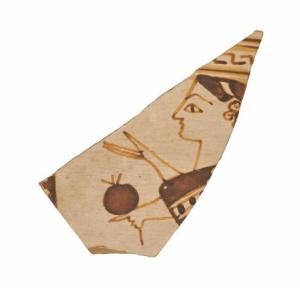
But it’s the symbolic associations that really make pomegranate significant. The sheer number of seeds in one seedcase suggested it represented of the unity of many under one authority so was adaptable by all rulers and religions. As Spagnoli commented it “represented immortality, eternity, and resurrection to people as far afield, geographically and temporally, as the Babylonians, Chinese, and Christianized Europeans. Rabbis, popes, kings, and poets all made the fruit symbolic of the one and the many, of multiplication and unity, the part and the whole.”

But what also seems particularly noteworthy is that in almost every culture the pomegarante appears in association with female deities such as Ishtar, Astarte, Hera, Demeter, and then later the Virgin Mary. Even today according to Damien Stone’s recent monograph on pomegranates he suggests they remain “unusual, alluring and ornamental” and embody “beauty, mystery and the female.” Imagery of the fruit is often seen as a reminder of womanhood. The red juice and seed replicating menstruation which was seen according to Stone as the female equivalent of a man fighting on the battlefield, and may explain why ancient greek physicians recommended, pomegranate juice as a way of stopping menstrual bleeding.

Unfortunately space [and my knowledge] is going to restrict this post to mainstream Europe where the pomegranate was quickly absorbed by all the classical civilisations, and like the golden apples of the Hesperides which I’ve recently written about, make lots of appearances in Greek myths [ Of course as we’ve seen in previous posts these stories come in many, often, contradictory versions so don’t be surprised if you know a different one to those below.]
The first pomegranate, so Greek legend has it, was created by the goddess Aphrodite from the blood of her lover Adonis, and the fruit became one of the symbols associated with her. Similar, even earlier stories, appear in Hittite and other Eastern Mediterranean belief systems. As a result the pomegranate was sometimes known as the “fruit of the dead and its in that capacity in which it plays a key role in the well-known story of Persephone.
Persephone was the daughter Demeter, the goddess of harvest and fertility and Zeus the king of the gods, and as she grew up she attracted many suitors. Demeter, however, kept all these would-be husbands well away from her, which infuriated one of them, Hades the king of the underworld. He decided that he was going to marry Persephone no matter what her mother thought, so one day when the girl was out with friends the earth opened in in front of her, Hades rode out on his chariot, and dragged her back down underground with him. When Demeter discovered what had happened she abandoned her duties to agriculture with devastating consequences. Harvests failed and famine spread across the whole world. Zeus had to intervene to save humanity from total starvation, but also to find a solution that would satisfy both Demeter and Hades. His ruling was that if Persephone was being held against her will she would be returned to her mother, but if she chose to become Queen of the Underworld then so be it. And this is where the pomegranate makes its appearance.
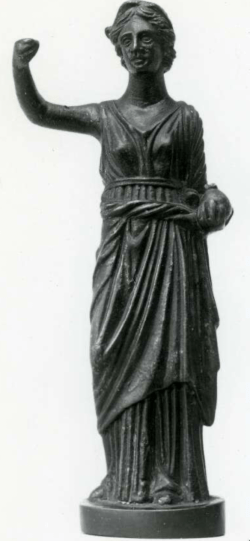
The story has it that anyone who ate food in the underworld was condemned to stay there [don’t ask – its all to do with The Fates but too complicated to explain here!] so when Hades heard of Zeus’s plan he persuaded Persephone to eat a few pomegranate seeds – and that was all it took. When her mother realised the trick that had been played she once again threatened to abandon the crops and once again Zeus was forced to intervene to fix a compromise. Under it Persephone would spend half the year with her husband in Hades and the other half with her mother. The autumn was when Persephone returned to Hades and Demeter stopped caring, the winter the result of her neglect before Persephone’s return heralded the spring and summer.

But Persephone wasn’t the only deity associated with the pomegranate. It was also a symbol of Hera, Zeus’s wife and queen of the gods, and there are several gruesome stories about how and why she adopted it. Look at the stories of Orion and Side if you want a good example. It’s even noted in one of the earliest travel books – Pausanius’s Description of Greece written in the second century AD, where describes a great temple built in her honour. Inside was a statue of Hera “seated on a throne; it is huge, made of gold and ivory, and is a work of Polycleitus. She is wearing a crown with Graces and Seasons worked upon it, and in one hand she carries a pomegranate and in the other a sceptre. About the pomegranate I must say nothing, for its story is somewhat of a holy mystery.”
As Christianity superseded paganism and the church took over and adapted pagan festivals and stories so the pomegranate and its symbolism was transferred to both Virgin Mary, and because of its association with death and rebirth, and Christ.


The first sign of that in Britain can be seen in the earliest known Christian mosaic found at Hinton St Mary in Dorset in 1963. Probably dating from the 4thc it features Jesus and both his chi-rho symbol and a pair pomegranates in a sort of halo. [ The mosaic has since had a long and chequered history, although excavations are still continuing, and you can hear more about it in this episode of Neil MacGregor’s A History of the World in 100 Objects].
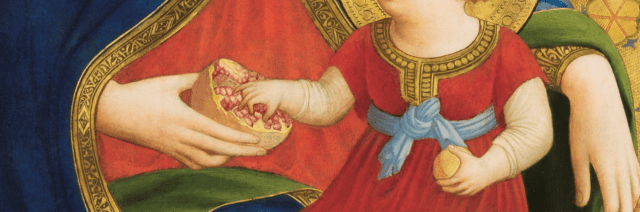
This association continues through the whole gamut of Medieval and Renaissance art, with pomegranates being embroidered on religious vestments, and even carved into a few church buildings although its in paintings of the madonna and child that it is probably best known. In those it can be seen as representing Christ’s bleeding and resurrection as well as Mary’s spiritual fruitfulness and chastity.

It can also be seen in mythical stories such as that told in the famous series of tapestries about the Unicorn now in the Metropolitan Museum in New York. Apart from being creatures of legend unicorns were adopted by the mediaeval church as Christian symbols known for their purity. They could only be captured by a virgin and could only be tamed by being tethered to a pomegarante tree
This panel shows a unicorn in a fenced meadow resting underneath a pomegranate tree. It appears to be bleeding from wounds inflicted during the chase that led to its capture but on closer inspection, it isn’t blood that drips but pomegranate seeds.
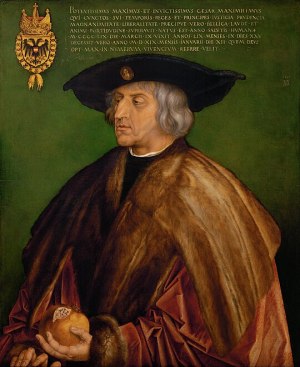
Pomegranates could also be seen as symbols of political power, probably because of their resemblance to an orb, as in the famous portrait of the Holy Roman Emperor Maximilian I by Durer, 1518. Here the fruit represents a symbol of unity in the diversity of his empire with the seeds representing his many subjects. A contemporary also noted that “although a pomegranate’s exterior is neither very beautiful nor endowed with a pleasant scent, it is sweet on the inside and is filled with a great many well-shaped seeds. Likewise the Emperor is endowed with many hidden qualities which became more and more apparent each day and continue to bear fruit.”
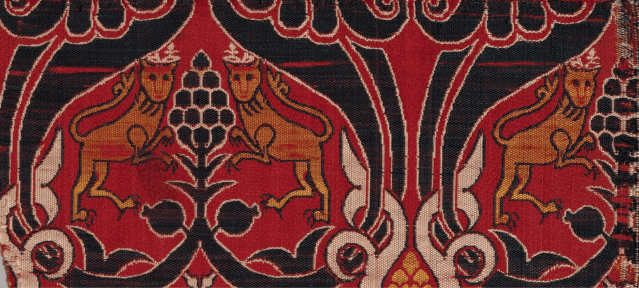
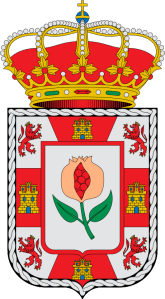
Arms of the Province of Granada
So pomegranates have all sorts of possible meanings but what’s signified by the pomegranate on that locket? In fact it’s probably something completely separate! Katherine of Aragon’s parents were King Ferdinand of Aragon and Queen Isabella of Castile who married and united their kingdoms. Later they completed the creation of a single united Spanish kingdom by conquering Granada, the last Muslim stronghold inAndalusia in 1492.

The coat-of-arms of the Spanish royal family
Isabella is, according to legend, supposed to stood with a pomegranate in her hand and said, “Just like the pomegranate, I will take over Andalusia seed by seed.”
Although the origin of the city’s name is disputed – and probably derives from the reddish colour of the local soil – it has long been associated with the pomegranate which in Spanish is granada , and the fruit appears on the city’s coat-of-arms, as well as that if the royal family.
For more on Granada and its association with the pomegranate see piccavay.com


So the pomegranate was very close to the heart of the Spanish royal family and was adopted as her personal emblem by Katherine when she came to England to marry into the Tudors. Although she is best known as the wife of Henry VIII, in fact she was, at the age of 15, first married to his older brother Arthur who died just a few months later.
The dynastic politics at stake suggested that she now marry Henry, the new heir to the throne. This was only permissible under canon law if her marriage to Arthur had never been consummated but despite her assurances that its never had been, gaining the papal dispensation for the marriage took six years! When it arrived the pair were swiftly married at Greenwich and then crowned together at a joint coronation in Westminster Abbey in June 1509.


The pomegranate would have been seen as a very apt symbol for Katherine and the promise of heirs that her marriage brought. Gilded versions of the fruit were used during the festivities surrounding the wedding ceremony and the Queen’s coronation, alongside the Tudor rose. This linkage was to continue throughout the couple’s marriage.


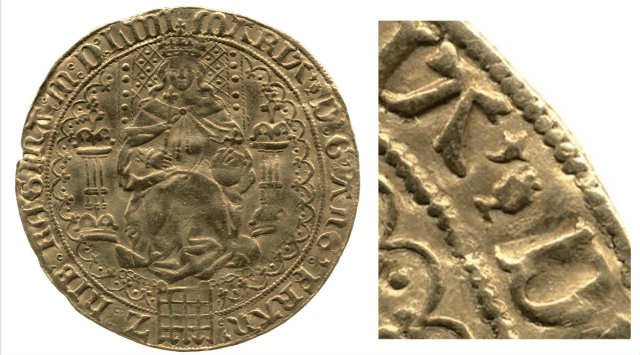
This is when pomegranates began to feature on the coinage. It was used as a mint mark, to identify the place of production.
Although worn the pomegranate can still be seen immediately above the kings crown and just before his name.
I presume its use stopped with the divorce but it was restarted by their daughter Mary when she became queen in 1553.
Unfortunately the pomegranate’s association with fertility was misplaced as far as Katherine was concerned. She is known to have had at least two miscarriages and bore three children who died in infancy, including a son. Only her daughter Mary survived.

The lack of a male heir was to lead to the famous divorce in 1533 which gives the lie to the inscription on the locket TOVS + IORS – a mix of English and French – for ‘all yours’ or a pun on the French for ‘always’. Its thought the locket was made around 1521, perhaps as a prize for a jousting match, while its quality suggests it was certainly either commissioned by or somehow related to someone high-ranking.
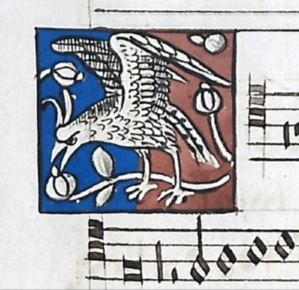
From The Anne Boleyn Book
c. 1530
With the divorce most of Katherine’s initials and pomegranate emblems were removed under Henry’s direct orders to be replaced by those Anne Boleyn whose badge was a white falcon. There is even an example of the personal feelings involved in Anne’s copy of a book of motets which has a sketch of a falcon attacking or eating a pomegranate at the beginning of one of the songs.
Nevertheless the pomegranate maintained its allure, and it continued as a royal symbol. Katherine’s daughter ,Mary , took her mother’s emblem for her own and despite its associations Elizabeth I also used it, although not quite so obviously.

In a very early portrait when she was still only partly rehabilitated, Elizabeth was shown in a gown of crimson silk woven with a pomegranate pattern. However, as a check on the V&A website shows this was a well-known pattern used widely across Europe.
More importantly though pomegranates featured on the background of the Hampden portrait [below] designed to impress foreign ambassadors and marriage suitors. The gold cloth of state behind her is woven with an abstract design in parts similar to the pomegranate pattern as the earlier portrait.

More obvious is the strip of red cloth on the right hand side which contains all sorts of emblematic references to marriage, including twin honeysuckle flowers, cherries, peas bursting out fat pods and a ripe pomegranate. The message being portrayed was clear Elizabeth the virgin queen was ready for a suitable match.

After Elizabeth, and with the suppression of overt Catholicism, the pomegranate as a symbol begins to fade from view…. so the story of its re-introduction to our gardens and hothouses, and its reuse by artists is one that will have to wait for another day [anda bit more research!]


 The Garden History Blog

,_detail_with_pine_tree_and_pomegranate,_Palazzo_Massimo_alle_Terme,_Rome_(8534614956).jpg)


A fascinating article. I am awed by the level of your research . Thank you. I’ve just spent an hour following your links! Can’t wait for the next blog!
Thanks! and remember you don’t have to wait for next Saturday to read another post because there are 501 others written over the last 10 years – that should keep you busy for a while! David