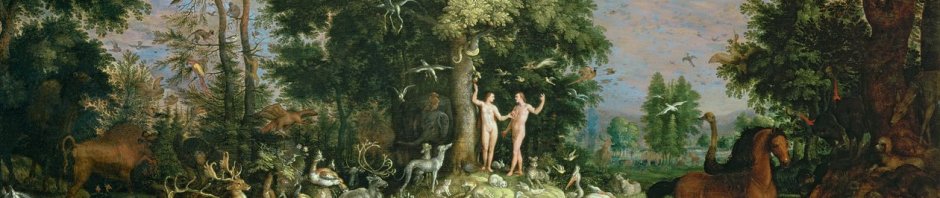

Summer time is always associated with garden visiting but the next few posts are going to be about a garden you’re unlikely ever to be able to visit. Yet it’s probably the most well known and most talked about garden in the world.
Ask yourself what you actually know about the Garden of Eden. I bet the answer will be not very much more than the Bible story in the Book of Genesis. You might also know that there are other Biblical references but I’d be surprised if you could actually recall much of what any of these description say?
So why does Eden have such a strong hold over our imaginations?


Most of us, even if we are not Christians, will know the Bible story – or think we do, but in fact the Book of Genesis say very little about Eden, and nothing really about what it was like or what, apart from the Tree of Life and the Tree of Knowledge, grew in it? I suspect that whatever else you think you know it’s because the story of Eden is the most popular Old Testament subject in Christian art, and you’ve simply absorbed the way that artists have imagined it.
I’ve chosen this subject because I’ve just been reading an interesting and thought-provoking new book, Olivia Laing’s The Garden Against Time which has the subtitle In Search of a Common Paradise. I’ll come back to the book in another post but it set me thinking, and over the next few weeks I thought I’d see if I can discover more about Eden starting with the basic question of what we really know about it and how do we know it…

The King James Version of the Bible says “The Lord God planted a garden eastward in Eden; and there he put the man whom he had formed. And out of the ground made the Lord God to grow every tree that is pleasant to the sight, and good for food; the tree of life also in the midst of the garden, and the tree of knowledge of good and evil. And a river went out of Eden to water the garden; and from thence it was parted, and became into four heads.” That’s about it, although I’m going to come back to the four rivers in a later post

That basic description is followed by the fact that God “took the man, and put him into the garden of Eden to dress it and to keep it” with the strict injunction that while, “Of every tree of the garden thou mayest freely eat: But of the tree of the knowledge of good and evil, thou shalt not eat of it: for in the day that thou eatest thereof thou shalt surely die.” As we know man did not die but, because he and the woman had eaten of the fruit of the Tree of Knowledge they were expelled from the garden in what has become known as the Fall, or the Expulsion. The fate of Adam and Eve [whom incidentally have not been named at this point] was to “till the ground from whence he was taken” and to make sure they did not try and return God “placed at the east of the garden of Eden Cherubims, and a flaming sword which turned every way, to keep the way of the tree of life.”

The garden was clearly very lush and fertile because it is referred to later in the Bible as the counterpoint to the more normal scenery of the Bible lands. In the book of Ezekiel [36:35] we are told that “this land that was desolate is become like the garden of Eden; and the waste and desolate and ruined cities are become fenced, and are inhabited.” A similar image can be found in Isiah [51:3] when the prophet says “the Lord shall comfort Zion: he will comfort all her waste places; and he will make her wilderness like Eden, and her desert like the garden of the Lord.”
But really that’s about it. There are no descriptions, no plant lists, planting plans, account books, list of tools etc etc.
So where do our ideas – and those artists – of what Eden was like come from?

Even the description of Eden in Genesis has its problems because of language and translation. Scholars have long been struggling with the origins of words from lost languages and short of discovering another Rosetta Stone with several parallel texts in different tongues are unlikely to come to a definite answer. Even the word Eden itself is fraught with confusion. It’s probably related to an Aramaic word meaning to be fruitful /plentiful or well-watered, which ties in neatly with the description in Genesis but also with the other biblical references. However, another, perhaps more likely link, is with a Hebrew word meaning luxury or delight. That’s certainly the meaning picked up in early Greek versions of the Bible, and then later by the late 4thc Latin translation of the Bible by St Jerome, known as the Vulgate which talks about “paradisum voluptatis” [or paradise of pleasure].

This is where we first encounter the idea of Eden being Paradise. Paradise is another word with convoluted derivations but is probably linked to the Median word pardaiza which meant surrounding wall and which usually implied a walled orchard. The word was assimilated into Hebrew during the long period when the Medes ruled the Bible lands. Its significant that this was the term adopted by the early Greek translators of the Bible rather than using the usual Greek word for an ordinary garden


By mediaeval times the association of Eden and a verdant paradise had become much more fixed and it can be seen in the way that Eden is portrayed. Unfortunately these early medieval styles tend to be very simple and almost formulaic, telling us nothing really of what the painter actually imagined the garden was like, indeed most early manuscript Bibles that I’ve looked at have very few illustrations, other perhaps than an illuminated initial letter or two.

Well illustrated manuscripts are usually associated with prestigious gifts or commissions but as in most images right through until the late 14th century there is still little attempt at realism.
There are some exceptions. In the earliest view of life after the Expulsion that I have found, [see above] dating from the 6th or 7thc, both animals and plants outside the garden are realistic but there is no sign of Eden or what it contained.


This lack of realism continues for centuries as can be seen right in both this mid-9thc century Bible page [above] painted in Tours that includes a series of trees but no other vegetation, and the 12thc Byzantine manuscript [left] with its vision of Eden as a large hilly forested place, with the four rivers and Adam also prominent. The signs of the expulsion to come can be seen in the angels waiting at the garden’s edge.
The four rivers can be also seen flowing through the garden in the 11thc Catalan illustration [below], although interestingly here they are spouting from the mouths of four animals.

The emphasis in most mediaeval portrayals of Eden is very much in the tradition of a morality tale. The garden obviously appears as part of telling the story of the Creation but is rarely depicted in any detail, and usually the most important part of the story is the Expulsion, with its overtones of original sin, temptation and punishment. Facts which were drummed into the consciousness by the church, as a means of social control.

As we move towards the dawning of the Renaissance so we can see a developing sense of naturalism. In the mid-14thc portrayal above, the four rivers are named and divide Eden into quadrants of green grass dotted with slightly more realistic trees even if the flowers are stereotypical and there’s still no sign of other vegeetation.


The discovery of perspective and the switch from symbolic to observed depictions of the world opened up new ways of portraying Eden. The number and quality [for want of a better word] of surviving images also increases enormously. [There are, for example, twice as many images of paradise in the 15thc as in the 14th, and four times as many as the 13thc in the archives of the Biblioteque national de France.]
It now comes with castle-like walls and drawbridge and plenty of planting inside them… and even an early depiction of a flowery mead, one of the hallmarks of our idea of the mediaeval garden.

By the end of the 15thc realism is very much the dominant style. At the same time we can see the emergence of many of the symbolic elements of medieval Christian theology.
Perhaps the best known is the fountain which forms the source of the four rivers, and which becomes associated with the Virgin Mary in the Hortus Conclusus [see earlier post for more on that]. In the marriage of Adam and Eve [below], which is not mentioned in the bible, we have the not only the fountain but the unicorn and other animals including a mermaid. We also have a garden, albeit still not with identifiable plants.


With the invention of printing manuscript illumination rapidly became redundant, and instead we need to turn to paintings to see how the idea of Eden developed. In fact at first there’s very little change. Most artists concentrate on the Fall of Man and the expulsion from Eden, concentrating on what if anything is outside the wall, rather than what was inside. For example, neither Masaccio’s view of the Expulsion from Eden or Michelangelo’s version gives the garden any content.

Then the Reformation happened and artists in northern protestant Europe began to break away from earlier artistic conventions. Eden becomes a very popular subject and although paintings continue to tell the same story and often include the symbolic elements the setting is much more natural. Eden assumes the form of a northern European elite parkland, complete with exotic animals, birds and plants. Perhaps the earliest and almost certainly the most famous of these is part of Heironymous Bosch’s triptych The Garden of Earthly Delight.

Painted in 1504 it follows in the late medieval tradition of a triptych altarpiece, designed to read from left to right as a single narrative, usually with Eden or the Creation on the left, the Day of Judgement on the right, and a central section that serves as the main message. The whole normally has a moral imperative to impart, but in the case of the Garden of Earthly Delight it’s hard to tell what that might be as it certainly isn’t a standard interpretation as I said in an earlier post the painting has been subject to endless analysis with no definitive outcome!

Eden is also a subject particularly dear to Lucas Cranach the Elder (1472–1553) he was a friend of Luther and painted at least 35 versions of Adam and Eve, many more of them singly and at least four of the garden of Eden.

All show what might be called “wild” spaces, nothing like the formal gardens of the day. Other Northern European artists took to the subject too. Nor was it just painters. In England Eden was used as a subject for embroidery.
In this late 16thc valance the garden, with its giant trees, is monumental in scale, almost overwhelming the figures. The depiction of the expulsion is probably based on a reading of contemporary vernacular English Bibles, with Adam and Eve wearing “breeches.”

The late 16th and early 17th centuries are the high point of artistic interest in Eden as a subject and for a good reason. Perhaps the next significant step was taken by Jan Brueghel the elder (1568–1625) around 1600 who manages to include not only a huge range of exotic birds and animals but for the first time as far as I can see, identifiable plants and flowers. In the version above Adam and Eve are almost invisible in the background. It was a sign of how Eden could be used to showcase the wave of new introductions of flora and fauna reaching Europe in the early/mid 17thc.


It is clear that Brueghel knew an awful lot about natural history and that his paintings were enjoyed as reliable and encyclopaedic accounts of the natural world as it was then known. He was court painter to the Hapsburg Archdukes who ruled Flanders, and so was able to study botanical specimens in their garden in Brussels and fauna in their menagerie He had also been to Prague in 1604, and seen the more famous menagerie and zoological library of Emperor Rudolf II. This was clearly a good excuse to show off what his patrons possessed and there are at least two versions of it. Brueghel also worked with Rubens on a different view of Eden before the Fall. Rubens did the figures, the tree and the serpent but then handed over to Brueghel to add the flora and rest of the fauna with great precision.


These landscapes have soft morning light over gently rolling terrain with fruit-laden trees, wilder woodland and clearings. They correspond with fellow-artist Karel van Mander’s description of “the joyful Spring time” when we should “notice the land’s adornment with colours of precious stones, and endeavour to paint the emerald green and sapphire blue cover of the land with its subtle variegation…”

This was more than just a coincidence, but seems to have been something of a stylistic approach to portraying not only paradise but other landscapes, especially in the Low Countries. Certainly Breughel’s style and attention to the plants and creatures almost seems to use Eden as an excuse and it’s copied by many other artists such as Roelant de Savery, David Teniers and Kessell. It definitely was an excuse for Savery because he used almost the same setting for paintings of Orpheus taming the animals.

There are dozens and dozens of similar canvases and the ability of these artists to switch the supposed subject but paint the same things was perhaps because of the decline in strict Biblical belief which meant that landscapes and natural history could be portrayed as they were rather than being wrapped up in theology. By the end of the 17thc Eden almost disappears as a subject.

However in the 19thc the idea of Eden, the perfect world returns in both the art of visionaries and the deeply religious, but also more interestingly in the art of “New Worlds” where “virgin landscapes” [even if they weren’t virgin at all] could be seen as places of hope and recovery from the fate that had befallen mankind. Thomas Cole, a Lancastrian who emigrated to the United States in 1819 at the age of just 18 was a great exponent of this idea. In his 1835 Essay on American Scenery, he described the beauties of the American wilderness and its capacity to reveal God’s creation as a metaphoric Eden.

Even though he had’t travelled far in Europe Cole thought European scenery reflected the ravages of civilisation, for which primeval forests had been felled, rugged mountains had been smoothed, and rivers diverted. The American wilderness on the other hand embodied a state of divine grace and he lamented that the signs of “progress” were rapidly encroaching on it. In his painting of the Expulsion, Adam and Eve are minuscule figures crossing an abyss in the hostile and drab world leaving verdant sunshine-filled Eden behind.

I’ll finish with a wonderful example of an artist who took the idea of Eden and re-interpreted it to suit his own view of history and religion. In one of those wonderful serendipitous discoveries I chanced upon the fantasy world of Erastus Salisbury Field [1805-1900] who switched from standard portrait paintings to biblical and other subjects. His paradise is a lush and precisely organised place. The cone-shaped mountains recede in orderly rows, fruit trees are matched with tropical palms, and—like a miniature Noah’s ark—the animals stand around in pairs. There are plenty of other artists interpreting Eden and we’ll see some of them when I return to Eden next week and try to pin down its precise location.


 The Garden History Blog

This is so interesting. Too much info to take in all at once,but the pictures are a great choice.
Thank you Basia. I’m glad you enjoyed it