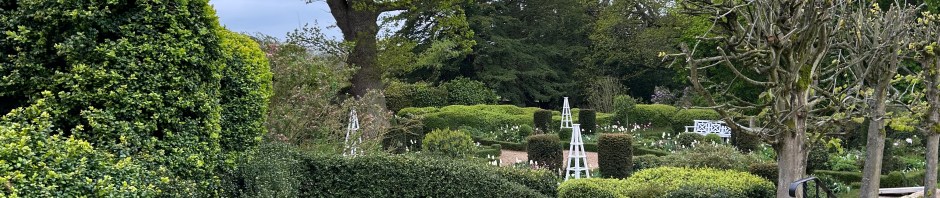
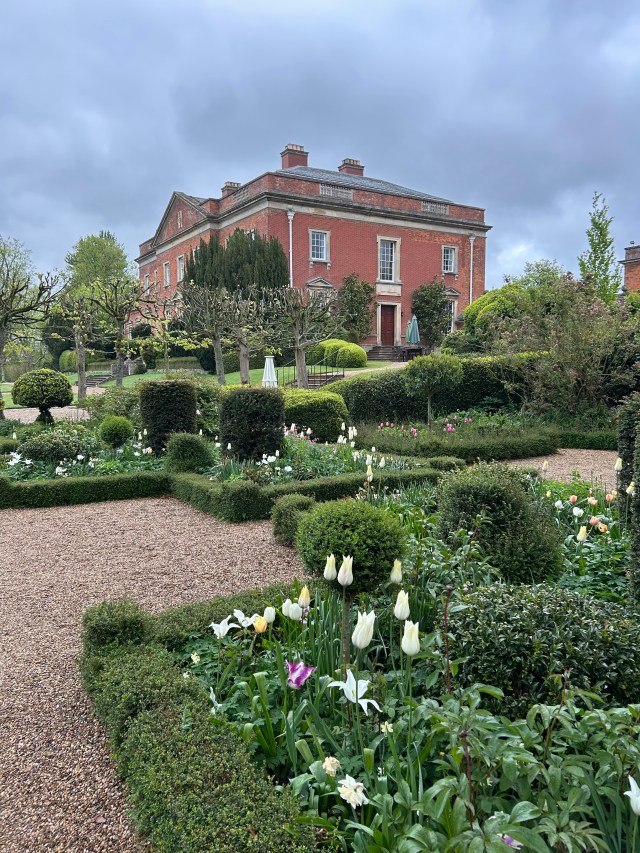
 If you’d like to see a house with “a perfect, extremely reticent design… done in an impeccable taste” and with a garden to match can I recommend Kelmarsh Hall in Northamptonshire.
That opening quote came from Pevsner and when I first visited Kelmarsh over 25 years ago, I could immediately see what he meant. The red-brick Palladian building by James Gibbs had a wonderful “liveable” feel, while its gardens largely created by Nancy Lancaster, with help from Norah Lindsay and later added to by Geoffrey Jellicoe, although then sadly in need of some tlc clearly had a glorious past and future potential.
The estate had just passed into the hands of a charitable trust after the death of the last owner and we were taken around by the late Keith Goodway, who was a trustee, met the head gardener and heard about their exciting plans for its future. After the tour I could see why they were both so enthusiastic, but would it all actually happen?
I finally managed to return a couple of weeks ago and yes it has – and more!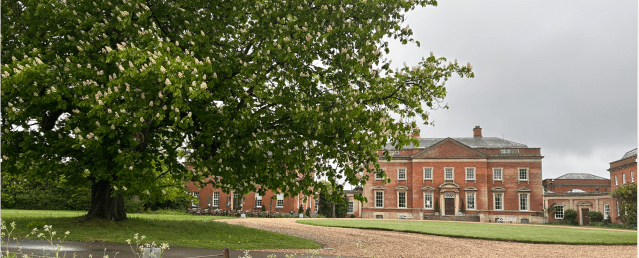
As usual the photographs are my own unless otherwise acknowledged while the quotes come from a series of interviews of Nancy by Robert Becker for Nancy Lancaster : her life, her world, her art, (1996), again unless otherwise acknowledged.
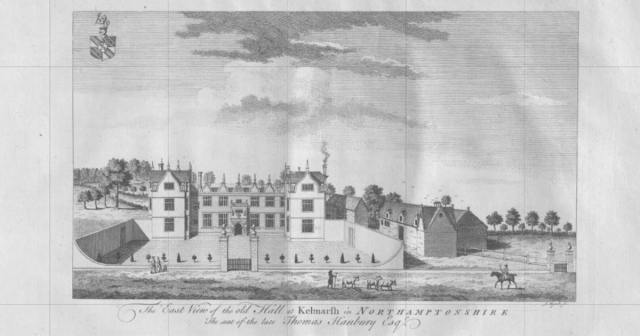
Let’s start with a brief history: There was a Jacobean house at Kelmarsh bought in 1618 by John Hanbury, a wool merchant who went on to become Sheriff of nearby Northampton. His great grandson William Hanbury, a noted antiquarian, married into money and was able to commission a fashionable new hall, from James Gibbs whose other works included the Radcliffe Camera, Oxford and St Martins-in-the-Field, London. Completed in 1732 it has a central grand entrance hall and saloon flanked by four rooms on the ground floor, with two linked pavilions. There is unfortunately an almost total lack of documentary sources prior to the 20th century so it’s difficult to know what the grounds were like since there are only two known images, which don’t show much, although it is known that the lake dates from 1791.
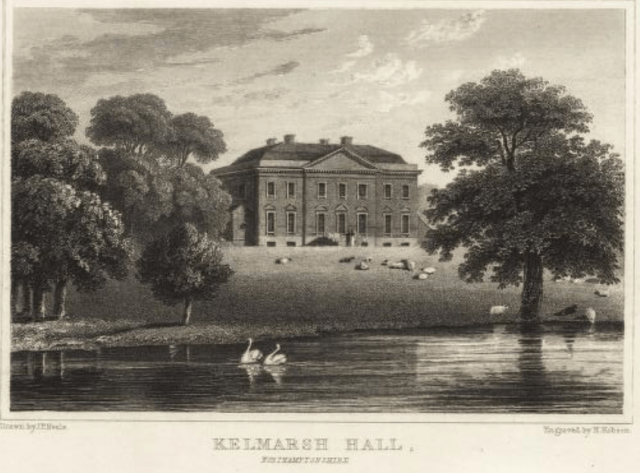
from “Views of the Seats of Noblemen and Gentlemen in England, Wales, Scotland and Ireland.“, by John Preston Neale. 1820.
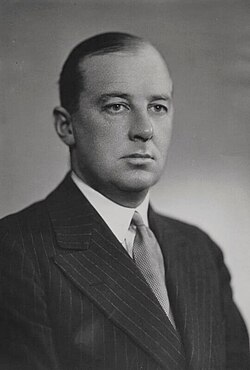
Kelmarsh remained with the Hanburys until 1864 when it was sold to the immensely wealthy Richard Naylor, a Liverpool banker, and the brother of John Naylor of Leighton Hall [see earlier post for more on him & his family] He invested a lot of money in the estate adding new service quarters and a grand ballroom as well as lowering the road that passes in front of the house so that it became invisible.
In 1902 the estate was sold to George Lancaster whose money came from iron and coal, but he did not enjoy it for long, dying in 1907. Eventually it was inherited by his son Claude – usually known as Jubie or ‘The Colonel” – who was a soldier and Tory MP.
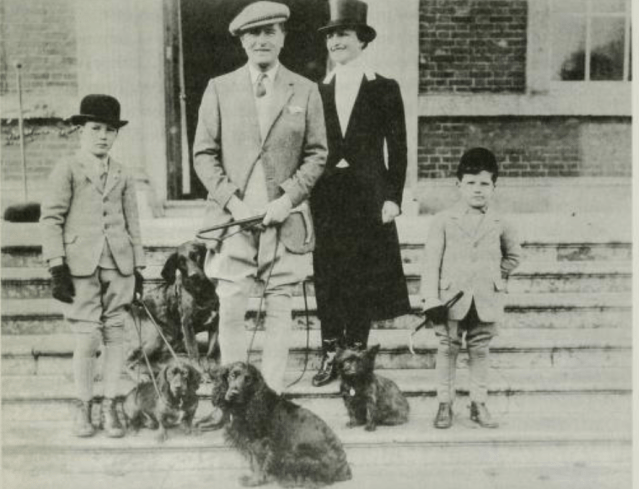
 In 1927 Claude leased it rent free for ten years on a repair and improvement contract to Ronald Tree and his wife Nancy, an extremely well-connected Anglo-American couple who had married in 1920 and come to England in 1926. Ronald was independently wealthy and she was the niece of Nancy Astor, the politician and socialite who lived at Cliveden. Both were keen huntsmen and Nancy recalled that “Ronnie received a wire offering him the position of Joint Master of the Pytchley Hunt in Northamptonshire. They were looking for someone to come in and liven it up… This is exactly what he was looking for; Master of the Foxhounds was the ideal training ground for politicians. So we went to live in Northamptonshire in the spring of 1926.”
At first they rented Cottesbrooke Hall but in the end decided against buying it and moving to Kelmarsh instead where they threw themselves into local life. Apart from the hunt he became the local MP, while she took the house in hand turning it into the ‘most inviting Hunting Box in England’.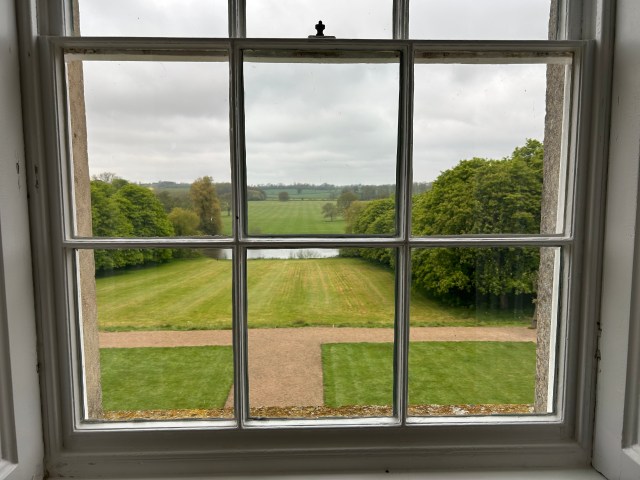
 Much though I’d like to talk about the interiors which are a stunning example is what became known as Nancy’s trademark “shabby chic” there isn’t time or space but check them out from the references at the end of the post. Suffice it to say contrary to custom, which would have been to invite in a leading interior designer and/or garden designer and leave it all to them, she decided to oversee the transformation of the house, gardens and landscape of the estate herself.
Of course she had help. In particular Kelmarsh already had an established head gardener named Williams. Nancy thought he was “such a nice man, but he was often frustrated working for me. He used to give notice all the time because I told him to do so many things; it never made him very happy when I asked him to move trees that I thought were in the way. He only ever did half of what I told him, though; he was deaf as a post and didn’t wear a hearing aid, so either he didn’t hear most of the time or just didn’t bother with most of the things I said. It worked out very well that way; we became intimate friends.”
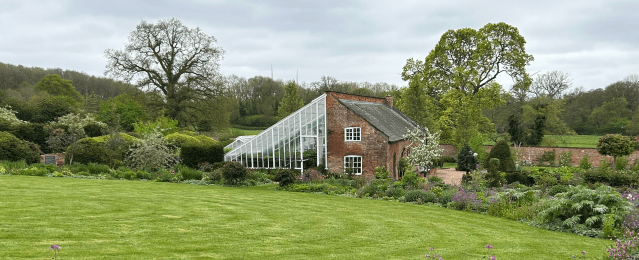
Kelmarsh is lucky in that it has a beautiful but unusual walled kitchen garden which is on sloping ground and triangular in shape. Mr Williams had a bothy and two greenhouses -a large heated one and a smaller one next to it, in the middle. Elsewhere the gardens were not particularly large and when the Trees arrived probably not particularly interesting.
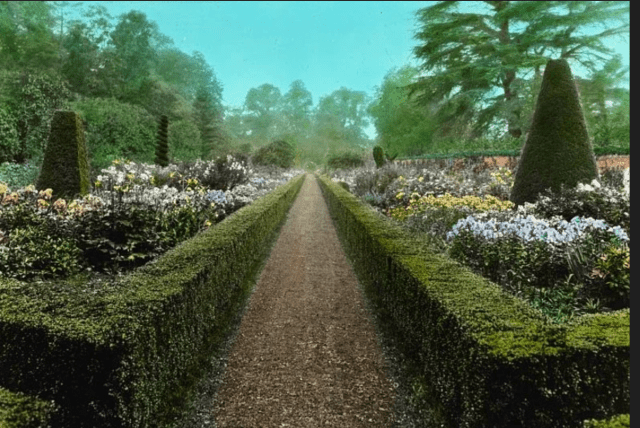
A visit to her aunt at Cliveden introduced Nancy to the work of Norah Lindsay who had designed the grand herbaceous borders there. Norah was invited to Kelmarsh and the two women became good friends.
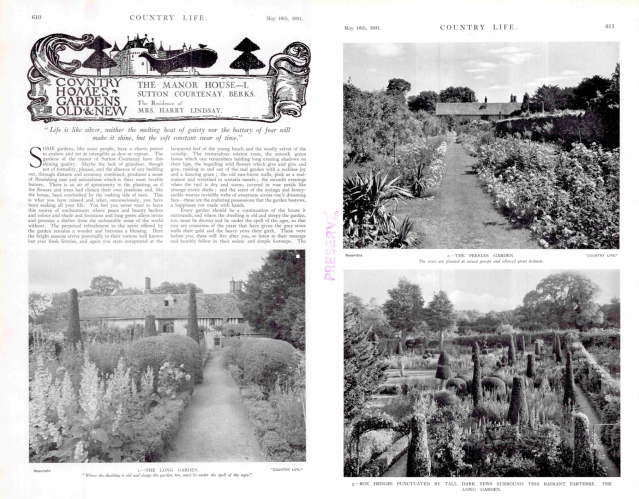
Norah Lindsay’s own garden at Sutton Courtenay from. Country Life 16th May 1931
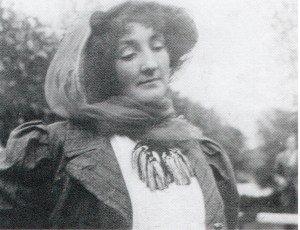
Norah from Hayward’s biography [full reference below]
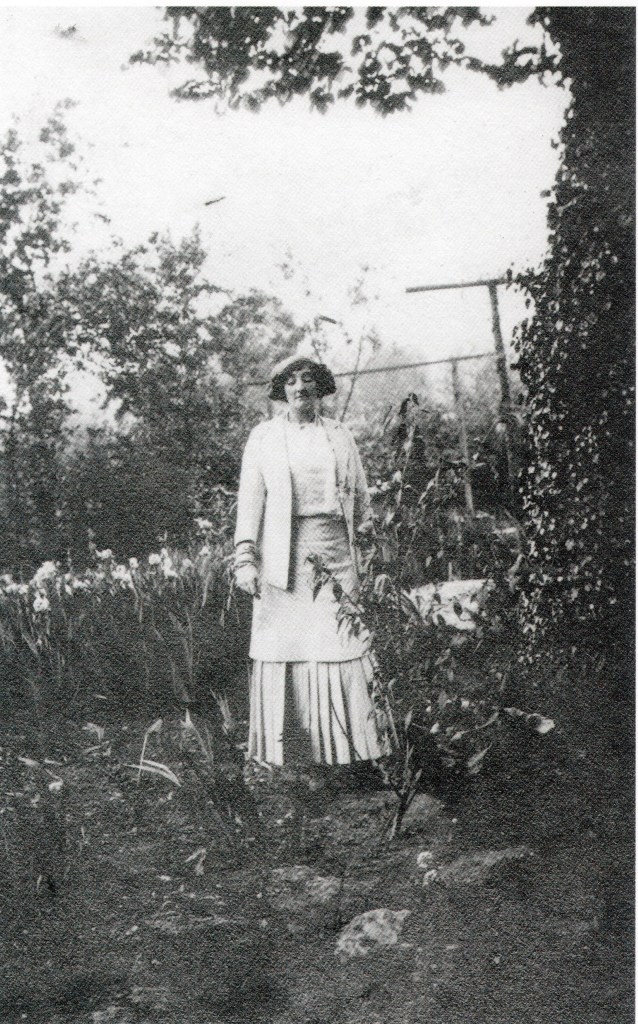
Norah from Hayward’s biography [full reference below]
Russell Page in his Education of a Gardener described Norah as having “a talent which I find hard to define. She lifted her herbaceous planting into a poetic category and gave it an air of rapture and spontaneity. I think she visualised very surely, added the unexpected species whose form and colour would shake a group of plants out of the commonplace, and then she would be on her way, leaving the rest to nature and the astonished gardener.”
Cliveden and Kelmarsh were just two of her commissions for friends because as Page goes on to say : “between the wars she moved from one country house to the next, gardening and keeping everybody amused and entertained. She rushed from garden to garden, leaving long and brilliant reports as to what should be done and what planted, all pencilled out in a large flowing writing on endless sheets of flimsy paper. For all her minor and charming eccentricities, Mrs.Lindsay could by her plantings evoke all the pleasures of a flower garden.”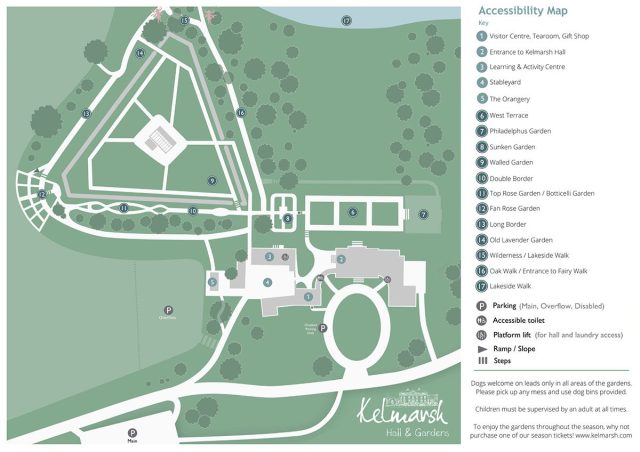
So what did Nancy and Norah do? A look at the plan shows there are now a series of long narrow gardens running around outside of the walled kitchen garden, all created by the pair.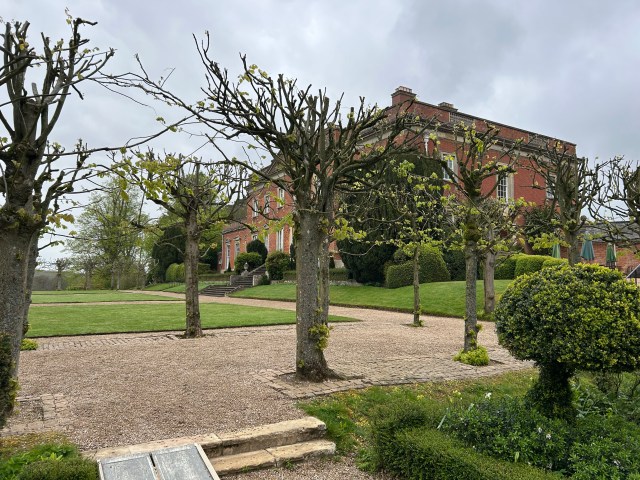
To reach them from the house would usually have meant passing the end of the wide grass terrace behind the house, turning through some pleached limes and then turning into the Sunken Garden.
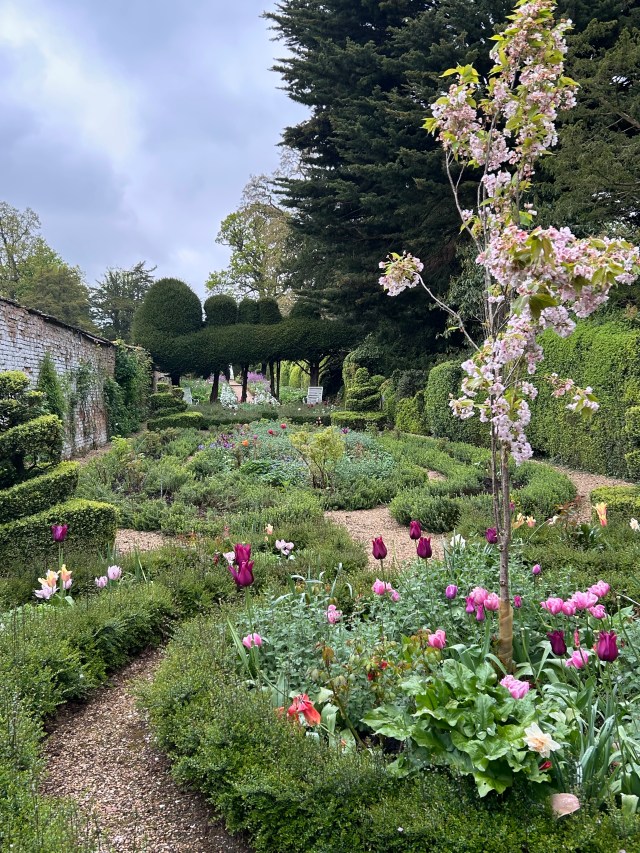
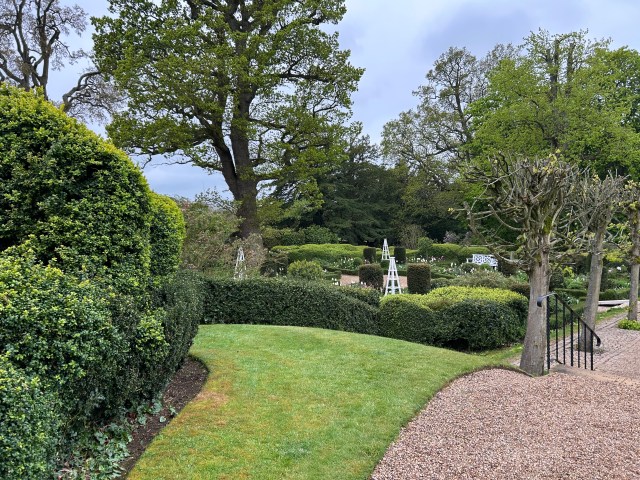 This is a small formal space with four box-edged L-shaped beds around a gravel area, and smaller beds beyond. At this time of year it’s full of tulips with peonies about to flower and later full of white perennials alongside white annuals and biennials as well as some short yew columns and standard evergreens.
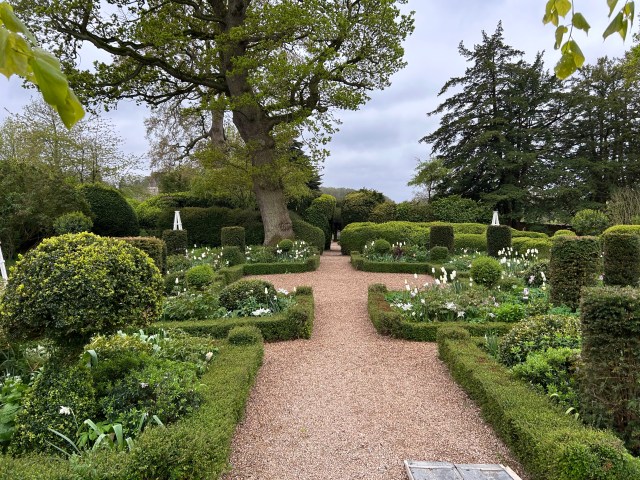
The Sunken Garden is less formal now than it was in Nancy’s day when the space was used for cocktail soirées.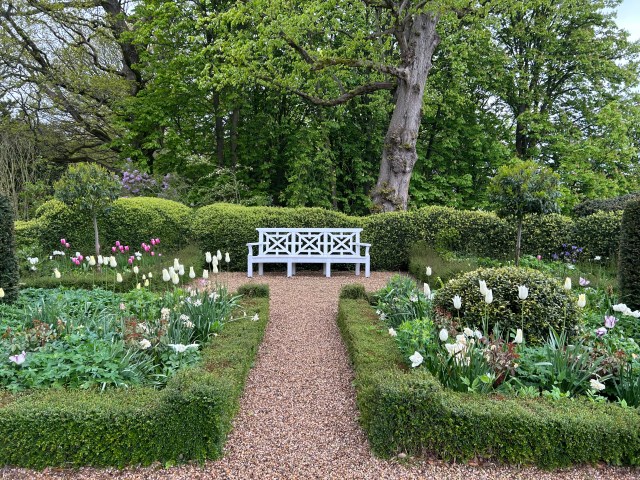
From here a path leads into an area where the servants dried the laundry, and which was divided up by high yew hedges into three sections. It was a stroke of near genius that instead of removing these Nancy had them cut through to form a screen which form a frame for the spaces beyond, and topiarised the tops.
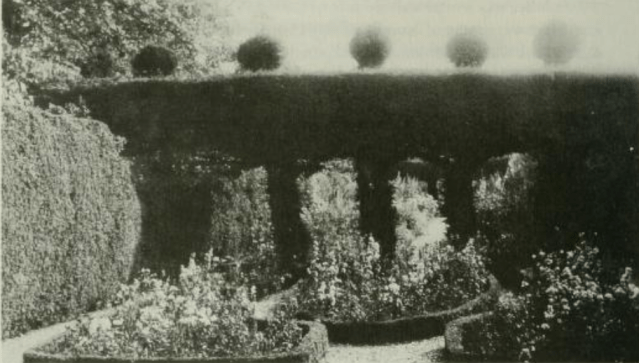
Image from Becker’s Nancy Lancaster
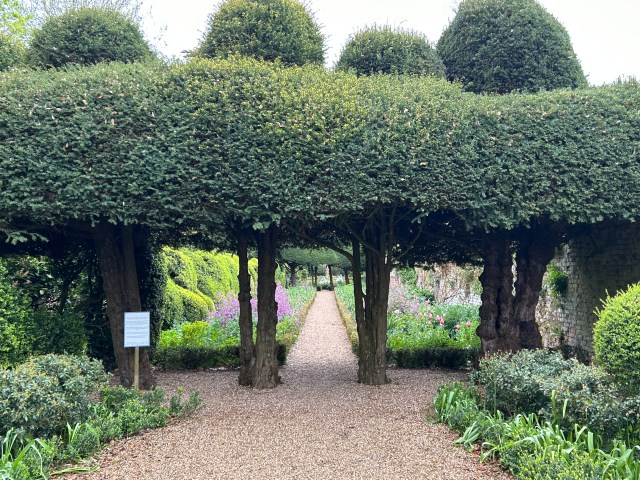
Norah Lindsey then designed and planted the double herbaceous border mainly in pastel colours, which was backed on one side by the wall of the kitchen garden and on the other by more evergreen hedging.
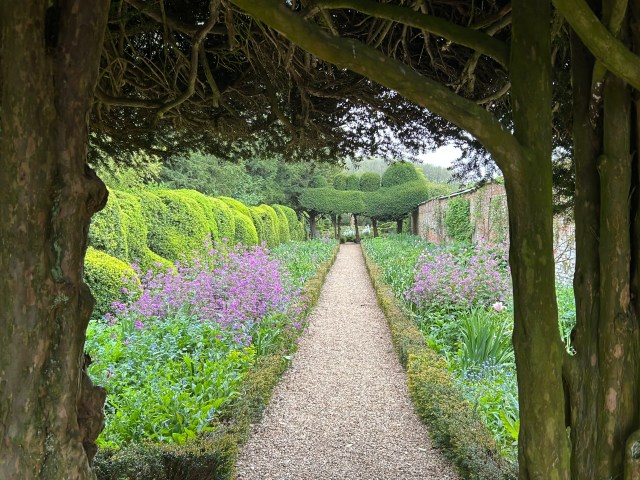
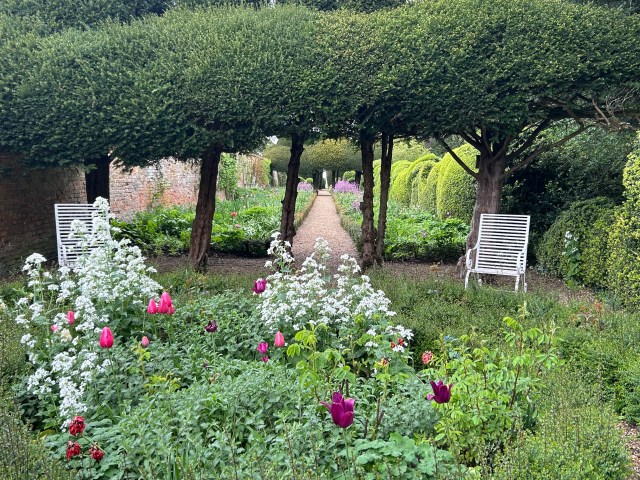 Unfortunately few photos survive of the original planting and there are no plans or plant lists. However it’s clear from descriptions and an early photo there was once a statue in the furthest area which was named the Botticelli Garden, but this has been replaced by a large terracotta amphora.
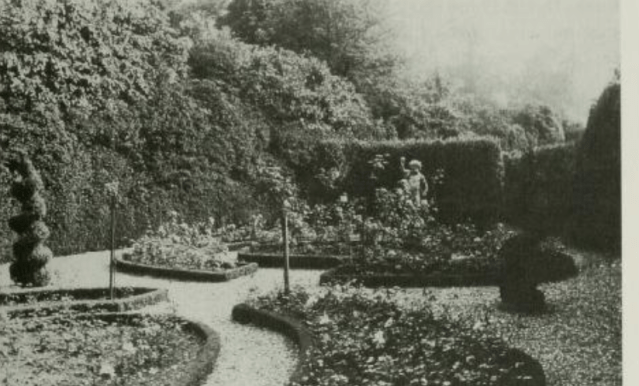
Image from Becker’s Nancy Lancaster
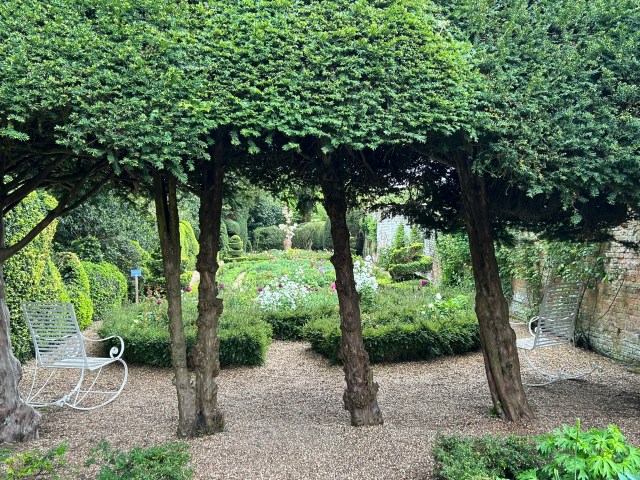
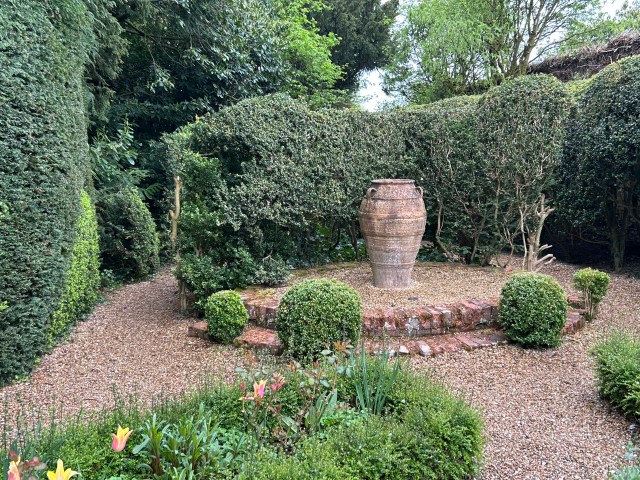
This area was originally planted with roses but later changed on advice from Russell Page and replaced with thousands of bulbs in the spring [his lists survive] and then dahlias in the summer.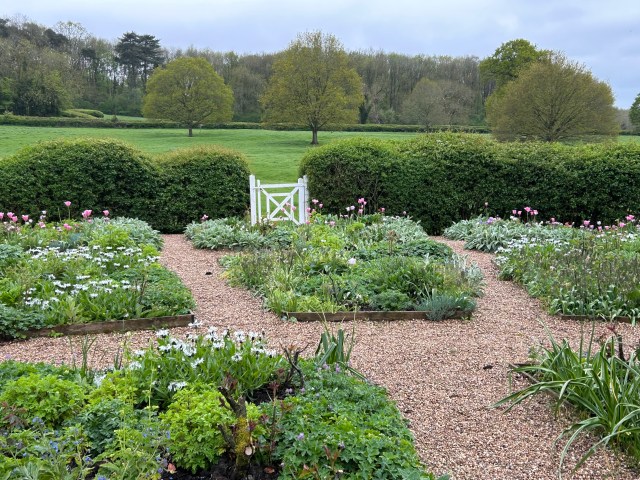
A narrow pathway through the final block of yew opens into the fan-shaped rose garden which sits on one of the corners of triangular walled garden and on the very edge of the garden now overlooking fields and the village church. Originally there were farm buildings in the field but these were pulled down in 1955. 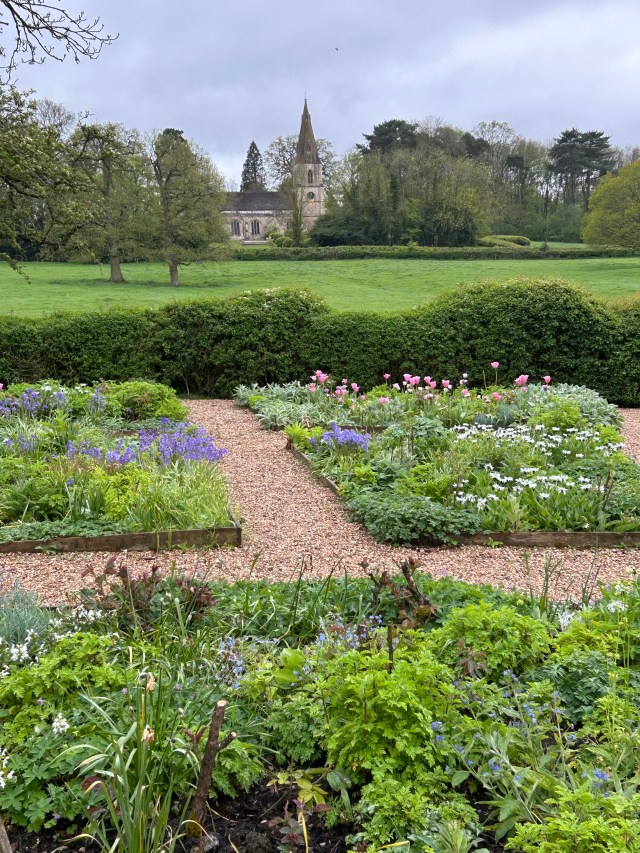
Planted originally just with old-roses of which Nancy was very fond, and which she used in profusion in all her other gardens as well. There is a lovely seat painted in her favourite outdoor colour, Confederate Gray, cut into the hedge with views across the roses to the church.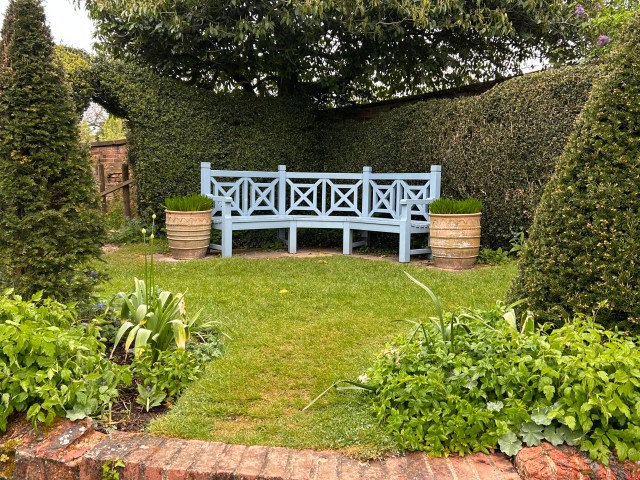
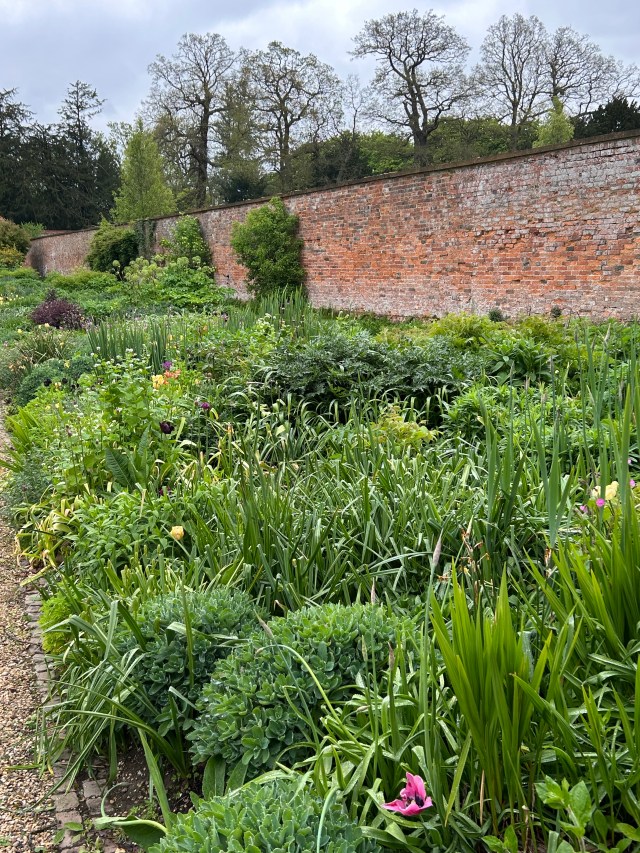 Turning the corner sharply to the right, there are scented shrubs edging the cattle-filled pasture outside the garden but on the other side the path widens out along the kitchen garden wall and provided Norah with a magnificent opportunity to create a deep 60 metre long, herbaceous border.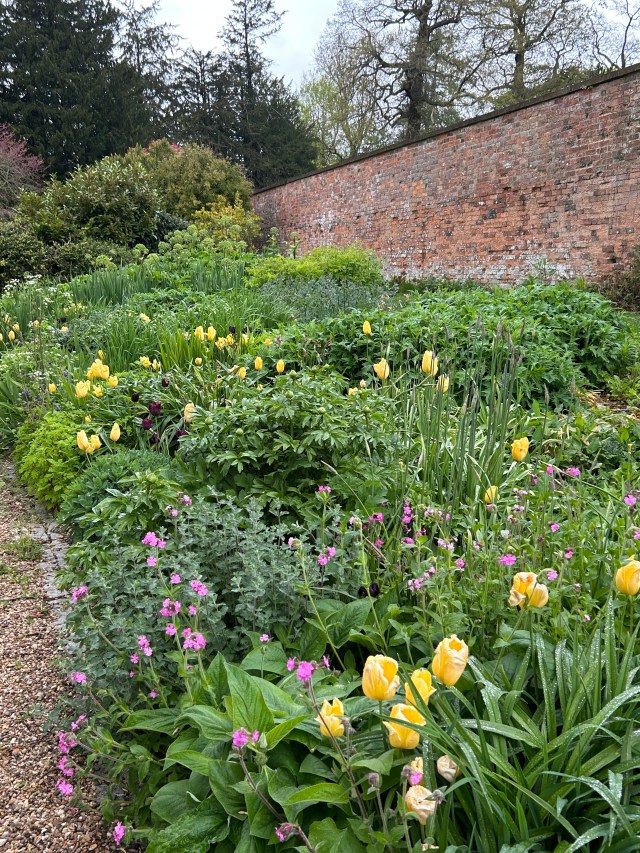
It was planned for successional flowering right through from spring into late autumn. She used lots of vigorous species such as onopordum and verbascum to cope with the heavy clay soil as well as lots of persistent self-seeders. Unlike her usual colour range here she chose strong shades of reds, oranges and yellows.
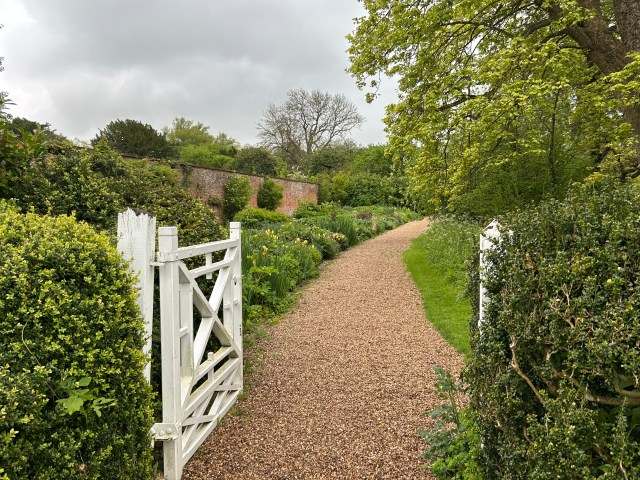
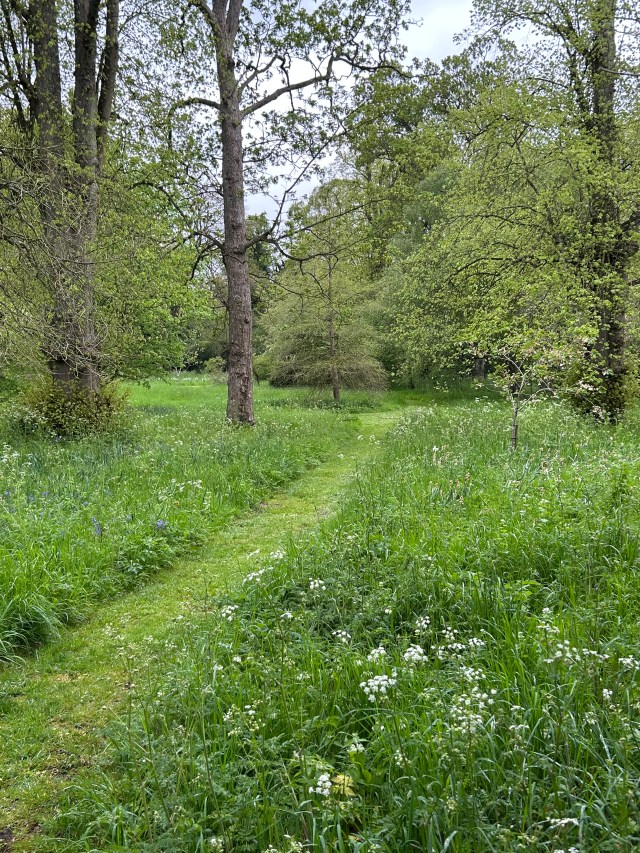 Turning the next corner of the kitchen garden wall there is a completely different feel. One way has paths leading into an area of high oak woodland and ornamental shrub planting, or to the lake and back to the Hall, and while the other way also leads back towards the Hall with bulbs, evergreens and a small summer house shaded by trees with a path through leading to the one of the entrances to the walled garden.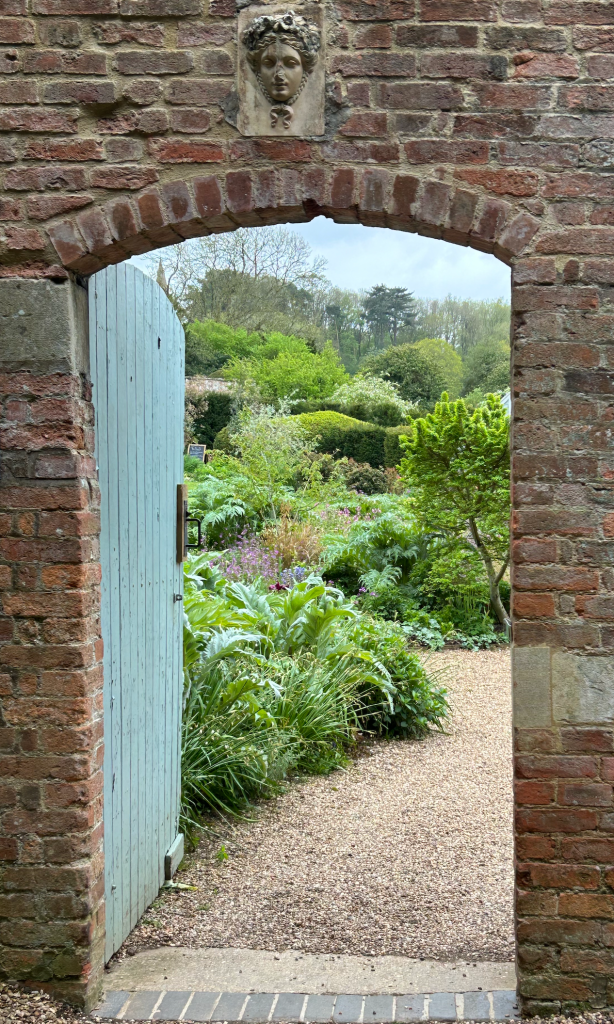
Unfortunately I can’t find any description of what the kitchen garden was like in Nancy’s day. The best I found is Becker’s biography which talked of its walls “patched, repointed, buttressed and bleached by the sun over the decades like an ancient fortress, extra bricks and plain stone cornices used and reused until they crumbled. The kitchen garden produced something- generally a cornucopia-all year long, from brussels sprouts and artichokes to Nancy’s favourite, sea kale. One corner was reserved especially for berry bushes: blackberries, raspberries and gooseberries.” Apart from the mention of seakale it could apply to virtually any old walled garden. These days it has been laid out in a much more contemporary style with areas set aside for particular plants such as peonies as well as a small productive area.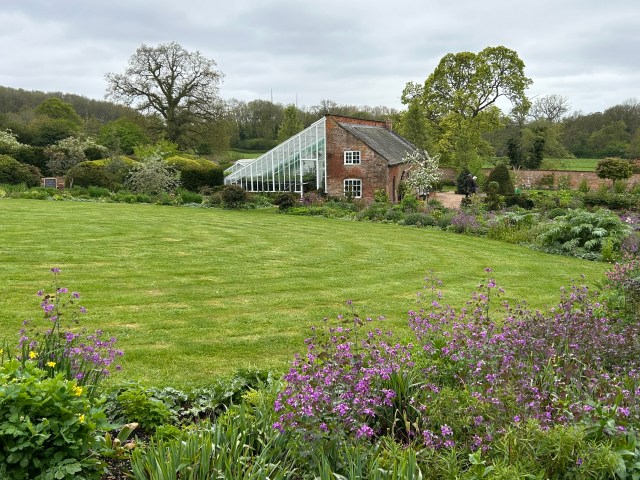
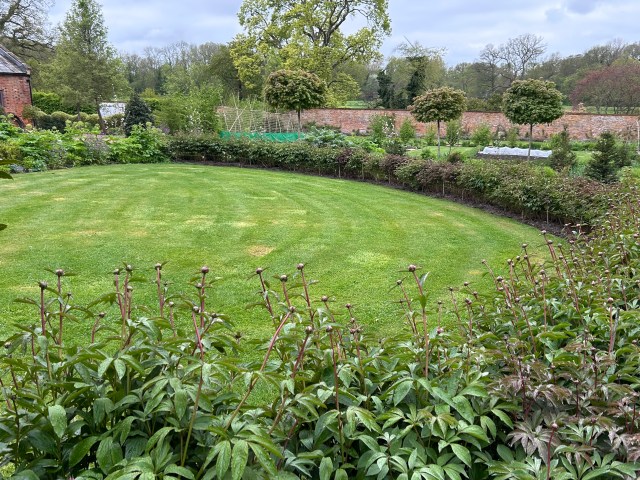
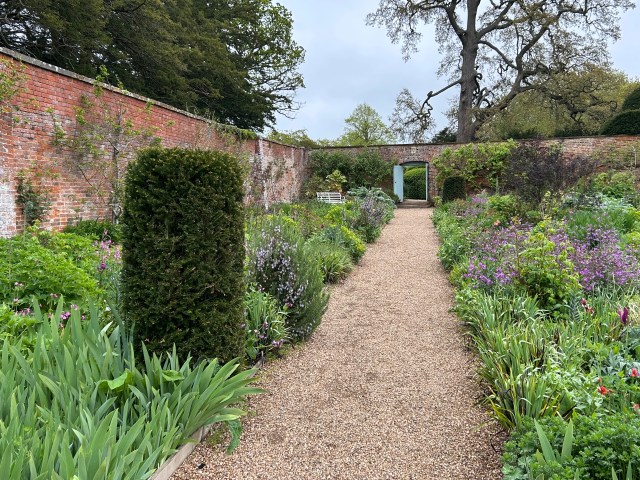
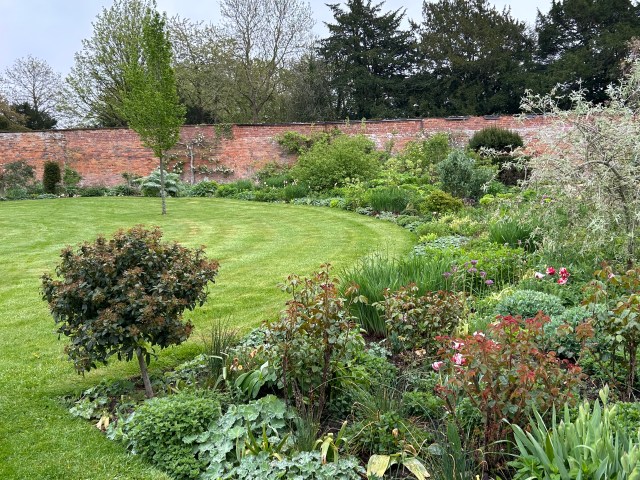
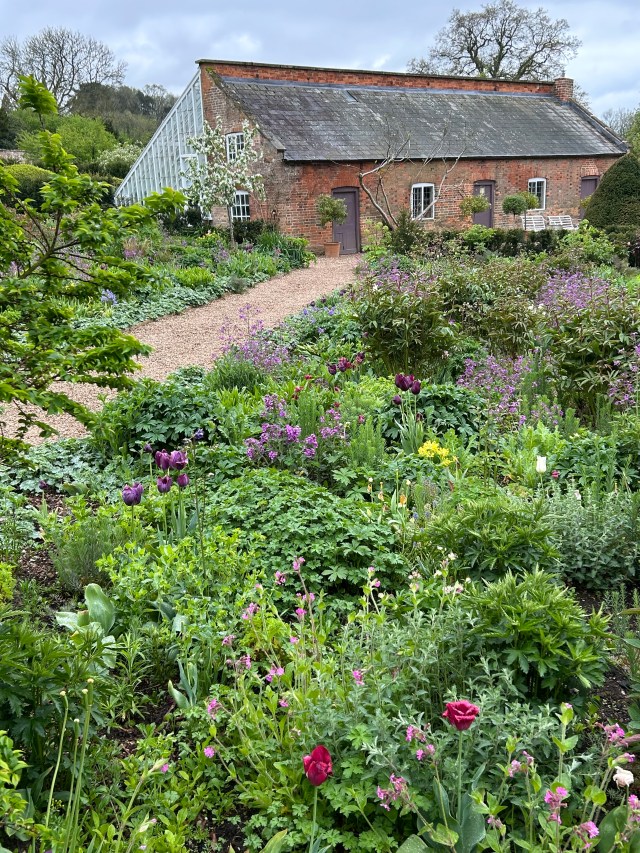
Because the two women had become friends and worked closely together it’s difficult to say who did what and who should get the credit. There’s no doubt the colouring and choice of plants, especially those which self-seed freely but within a formal framework sounds like Norah who is always seen essentially a plantswoman but Nancy too was a plant connoisseur and liked “spontaneity in the planting, as though the flowers and trees had chosen their own positions.” Becker thought the theatrical way that each linked area revealed itself in “a sequence of surprises” was down to Nancy’s “legendary sense of style”. But I can’t help thinking that Nancy had the upper hand because Norah was on an annual retainer of £100 and was working in many gardens at a time. Interestingly Kelmarsh merits less than a page of text in Allyson Hayward’s biography of Lindsay, [full reference below] with just a few photos.
So perhaps it’s easiest to agree with Becker when he concludes that ” In the end, sorting out the strands of their collaboration doesn’t really matter. What does matter is what survives, a sublime synergy of client and consultant.”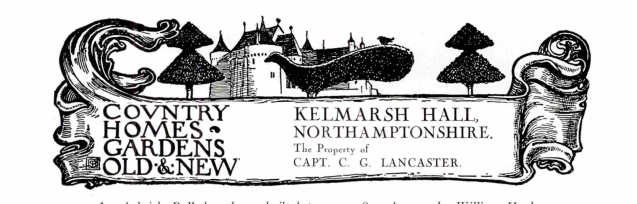
The Trees only stayed at Kelmarsh for a few years because in 1933, the year that it was featured in Country Life, they bought Ditchley Park in Oxfordshire, and handed Kelmarsh back to Claude Lancaster. That could almost be the end of the story but it definitely isn’t.
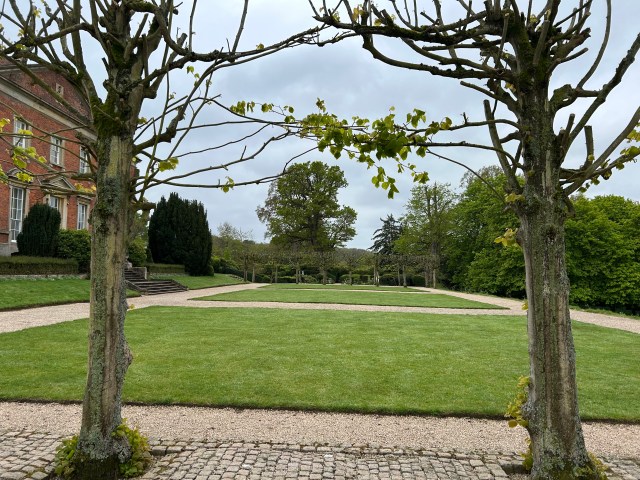
Once at Ditchley they commissioned a young Geoffrey Jellicoe to help them on the house and grounds. A recommendation from them is probably the reason that in 1936 Claude called him in to remodel the terraces on the garden front at Kelmarsh but suggestions for a very grand Italianate makeover were not taken up. However he did create a new wide grassy terrace framed by a double row of pleached limes on either side and then two triple lines of chestnut trees to border a wildflower meadow on the slope leading down to the lake.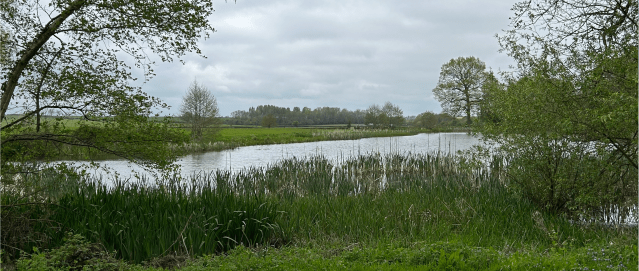
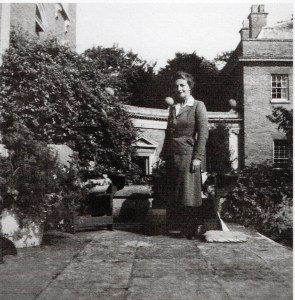
Nancy at Kelmarsh 1953. Image from Wood’s book
In one of those convoluted twists of fate Ronnie had an affair and he and Nancy divorced. However she had maintained a friendship and probably more than that with Jubie Lancaster and in 1947 she married him and returned to Kelmarsh as mistress once more. It had been untouched since she had left in 1933 and so she quickly asked Geoffrey Jellicoe back to advise on further improvements, particularly something for the ground that sloped away at northern end of the terrace. He came up with the Philadelphus Garden which according to Martin Woods book on Nancy his staff thought boring, and to be honest I think they were right.
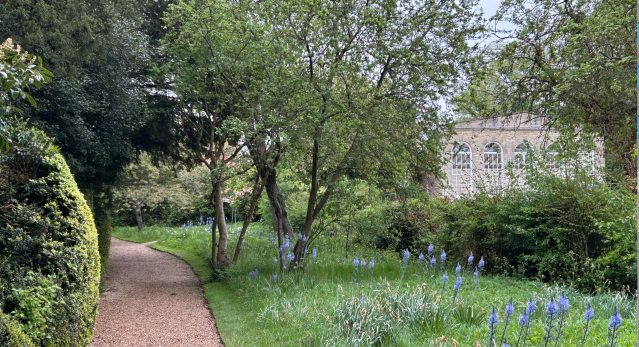
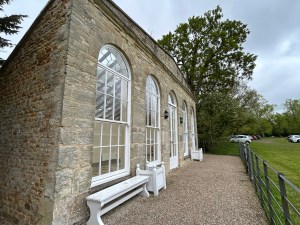 Meanwhile the aftermath of war saw the destruction of many country houses, one such being nearby Brixworth Hall. While the mansion was pulled down Nancy and Jubie salvaged the small 18thc orangery designed by Smith of Warwick, and had it movedstone by stone to Kelmrash where they had it rebuilt to hide the service buildings and stable yard. At the same time they pulled down some of the other old farm buildings in the fields between her rose garden and the church causing a neighbour to comment “It’s lucky she doesn’t mind where they put the church, or she’d have that down as well.”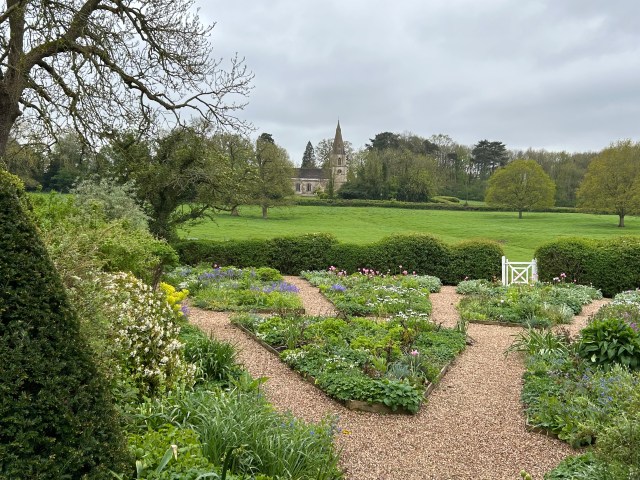
Unfortunately while they might have been friends before they were married the marriage was not a great success. “Jubie was amusing to be around,” said one person who knew him well, “but he was a cad”. They divorced but as her son Michael Tree commented “My mother wasn’t really married to old Jubie, she was married to Kelmarsh.”
After Nancy left she set up home at Haseley Court in Oxfordshire where she died in 1994, Claude continued to manage the estate but conscious of the future started plans to form a trust to preserve Kelmarsh. Claude continued to manage the estate alongside his military, mining and political careers until his death in 1977. His sister, Cicely Valencia Lancaster then inherited and finished forming the Kelmarsh Trust which took over following her death in 1996. Unlike many other properties Kelmarsh still feels alive so they must be doing something right and I’m sure Nancy would be both pleased and proud of what they’ve achieved! 
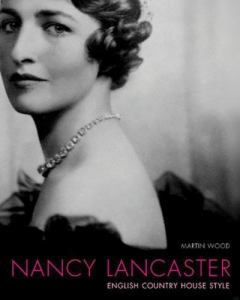 For more information good places to start are


 The Garden History Blog
Thank you for a lovely walk round a beautiful garden. Alison