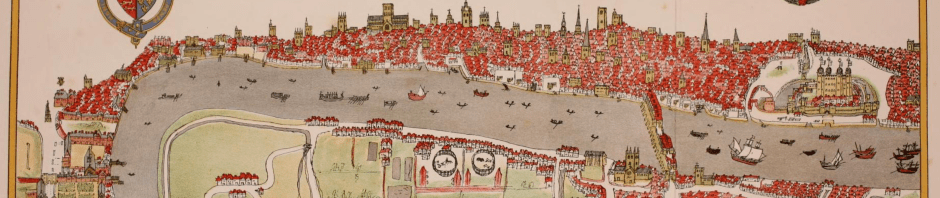
 Bankside is the riverside area on the south side of the Thames opposite the City of London proper, and in early modern times it was outside the control of the City authorities. Renowned for its market gardens and orchards it was also London’s main space for recreation and entertainment of all kinds.
It was home to Shakespeare’s Globe and two other theatres, to bull and bear baiting arenas, fishing ponds and riverside taverns. Yet it was also considered the most disreputable quarter of early modern London.
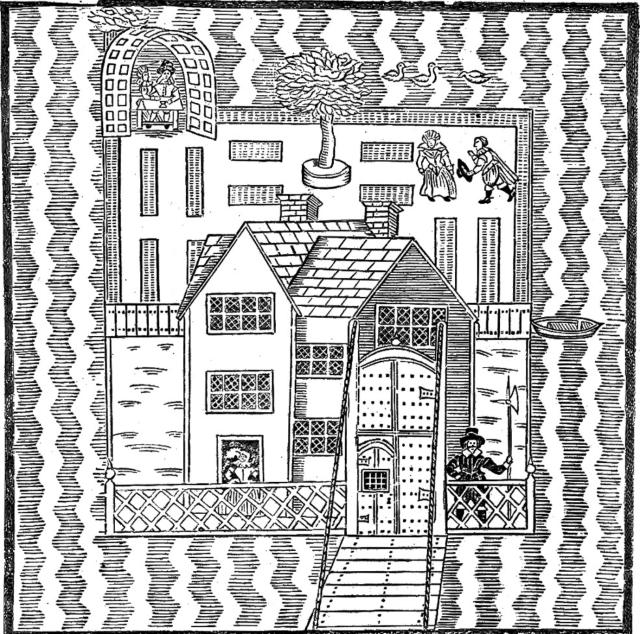
Part of the reason can be seen in the woodcut above which dates to the 1630s. It shows a large moated building with a garden at the rear, with flowerbeds, trees and an arbour, and even some ducks bobbing about in the water. BUT…take a closer look and ask yourself what else might be going on…
 There’s no doubt that at first glance the Manor House looks very respectable. The garden at the rear conforms to our ideas about gardens of the period. It’s enclosed with walls or trellising, has rectangualr beds and a cosy garden seat but why is there a drawbridge to the entrance ?
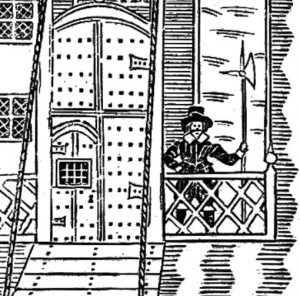
Or a heavy studded front door with a grill?
Or a guard with a large pike presumably controlling admission?
Look more closely and you’ll get a better sense of what might have been going on inside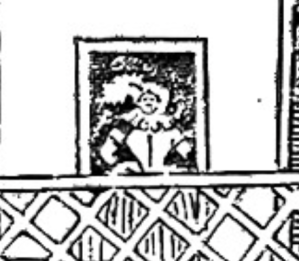
In the left-hand window, although the print is rather worn, you can just make out a man with a feather in his hat embracing a woman.
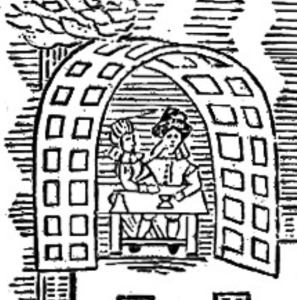
Meanwhile in the arbour in the corner of the garden there’s a couple sitting rather closely together at a table.
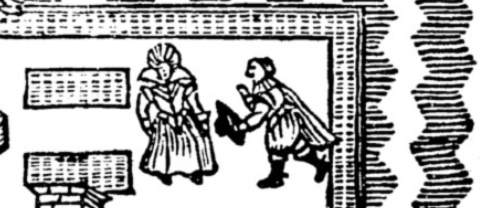
And on the other side of the garden a gentleman is showing a lot of gallantry to a lady by bowing and taking his hat off
What is going on?
First of all its important to note this is not an imaginary house but one which stood close to, but not fronting, the Thames in an area named Paris Gardens which has now largely disappeared under the approach to Blackfriars Bridge. It was a substantial property with much larger grounds than it would seem from the woodcut. The same engraving can be found illustrating several different texts and in one of them it has this heading
The Latin is from Virgil’s Aeneid (Book VI) and describes the entrance to Dis or the underworld – literally “Night and day the door of gloomy Dis stands open” because like Dis the Manor House never closed!
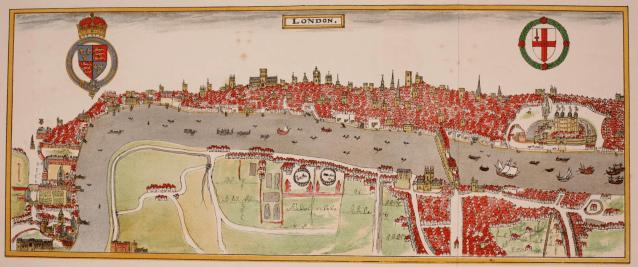
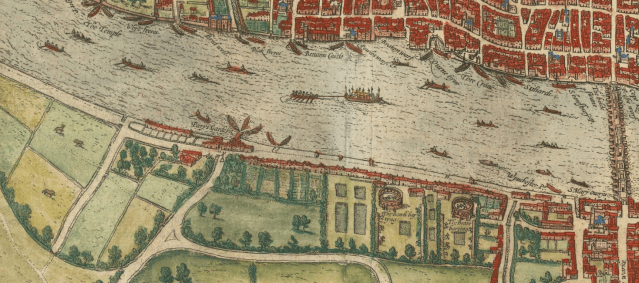
from “The particular description of England”, William Smith, 1588. The Manor House can be seen slightly left of centre, with fish ponds and two circular arenas to its right
Paris Gardens [probably initially “Parish Gardens”] was an area of around 100 acres of marshy ground, most of it too boggy for building because it was several feet below high-water level. Because of that it had to be protected from flooding by a high embankment along the bank of the Thames which was its northern boundary. The other three sides were formed by a stream [effectively an open sewer] which ran in a wide loop round the rest of the site. You can see more clearly on the image below.
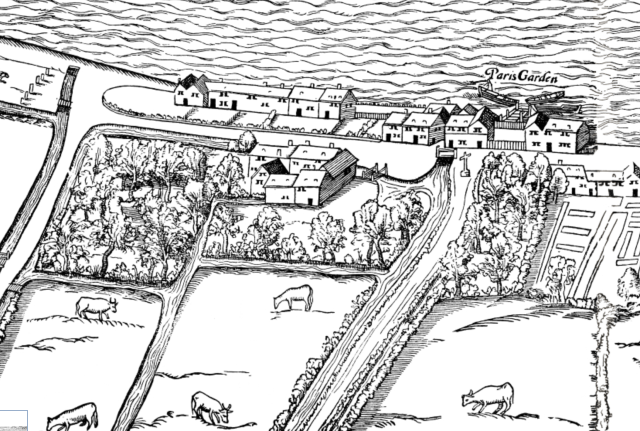
The Manor House was probably built, or at the very least modernised and enlarged, by the Duke of Bedford in the early 15thc. By the early 16thc it had come into the hands of William Baseley, an MP and the Bailiff of Southwark who not only lived there for over 24 years but turned the property into a gambling den with “cardes, dyze and tables” as well as a bowling alley in the garden. This was the start of a slippery slope to decline because, as you might have guessed, gambling and bowls were not the only activities going on at the Manor House. Certainly by the time the woodcut was made it was a brothel, and perhaps the most famous one in early modern London. Hence the quotation from Virgil.
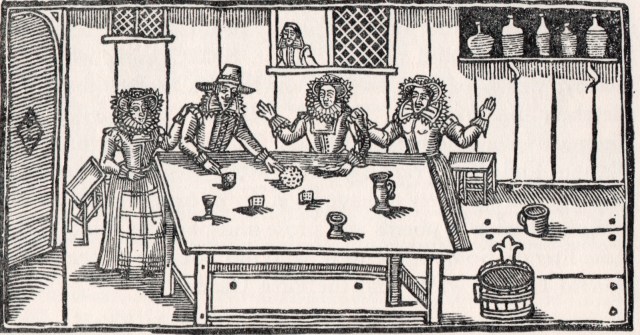
Image scanned from Queen of the Bawds [full reference below]. Unfortunately I can’t find the original source
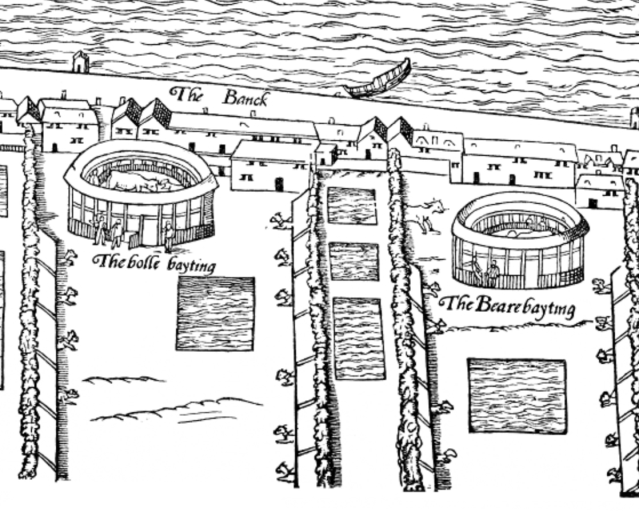
John Stow in his Survey of London [first published in 1598] writes of how Bankside, to the east of Paris Gardens, was also home to two great prisons – the Clink and the Marshalsea and to two arenas. These were “the old and new… wherein be kept bears, bulls, and other beasts, to be baited; as also mastiffs in several kennels, nourished to bait them. These bears and other beasts are there baited in plots of ground, scaffolded about for the beholders to stand safe.” There were also many fishing ponds -often referred to as pike gardens – which were run commercially.
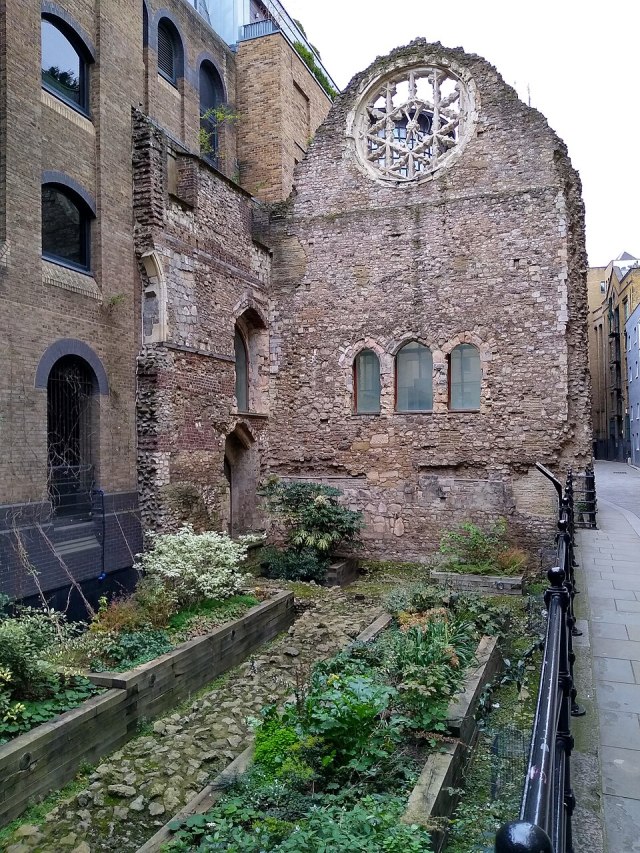
“Next on this bank was sometime the Bordello, or Stewes, a place so called of certain stew-houses privileged there, for the repair of incontinent men to the like women” Because most stood on land owned by the Bishop of Winchester, whose palace was nearby, the church took the rent and turned a blind eye to the activity taking place, so the women who worked there became known as “Winchester geese”. The remains of the bishop’s own residence can still be seen.
However Stow added that “so long as they continued in that sinful life” the women were denied access to Christian burial and a special graveyard was opened for them in the area and called Crossbones .
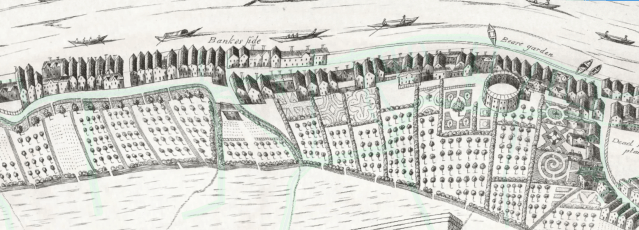
But Bankside also continued lots of gardens. They can be seen on Richard Newcourt and William Faithorne’s Exact Delineation, the large scale map of London, surveyed in the 1640s but because of the Civil War not published, until 1658. It’s clear the mapmakers merely filled in space with standardised designs, rather than a true depiction of the complexity of streets, courts, buildings and open grounds that must have existed. As you can see there are a few parterres at the rear of some of the houses, which were generally separated by a fence from an area of trees [presumably orchards] beyond.
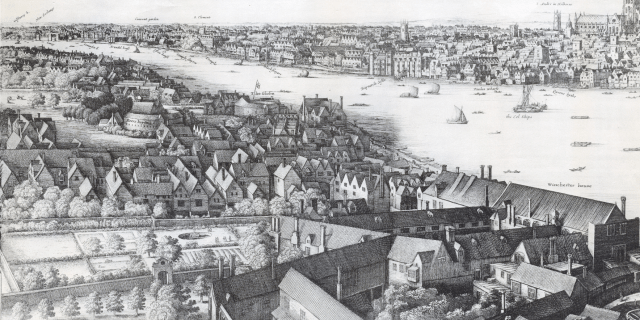
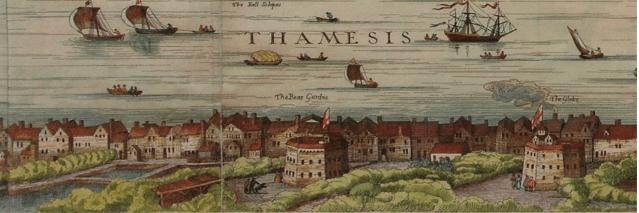
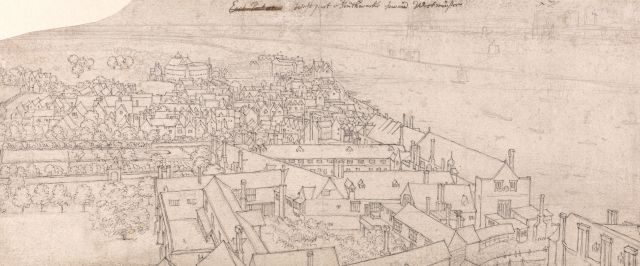
Luckily we are not entirely reliant on Newcourt’s map for our knowledge because Wenceslaus Hollar’s “A Long View from Bankside” was first published in 1647, and ran to thirty eight editions before 1756. Two preliminary sketches also survive. It’s tempting to believe every detail because the engravings are so well executed but since they were actually produced and published in Antwerp some time after the sketches were first taken, complete accuracy is highly unlikely. Nonetheless, they offer the first real visual impression of actual gardens, and of Bankside more generally, in the period.
The area’s disreputable status was finally fixed in the 1630s when the Manor House became something of a cause celebre with the publication of a pamphlet Hollands Leaguer by Nicholas Goodman. It told the story of Elizabeth “Bess” Holland and her “Leaguer” which for reasons which will soon become apparent derives from the military term for a camp engaged in a siege.
The pamphlet’s accuracy is open to a lot of debate, but the likelihood is that it’s at least loosely based on truth. Bess is thought to have come to London aged 16 and somehow married into the Holland family, who were well-known in the Elizabethan underworld. Her first ventures into bordellos had been in London proper but she ran into endless problems with the authorities so she searched for somewhere safer to run her business. She was “informed of a place fit for her purpose, being wondrous commodiously planted for all accommodations. It was out of the city, yet in view of the city, only divided by a delicate river…a mansion house, so fortified and environed with all manner of fortifications.” It had “a world of other bulwarks, rivers, ditches, trenches, and outworks, which hemmed in the orchards, gardens, base courts, and inferior offices.” It obviously sounded good and even better when she discovered “what other benefits were appertaining unto it, as neighbourhood, pleasant walks, concourse of strangers, and things of like nature.” She was also “most taken with the report of three famous amphitheaters which stood so near situated that her eye might take view of them from her lowest turret.”
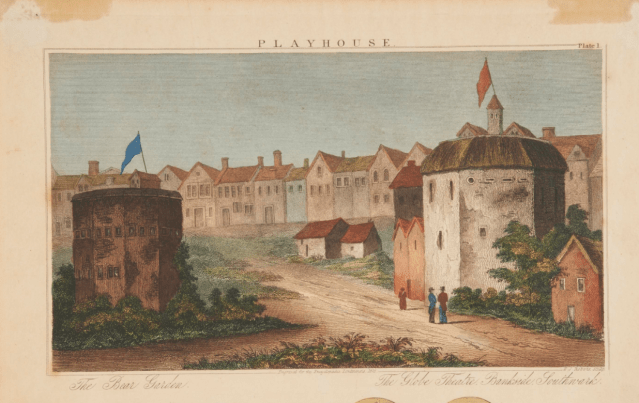
These of course were the three of the great theatres of early modern London: Goodman’s pamphlet describes them as follows: “One was the Continent of the World, because half the year a world of beauties and brave spirits resorted unto it.” This was The Globe which opened in 1599.
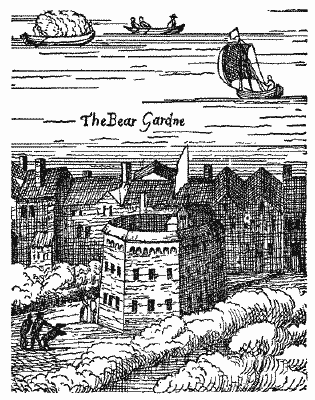
Next came “a building of excellent Hope” which took over the site of the Bear Garden – both at least part-owned by the theatrical entrepreneur Philip Henslowe.
After the Hope Theatre was opened in 1614, it was often still called the “Beargarden” in common parlance and in the extant documentary record. “Plaiehouse fitt & convenient in all thinges, bothe for players to playe in, and for the game of Beares and Bulls to be bayted in the same, and also a fitt and convenient Tyre house and a stage to be carryed and taken awaie, and to stande vppon tressels.”
Finally there was the Swan which right next door to the Manor House so that it “shaked hands with this fortress“. When it was opened in 1595, there were instructions to put the stocks and a ducking stool back in working in order and to build a pound to hold prisoners which gives some sense of the area’s character and its clientele. By 1615 it “was now fallen to decay, and like a dying swan hanging down her head, seemed to sing her own dirge.”
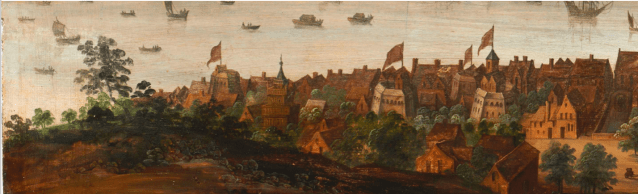
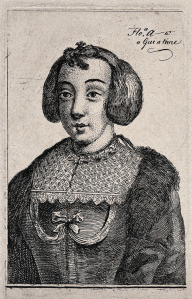
So Bess took a lease on the Manor from Lord Hunsdon and set it up for its new role. In the popular imagination the house was modelled on Dutch lines, ie it was clean and comfortable with good food and “modern” plumbing. That meant she could charge extremely high fees rather than rely on what a contemporary called “sixe-penny whoredome” and all went well for several years, with a clientele reputed to have even included royalty. While we don’t know the names of any of the women who worked there we do have a series of engravings by Hollar of other courtesans and their fees.
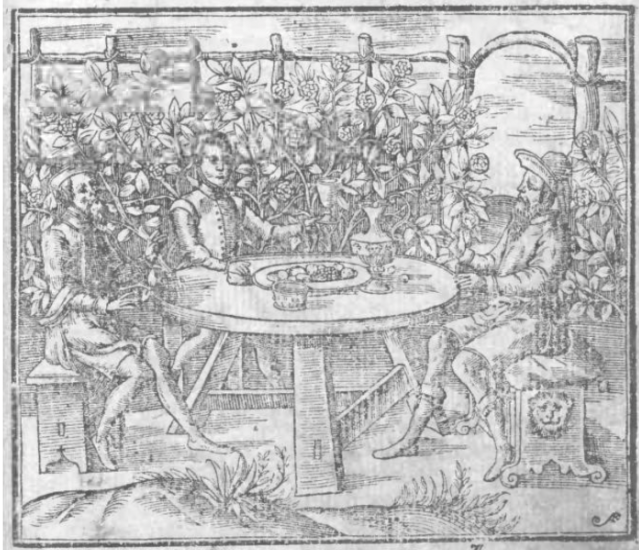
Unfortunately all good things come to an end. James I had turned a blind eye to all sorts of things – it was even rumoured that he partook of many of them himself – but with his death in 1625 the moral climate changed. Charles I was much more moral if not prudish and not inclined to tolerate the debauchery of Bankside.
In December 1631 probably under pressure the king, the bishop of Winchester and local magistrates sent constables to close the Manor House. Bess was obviously not best pleased and instead of complying, raised the drawbridge while there were officials on it, so some fell into moat. Then the inmates tipped the contents of chamberpots [that’s the modern plumbing ] over them. This gave the king a good opportunity to send in troops to enforce the closure but a stand-off took place with Goodman stating “Shee standes uponn her Gunnes: hanges oute a Flagge of Defiance and bids them enter at their perill…”
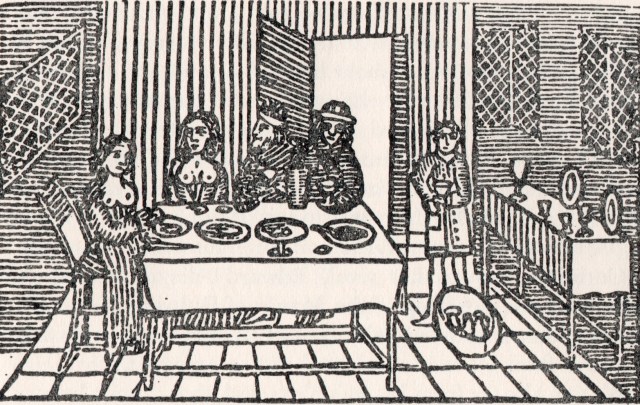
Image scanned from Queen of the Bawds [full reference below]. Unfortunately I can’t find the original source
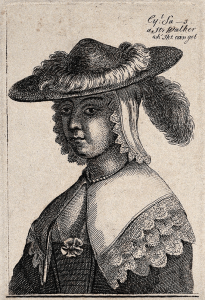
Next “Elizabeth Holland a woman of ill reporte and her husband were called upon intimation [a fine for non-attendance] of £100 ” by the Church Court of High Commission. By then despite her defiant stand Bess must have realised the game was finally over and “they did not appeare, therefore another intimation of £200″. Again “Elizabeth Holland was called but appeared not, it was said she was gone away from her house against shrovetyde: and that the tenant had petitioned the Bishop of Winchester that the house might be guarded for fear of pulling down”.
That might sound a bit drastic but in early modern London apprentices had a reputation for rioting, especially on Shrove Tuesday every year, when they attacked whatever took their fancy, with theatres and brothels being regular targets. [For more on the background of this see this page on London Radical History website] The siege attracted a lot of publicity and so was thought to be an obvious target so the residents of Paris Gardens [who of course included the owners of the other brothels] petitioned the Privy Council asking that “the Trained Bands of Southwark maye attende alle thatte daye” to protect them. As a result there were no reports of serious damage. But by then Bess and her husband had fled the scene and vanish from history.
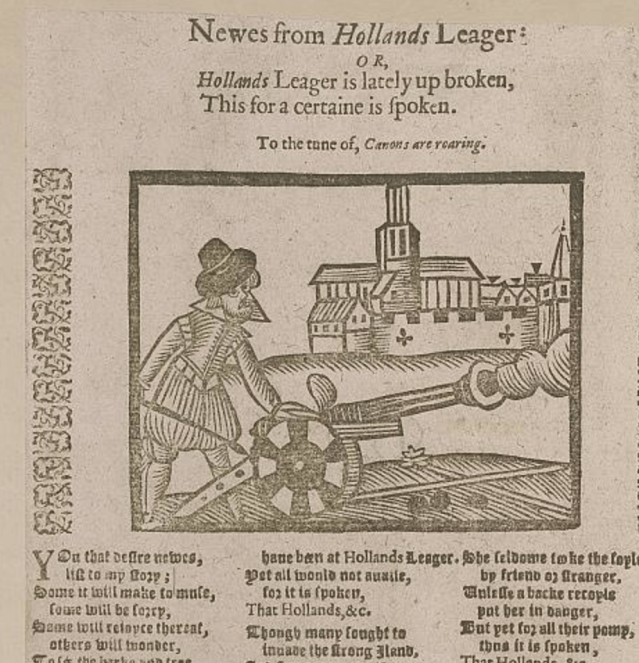
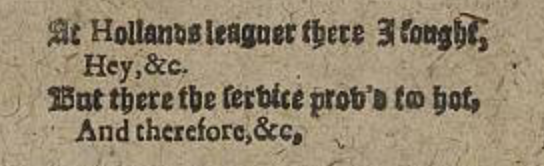
The siege quickly entered popular legend, making the Manor House even more famous than before even though it was closed down. Apart from Goodman’s pamphlet it gave rise to the play Holland’s Leaguer by Shackerley Marmion, and it appears in a couple of popular ballads: “News from Holland’s Leaguer” which details the events of the siege and the actions of “Dona Britanica Hollandia” (ie Bess Holland), and “The Jolly Broom Man”.
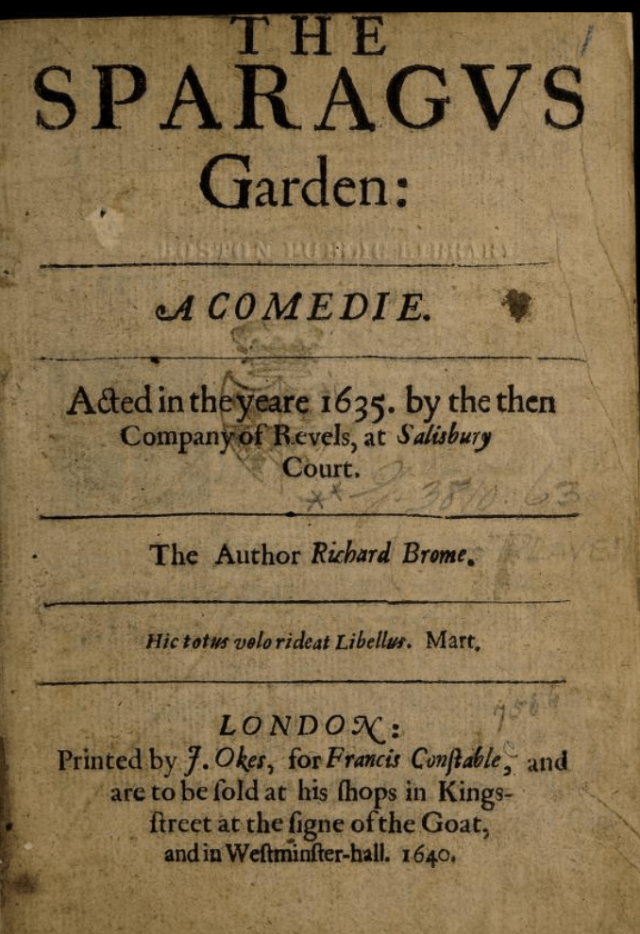
It probably also inspired a play The Sparagus Garden by Richard Brome, first performed in 1635. Partly set in a market garden on Bankside and drawing on Bess’s story the gardener tells his wife, Martha, that he “had once a hope to have bought this Manor of Marshland for the resemblance it has to the Low Country soil you came from, to ha’ made you a Bankside lady.”
Martha then makes clear where the real profit comes from : ” ’tis not your dirty sparagus, your artichokes, your carps, your tulips, your strawberries can bring you in five hundred pound a year, if my helping hand and brain, too, were not in the business.”
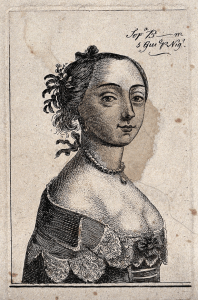
I’m sure you can guess what Martha does but just to reinforce the point the gardener asks: “What did the rich old merchant spend upon the poor young gentleman’s wife in the yellow bedchamber?” only to be told it was “but eight and twenty shillings” even though they “kept the room almost two hours.”
And what about “the knight with the broken citizen’s wife (that goes for ladylike) in the blue bedchamber? Almost four pound”. While that was going on “her husband, and a couple of servingmen, had a dish of sparagus, and three bottles of wine, besides the broken meat into one o’ th’ arbours” so Martha profited all round!
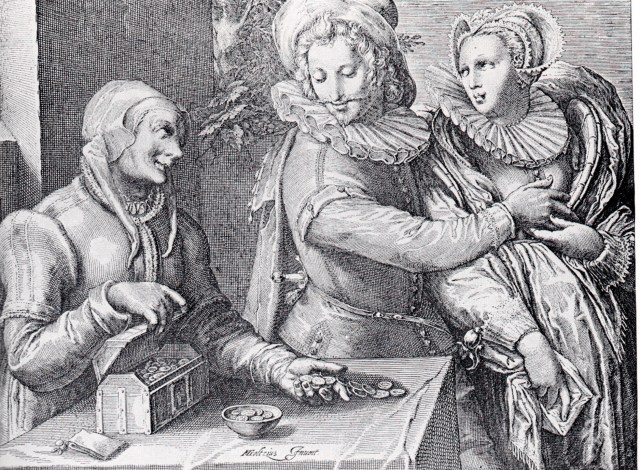
What’s going on here? Engraving after Hendrik Goltzius 1598
Bankside came in for a lot of similar criticism elsewhere too. Donal Lupton in London and the countrey carbonadoed and quartred into seuerall characters, published in 1632 described the bear and bull baiting – “heere are cruell Beasts in it, and as badly us’d” and partly because of the customers – or as Lupton put it -“heere are foule beasts come to it, and as bad or worse keepe it, they are fitter for a Wildernesse then a City.” He summed them up as “the swaggering Roarer, the cunning Cheater, the rotten Bawd, the swearing Drunkard, and the bloudy Butcher haue their Rendeuouz here.” There are, in short, “as many civil religious men here, as there are Saints in Hell.” the area “may better bee termed a foule Denne then a faire Garden. It’s pitty so good a piece of ground is no better imploied.”
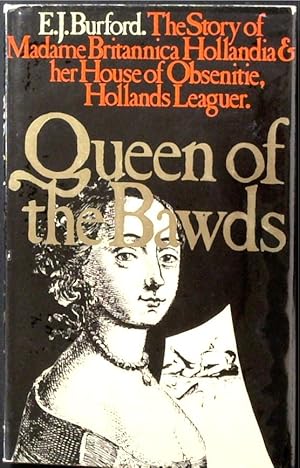 So, there’s no doubt while it might have been full of gardens and green open spaces Bankside doesn’t sound a very savoury place!
For more information about the detailed history of Paris Gardens see The History of Parliament website under Southwark. For more on prostitution and brothels in London more generally see Wallace Shugg’s Prostitution in Shakespeare’s London and about Southwark and Bankside in particular in the excellent long read Wrong Side of the River: London’s disreputable South Bank in the sixteenth and seventeenth century, by Jessica Browner. Bear-baiting on Bankside has been the subject of recent archaeological resaerch by the universities of Southampton & Nottingham. There is even a book on Bess Queen of the Bawds by EJ Burford,which, although it’s not available digitally is still relatively cheap second-hand.


 The Garden History Blog


Thank you. I loved itThis was my Saturday treat! Xxx