The Morning Chronicle for Friday, January 24th 1834 reported the death “At Bath, Mrs. Meen, aged 82.” Those six little words marked the end of a remarkably talented, and until recently, largely forgotten, botanical artist and teacher.
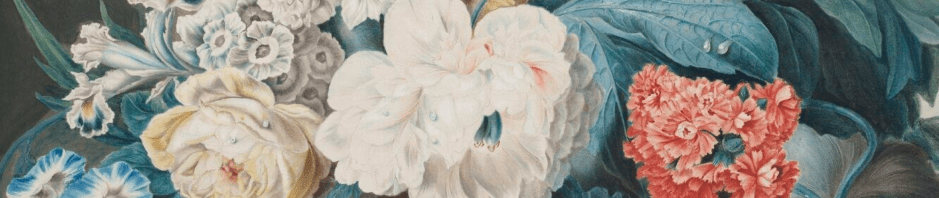
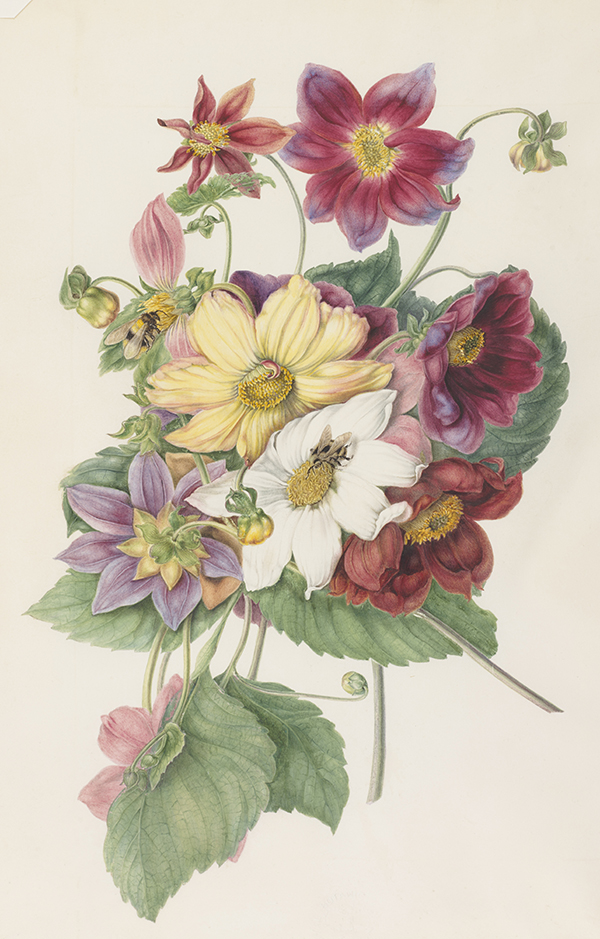
You might have seen some of her work in “Now you see us” a 2024 exhibition at Tate Britain which aimed to reveal the range and output of British women artists over the course of half a millennium, from 1520 to 1920. One of those included was Margaret Meen
She was one of the first botanical painters commissioned to systematically record the plants growing in the royal gardens at Kew, she illustrated books, and she taught Queen Charlotte and several of her daughters. Unfortunately since she, like most of her contemporary female artists, left very little documentary evidence and rarely signed her work her reputation quickly faded after her death and her work is only now being properly appreciated.
Margaret was the daughter of a well-to-do apothecary Henry Meen and his wife, Sarah, and was baptised at Harleston in Norfolk in December 1751, although the family moved to Bungay in Suffolk soon afterwards. Little is known of her childhood or upbringing except that she had an elder brother, also Henry, who went to Cambridge, took holy orders and became a Prebendary of St Paul’s Cathedral, as well as a noted classical scholar.
Margaret may have been able to use his connections to secure some clients when she first moved to London around 1770 and set up as a drawing teacher.
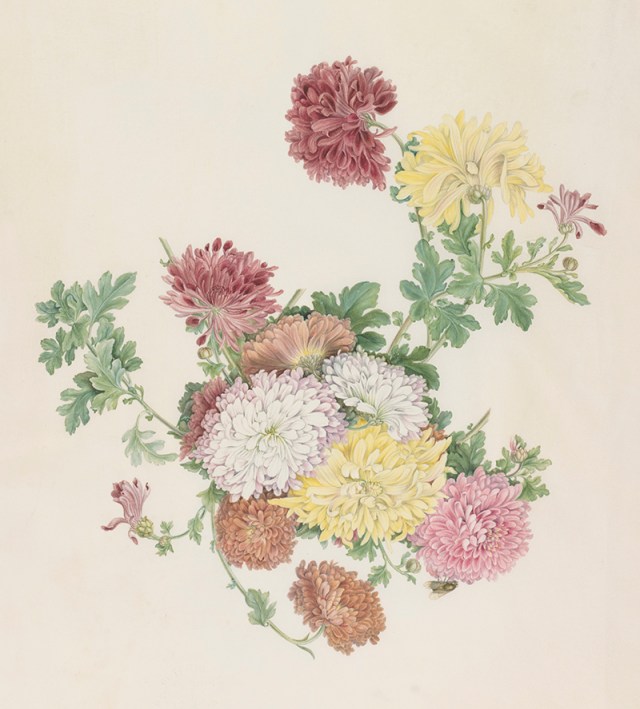
She soon gathered enough students to make a living, set herself up in lodgings in fashionable Marylebone where she is known to have lived until at least 1785. That she was able to do so points up the growing passion for botanical drawing in Britain during the second half of the eighteenth century. Botany was seen as an acceptable pursuit for elite women and a harmless diversion which did not challenge the traditional limitations placed on them. More subversively it also allowed them to engage with scientific inquiry in a domestic setting. Painting flowers required close observation, knowledge of plant anatomy, as well as an appreciation of natural beauty, although as an earlier post about another female artist Henrietta Moriaty showed there were limits to that.
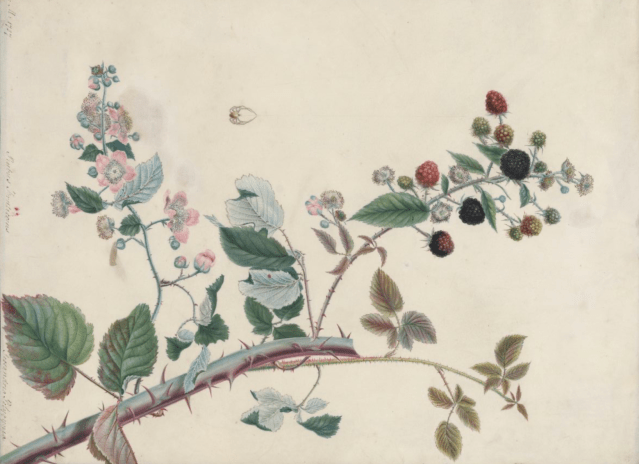
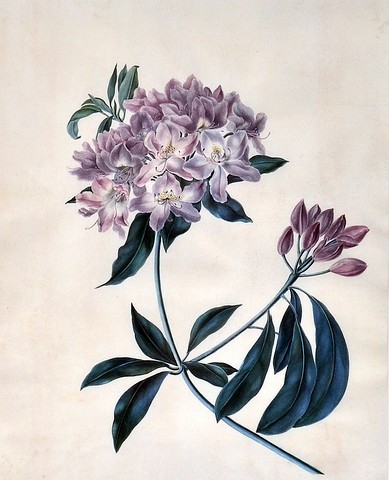
In 1781 the botanist Thomas Jenkinson Woodward, gave Margaret a note of introduction to William Curtis who had recently established his own botanic garden in London. Jenkinson who had connections with Bungay, and so may have known her there, described Margaret as “a young lady of Bungay settled in London for the purpose of teaching flower and insect painting, in which her performances are very capital.” He asked Curtis to let her have a few specimens to draw which he clearly did as another letter from Woodward offered him thanks “for the attention to my recommendation of Miss Meene to you.”
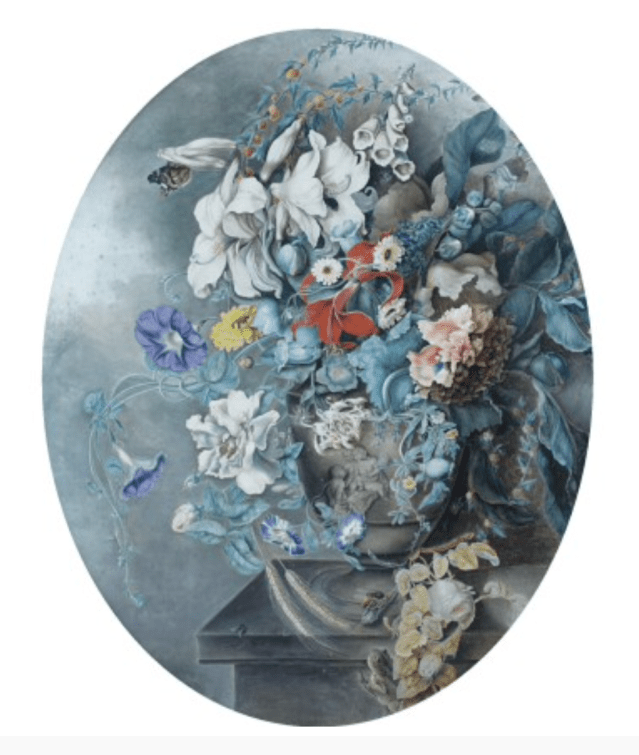
At the same time she was exhibiting flower paintings at the Royal Academy and continued to do so for about ten years between 1775 and 1785. This was time of the increasing. professionalisation of art with many artists, especially those working in the “new”medium of watercolour, feeling they were discriminated against by the Royal Academy, which was the only “official” artistic organisation of the day. As a result the Society of Painters in Water Colours was established in 1804 to exhibit its members work. That too became quite exclusive and so yet another group the New Society of Painters in Water Colours formed in 1807 to showed the work of non-members’ alongside that of members. It changed its name in 1808 to the Associated Artists in Water Colours. and its exhibitions attracted some of the foremost watercolourists of the time including: David Cox, William Blake, Samuel Prout, and Paul Sandby. Joining them in 1810 was Margaret Meen. Unfortunately the group was not a financial success and they folded in 1812.
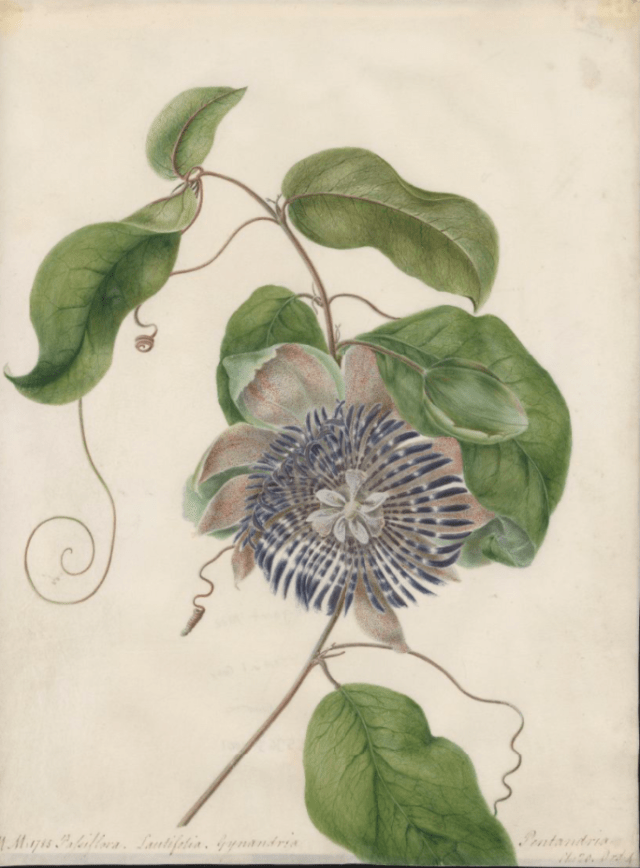
What is not known is how she made a breakthrough to gained patronage at the royal court The likelihood is that it came through her one or other of her high-profile pupils. Since there is very little surviving documentary evidence we don’t know the names of many of them but there is evidence that from 1784 at the latest they included the four daughters of the MP for Devizes, Joshua Smith. These lessons lasted until well into the 1790s and all four young women became accomplished amateur artists. They were connected by marriage and friendship with Jane Austen and her family, and Meen went on to teach taught at least one of their children, Emma Smith. She was the future wife of Jane Austen’s nephew, James Edward Austen Leigh) and her diary records her starting lessons with Meen when she was 13 in 1815. They continued for at least three years, either in London or by invitingher to stay at the family home in Essex. Later Austen family correspondence show a continued relationship with Meen right through the 1820s and 1830s.
There’s more about her connections with Jane Austen & her family on the Lindley Library website;
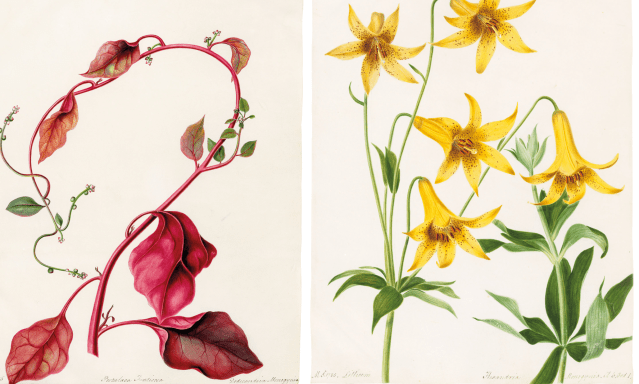
Another daughter, the eldest, Maria, became Marchioness of Northampton. She too seems to have continued the connection with Margaret Meen. In 2020 an album of 69 botanical illustrations mainly by Maria but also perhaps by her niece Emma as well Meen herself was rediscovered and sold at Christies for £40,000.
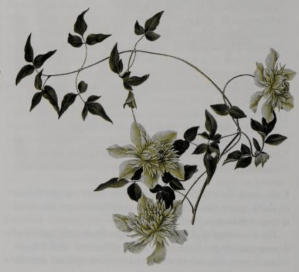
Luckily four letters dating from 1797-1820 also survive between Meen and another of the sisters, Eliza, who married William Chute of The Vyne, near Basingstoke, which throw brief glimpses of light into her world and document her closeness to court circles. Clearly they are the remnants of a much greater volume of correspondence. The letters are examined in detail by Kelly McDonald in Margaret Meen: A Life in Four Letters
One of these connections may also have bought her to the attention of John Stuart, 3rd Earl of Bute, who assisted Augusta, Princess of Wales, in establishing the royal gardens at Kew and also served as tutor to the future George III, and later briefly as Prime Minister. After his fall from political power Bute remained involved with the running of Kew, and, was responsible for the appointment of William Aiton to catalogue the plants there :Hortus Kewensis.
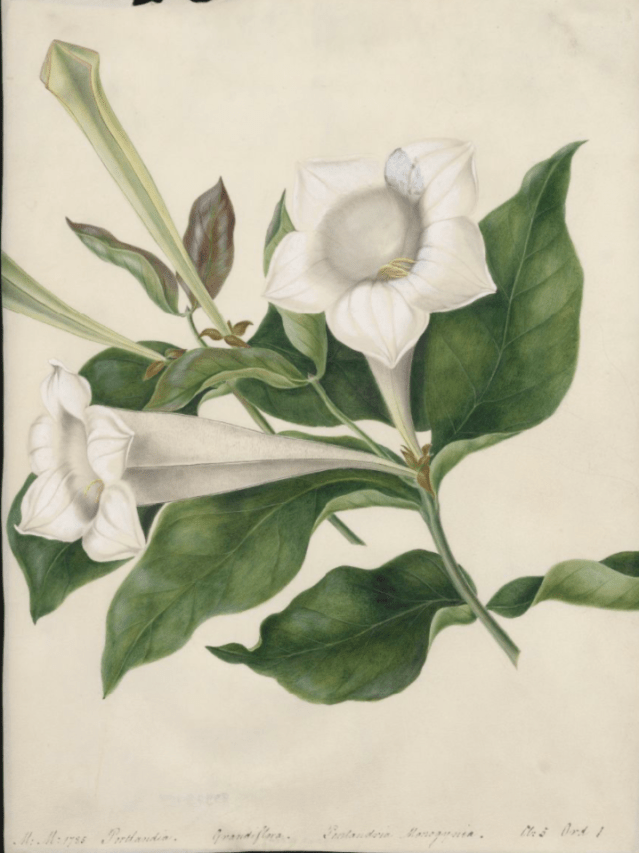
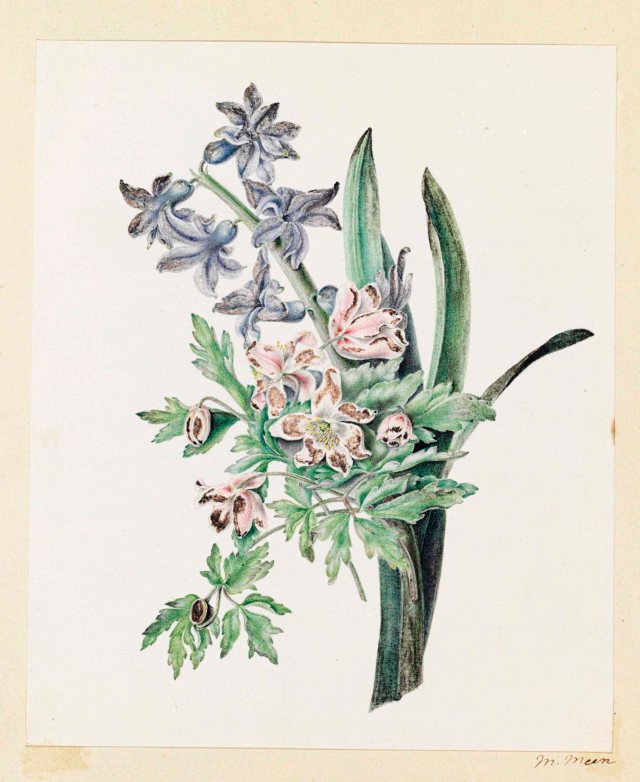
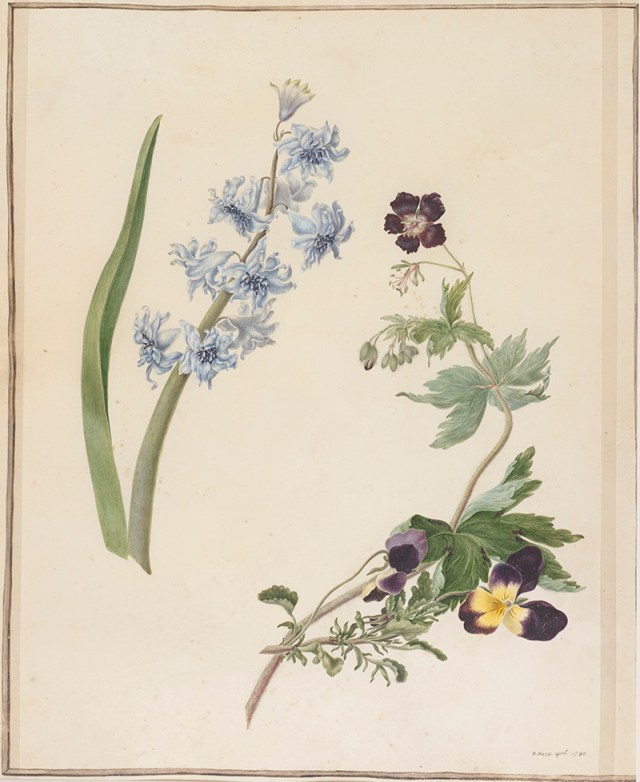
Bute was also a keen botanical scholar and published his Botanical Tables, privately printed c.1785. Amounting to nine royal quarto volumes, this beautifully-produced work contained over 400 specially commissioned hand-coloured plates including some by Margaret Meen. Other paintings by her are known to have been in the Bute family collections including an album amicorum containing one of her paintings.
The patronage of Bute would have enabled access to paint specimens from the royal gardens at Kew, and the Tate Gallery goes so far as to say that Margaret Meen was employed to record plants growing there. This may in turn have led her to the attention of Queen Charlotte. By 1789 she had entered the inner circle because the queen’s diary records that on the 8th December ‘I drew with Miss Mean from 10 till one’. We don’t know if this was a one-off or part of a regular pattern, but we do know that she went on to teach. some of the princesses.
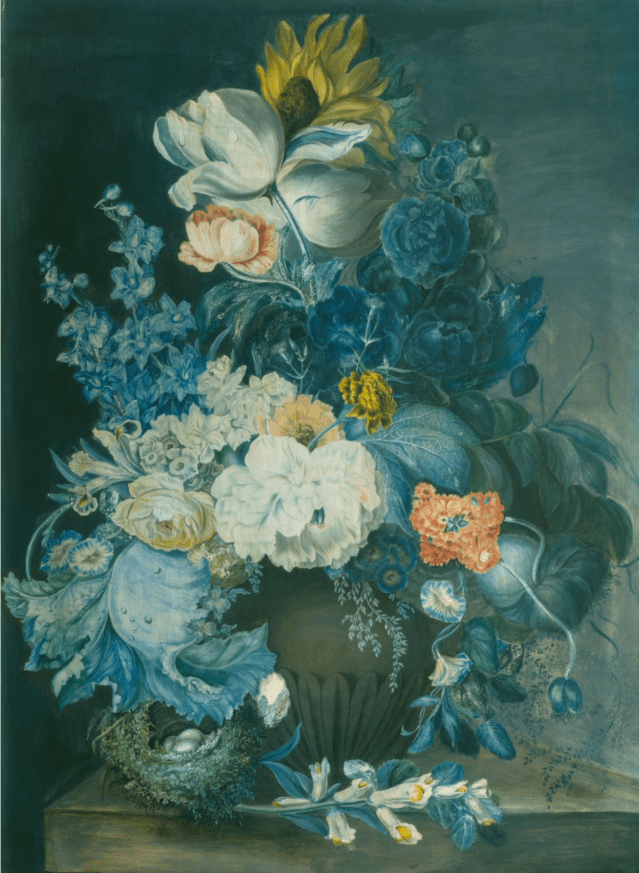
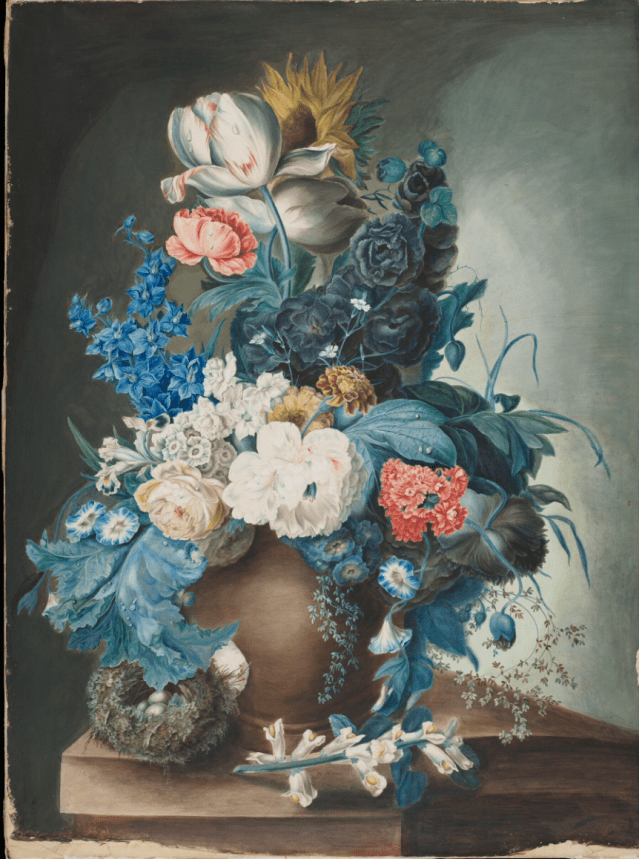
Of course other artists taught the royal family too – notably Francis Bauer who also worked at Kew. These lessons would have been pretty dull mainly involving copying other artists or even the tutors own work. An example of that is a watercolour by Princess Elizabeth of a floral arrangement with bird’s nest (1792, now in the Royal Collection), which was directly copied from a still life by Margaret Meen, now in the Victoria and Albert Museum. This work may have once been owned by the royal family, perhaps for the purpose of copying; the accounts for the royal nursery include a payment of £22 12s., on 23 March 1792, to ‘M. Meen’ for drawings.
Nevertheless Meen’s instructions probably benefitted Elizabeth, who was a keen flower painter and is known to have painted floral garlands for Frogmore as well as some of the plant motifs at Queen Charlotte’s Cottage at Kew. In 1822 Elizabeth left for Germany to marry Frederick, the Landgrave of Hesse-Homburg, but she is known to have corresponded with Meen after that,
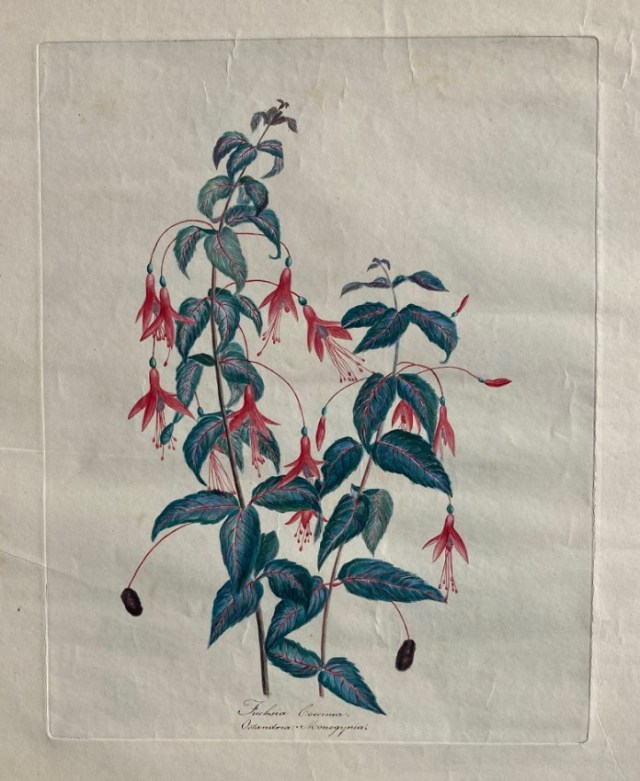
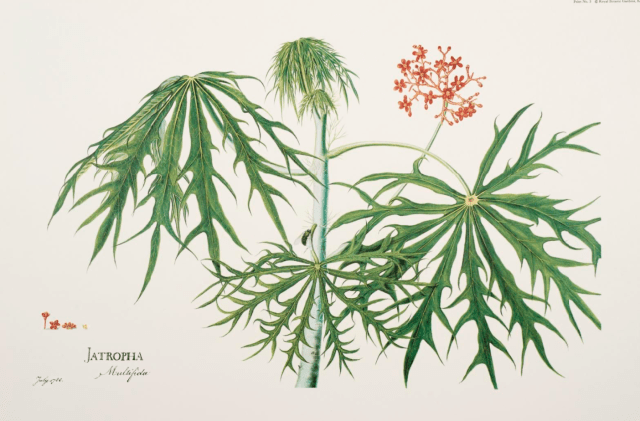
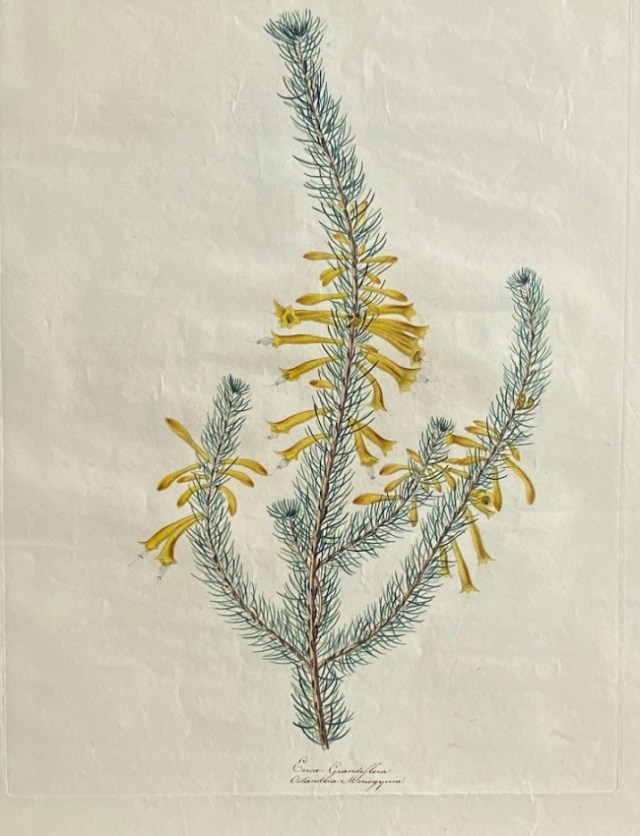
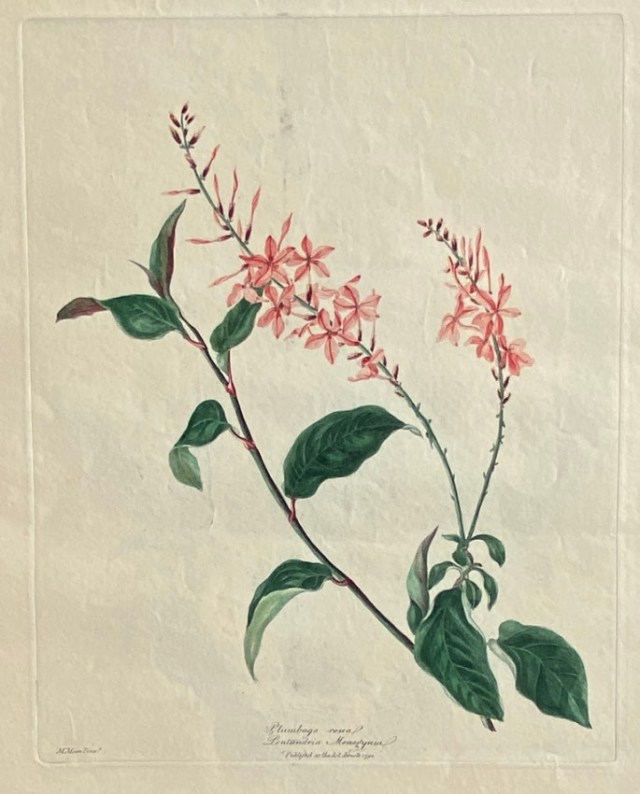
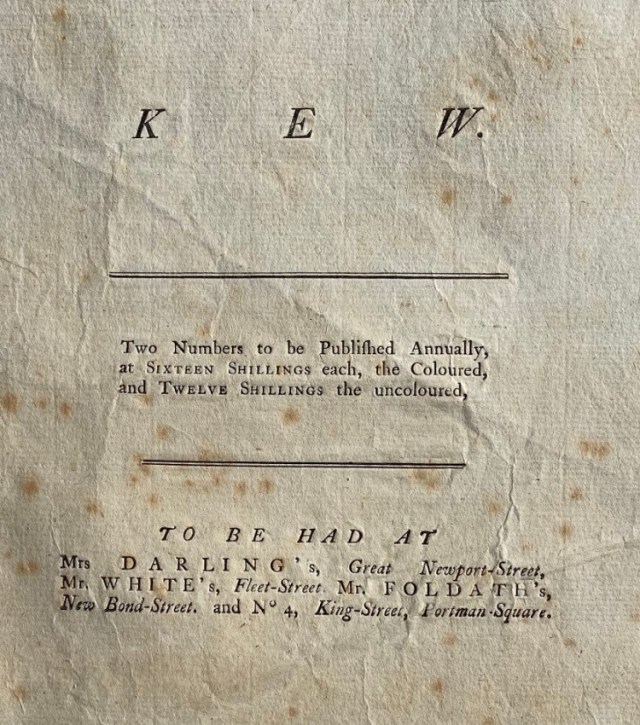 In 1790 Meen began a serial publication entitled Exotic Plants from the Royal Garden at Kew, which she dedicated to Charlotte. This folio publication was intended to appear twice a year, ‘at Sixteen Shillings each, the Coloured, and Twelve Shillings the uncoloured. To be had at Mrs. Darling’s … Mr. White’s … Mr. Foldath’s … and No 4, King-Street, Portman-Square’ .
The plates were executed in etching and acquatinted some printed in one colour but all carefully coloured by hand. This was an expensive process and as a result unfortunately, only two issues, with a total of 8 scientifically named plates, using William Aiton’s Hortus Kewensis to name the species she illustrated were ever published.
After this much of her life is obscure but it would seem that after the illness and death of her major patrons like Bute and Queen Charlotte, both teaching and commissions may have begun to dry up. This may have been the reason, alongside her increasing age that she moved first a less fashionable district of London and then by 1819 to Sunnybank Cottage in Loughton then a small Essex village which was beginning to attract artists and wealthy merchants alike. [Unfortunately Sunnybank was pulled down in 1889. For more on it and Loughton at the time see the website of The Hills Amenity Society]. Despite moving to the countryside she carried on teaching a couple of days week near London, basing herself at Mrs Fryers boarding school in Hammersmith. Sh e clearly enjoyed the work because although “were it to cost me all that I make there in coaches, it still would be worth my doing as a means of supporting my spirits and of keeping up some intercourse with the world. I have one or two pleasant schollars there.”
Unmarried she also began calling herself ‘Mrs’ rather than “Miss” and in a letter of 1820 it seems she was actively seeking a companion at Sunnybank who would live cost-free although be unpaid. Her will written in 1825 in Loughton suggests that this might have been Elizabeth Browning, a spinster “at this time residing with me” who was left £2500 invested in a consolidated annuity. A further £200 was left to relations in Norfolk and the rest of her estate to Catherine Renouard, the sister of a clergyman from Kent who was her executrix. There is no further evidence until we hear of her death in Bath where she was living very early in 1834, and where she was buried on 9th January aged 82.
Like that of many female botanical artists working at this period, Meen’s work has suffered some hard historic criticism. For example, Wilfred Blunt in The art of botanical illustration first published in 1950 starts off positively: The indefatigable Margaret Meen made many hundreds of very effective paintings of exotic plants at Kew and elsewhere” but before sinking into a typical put-down of many other female botanists.cal artists of the period, “In spite of all her immense industry and patience, however, she never quite rises above the level of a very highly gifted amateur.”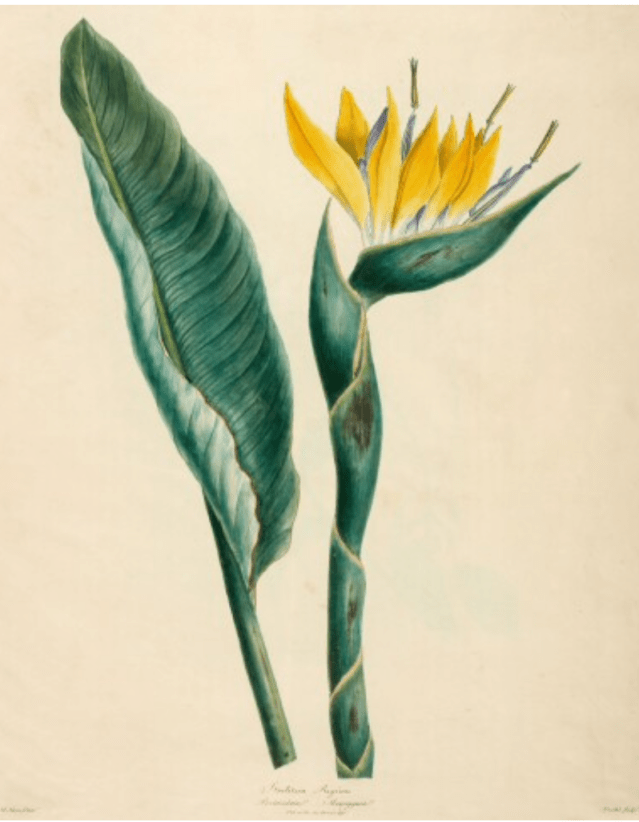
Others are more generous. According to Jane Simpkiss who wrote her entry in the Oxford Dictionary of National Biography in 2024: “Meen’s work reveals her to have been an artist of immense talent and vision and her use of light and movement has been considered to give her depictions of botanical specimens a dynamic realism.”
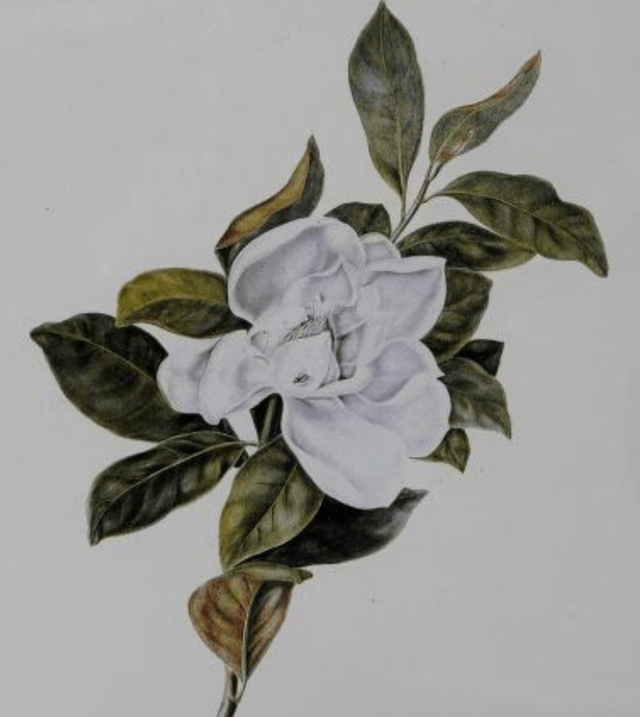
Richard Mabey in his comprehensive look at Kew and its botanical illustrators and their work : The Flowers of Kew is even more positive. He argues “there is an exhilarating sense of light and movement about her plants” which. makes her images were so effective that they could make her contemporaries’ work, even those of the great Georg Ehret, appear “stiff and vasebound” by comparison. He cites the plate above in particular as “an affectionate dig at the latter’s artificial posing of extravagant butterflies above his flowers. In the voluptuous fold of her magnolia flower, looking as if it had just settled and couldn’t possibly be disturbed, is a single, small house-fly.”
Meen’s work was clearly collected during her lifetime. As I showed above The Earl of Bute had quite a few of her paintings, and some of these were acquired by Reginald Cory the wealthy horticulturist of Dyffryn who bequeathed them to the Lindley Library. Another large holding was owned by the Earl of Tankerville – or more probably his wife [who deserves a blog of her own one day]. This is now part of the archive at Kew.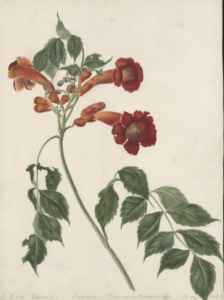
Normally I’d add a list of places to go for further information but I’m afraid apart from checking out the Lindley Library holding on-line or going to visit the archive collection at Kew unfortunately I can’t think of anything else to suggest.
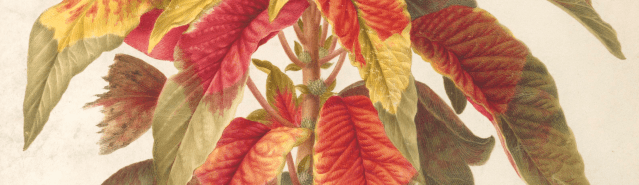
detail of Amaranthus tricolor, 1789. Image from RHS Lindley Library


 The Garden History Blog
You must be logged in to post a comment.