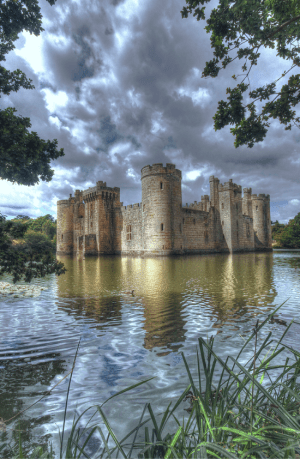
Bodiam Castle


from flickr, copyright irezumi13 2010

Bodiam                                                                        from flickr, copyright irezumi13 2010

Bodiam in Sussex has been described as the most written about and photographed  castle in the whole of Britain. This is not just because it’s a wonderfully photogenic site with opportunities to show off even an amateur’s camera skills.

Bodiam doesn’t  figure on our database because its not a park or garden in the traditional sense but for the last 30 years it has been at the centre of a vigorous academic debate as to its purpose and function which is perhaps not as obvious as you might think.  In short its been a debate about whether Bodiam is just a castle in the traditional sense or something much more elaborate and significant: an entirely artificial mediaeval landscape.

Read on to find out more…

Aerial photo of Bodiam Castle , from 1800 feet Creative Commons Licence [Some Rights Reserved] © Copyright Phil Laycock 2007 and licensed for reuse under this Creative Commons Licence.

Aerial photo of Bodiam Castle , from 1800 feet
 © Copyright Phil Laycock 2007 and licensed for reuse underCreative Commons Licence.

Continue reading

Posted in Uncategorized | Tagged , , , | Leave a comment
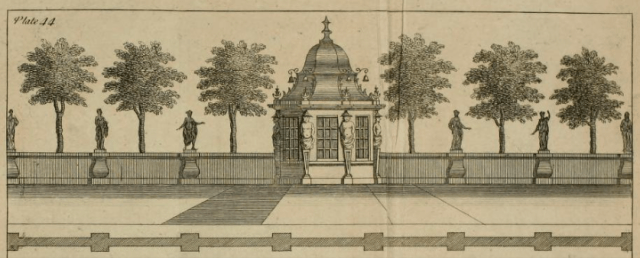
 a Building for the Termination of a Walk in the Chinese Taste, from rural architecture in the Chinese Taste.

A Building for the Termination of a Walk in the Chinese Taste, from Rural Architecture in the Chinese Taste.

It was hard not to smile when, whilst researching for a lecture on Chinoiserie in the garden, I flicked through the pattern books published by William Halfpenny,  a virtually unknown 18thc architect.  

Very little of his work appears to have survived, although what does is impressive and suggests that perhaps he has been under-rated. In particular the recent re-creation of the Chinese bridge that he designed for Lord Coventry at Croome Park is an elegant reminder of his ability.

But really his fame, such as it is, now mainly rests on a series of  books of architectural designs for garden structures and other features, which are often whimsical when they are not pure comic fantasy.  Halfpenny clearly had a vivid imagination so read on to find out more and, I hope, be at least mildly amused…

from Rustic ARchitecture in the Chinese Taste

Plan and Elevation of a Temple or Summer House on a Tarrass in the Chinese Taste, from Rural Architecture in the Chinese Taste

Continue reading

Posted on by The Garden History Blog | Leave a comment

Carters Tested Seeds.

Carters Tested Seeds, Catalogue 1915

In a recent post we saw Carters establish themselves as the premier seed company in Britain and then one of the leading seed brands globally. This prominence continued throughout the first half of the 20thc, but then things started to go slightly awry until  suddenly in the late 1960s the company was sold up and gradually descended into limbo.

To catch up on the previous post see http://wp.me/p4brf0-zr7

Then read on to find out more about the good times and then about the surprising decline and virtual disappearance of James Carter’s once global enterprise….

screenshot

from Carter’s 1939 Blue Book

Continue reading

Posted in Uncategorized | Tagged , , , , , | 3 Comments

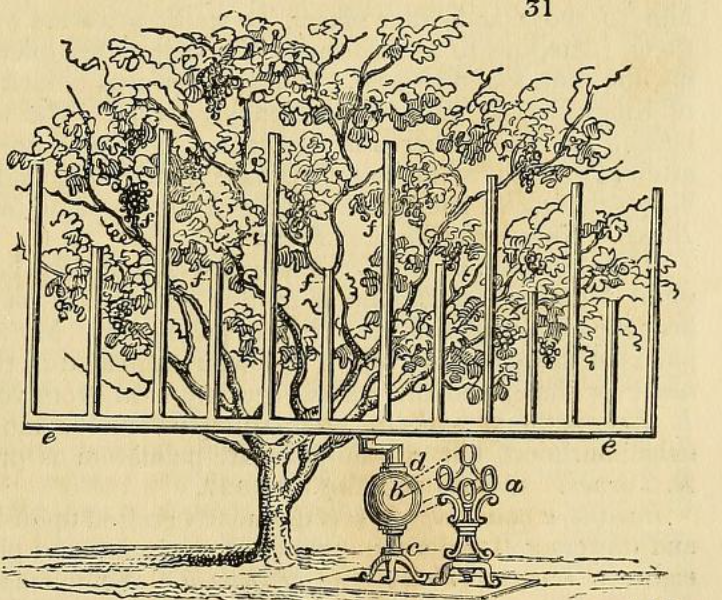
Robert Gauen & his ingenious horticultural inventions No.2

From The Gardeners magazine, September 1829

From The Gardener’s Magazine, September 1829

Earlier this year ago I shared the secrets of a machine for putting the bloom back onto cucumber, grapes and other fruits. It was one of the products of the fertile imagination of Robert Gauen, an early 19th Southampton nurseryman.

To catch up on that post see:

Robert Gauen & his ingenious horticultural inventions No.1

In this post I’m going to take a brief look at two more of Gauen’s inventions, and apologies in advance that there aren’t as many colourful images as usual.

So…any guesses as to what this strange looking device this might be?

Read on to find out more…. Continue reading

Posted in Uncategorized | Tagged , , , , , , , | Leave a comment

James Carter conquers the world

From Carter's 1909 catalogue

From Carter’s 1909 catalogue

Wherever you live in the world if you are a gardener ‘of a certain age’ then you’re bound to remember Carters Tested Seeds. They were one of the great horticultural institutions of the 19th and 20th centuries. But where are they now?

When I was a child and first learning about gardening my grandparents had an allotment where I was allowed a little patch of ground on which to grow plants.

From Carter's 1909 catalogue

From Carter’s 1909 catalogue

We would go to the local seedsman and nursery sundries shop – Roses in Farnham  – and choose a few packets from the colourful display of Carters seeds.  If we went to London by train we would travel past their nursery and trial grounds on the south western outskirts so it was very sad when, in the late 60s and I had begun commuting,  that these were sold off and built over, and Carters seemed to vanish.

From Carter's 1909 catalogue

From Carter’s 1909 catalogue

Of course the company didn’t disappear completely, as you will see, but I was reminded of Carters a few months back when when writing a post about sweet peas. [Catch up on that at   http://wp.me/p4brf0-vyp]  That’s  because the founder of the firm, James Carter seems to have been a pioneer in hybridizing them to sell from his shop on High Holborn.

It made me investigate a little further, so read on to find out more about the rise and rise and then the Cheshire-Cat-like disappearance of this pioneering and iconic firm of seedsmen . Continue reading

Posted in Uncategorized | Tagged , , | 2 Comments