Sir Nathaniel Bacon, his kitchen garden and his cookmaid


xxxx

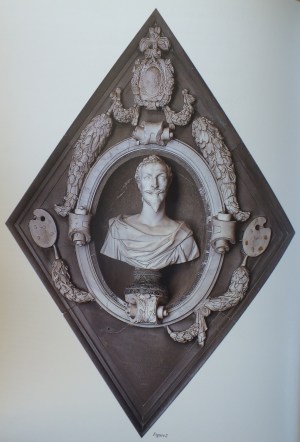
Bacon’s memorial in Culford Church, Suffolk, image from Karen Hearn, Nathaniel Bacon, Full reference at the end of the post.

The Latin epitaph on this marble funerary monument translates as “Look Traveller, this is the monument of Nathaniel Bacon, A Knight of the Bath, whom, when experience and observation had made him most knowledgeable in the history of plants, astonishingly Nature alone taught him through his experiments with the brush to conquer Nature by Art. You have seen enough. Farewell.”

Erected in the church at Culford in Suffolk  after Bacon’s death in July 1627 the monument is, according to Karen Hearn, former Curator of 16th and 17th century art at the Tate, “cutting edge in artistic terms. It is equally significant  for garden historians because it commemorates not just the life of a prominent country gentleman,  but also a pioneer artist and horticulturist.  You may well never have heard of Nathaniel Bacon, and you are unlikely to  have ever seen any of his pictures unless you have noticed the one the Tate acquired 20 years ago but that doesn’t diminish his importance. And as you will see  although  he’s an elusive figure  he’s definitely one worth discovering….

Bacon's signature from Essex Record Office D/DByC15, fol..116

Bacon’s signature from Essex Record Office D/DByC15, fol..116
Continue reading

Posted in Uncategorized | Tagged , , , , , , , , , , , , | Leave a comment

The Rev Ditchfield & another view of Capability Brown

screenshot

from The Cottages and Village Life of Rural England, 1912

Today is a post about the  author or editor of around 100 books and articles, who, in the fine tradition of this blog, has partly been chosen because you won’t have heard of him!  He’s also another in the line of gardening clergymen who seemed so prominent in the later 19th and early 20th centuries.

The Rev Peter Hampson Ditchfield was a historian and antiquarian rather than a garden writer but several of his books cover gardens in some depth, particularly those of the manor houses and villages of southern England, including Berkshire where he was a parish priest for 44 years.

screenshot

from The Cottages and Village Life of Rural England, 1912

He writes, even in the early 20thc, in a rather nostalgic way about what has been lost because of ‘modernity’ but I decided to research him a bit further when I read his rather trenchant views on Capability Brown….

So read on to find what they were, and to discover a little more about rural gardens of all kinds a hundred or so years ago…. Continue reading

Posted in Uncategorized | Tagged | Leave a comment

Fishing Temples 2: the 18th century

detail from 'Pisho Bury' by Jan Drapentier in Henry Chauncy's Historical Antiquities of Hertfordshire, 1700 'http://www.furneuxantiquemaps.com

detail from ‘Pisho Bury’ by Jan Drapentier in Henry Chauncy’s Historical Antiquities of Hertfordshire, 1700 ‘http://www.furneuxantiquemaps.com

Last week’s post was about the earliest surviving garden buildings designed for fishing which dated from the 16th and 17thc. After I’d published it I realised that I’d missed out some tiny but atmospheric details from some plates by Jan Drapentier for Henry Chauncy’s Historical Antiquities of Hertfordshire, published in 1700.

detail from 'Pisho Bury' by Jan Drapentier in Henry Chauncy's Historical Antiquities of Hertfordshire, 1700 'http://www.furneuxantiquemaps.com

detail from ‘Pisho Bury’ by Jan Drapentier in Henry Chauncy’s Historical Antiquities of Hertfordshire, 1700 ‘http://www.furneuxantiquemaps.com

The quality isn’t brilliant but I thought  I’d include a couple in this post before going on to  show how  as the 18th century progressed fishing temples became more sophisticated, often doubling up as boathouses or places to eat.  Perhaps this is associated with the shift from formal gardens to designing the  landscape in a new way, and particularly with an increasing emphasis on the importance of water.

detail from 'Little Offley' by Jan Drapentier in Henry Chauncy's Historical Antiquities of Hertfordshire, 1700 'http://www.furneuxantiquemaps.com

detail from ‘Little Offley’ by Jan Drapentier in Henry Chauncy’s Historical Antiquities of Hertfordshire, 1700 ‘http://www.furneuxantiquemaps.com

Tiny detail from Bedwell Parke, by Jan Drapentier in Henry Chauncy's Historical Antiquities of Hertfordshire, 1700

Detail from ‘Bedwell Parke’, by Jan Drapentier in Henry Chauncy’s Historical Antiquities of Hertfordshire, 1700

Whatever the reason the result is a collection of amazing garden and landscape buildings. So read on to find out more about some of them. Continue reading

Posted in Uncategorized | Tagged , , , | Leave a comment

Fishing Temples 1 : the earliest survivals

Charles Cotton's Fishing Temple in Dovedale, Derbyshire http://images.google.fr/imgres?imgurl=https%3A%2F%2Ftheincompleatangler.files.wordpress.com%2F2014%2F07%2Ftempblog1.jpg&imgrefurl=https%3A%2F%2Fincompleatangler.com%2Ftag%2Ftemple%2F&h=951&w=713&tbnid=zt5AYZkoMLImJM%3A&docid=n46J805cY046bM&itg=1&ei=DOmmV4aPEMKqa4mAo7AN&tbm=isch&client=safari&iact=rc&uact=3&dur=628&page=2&start=15&ndsp=25&ved=0ahUKEwiGxZ3M6a7OAhVC1RoKHQnACNYQMwhIKBQwFA&bih=601&biw=1215

Charles Cotton’s Fishing Temple in Dovedale, Derbyshire
https://incompleatangler.com/tag/temple/

Its August and I’ve been sitting admiring my lake – how’s that for showing off?  It’s about an acre in extent and stuffed full of hideous fat carp.  It’s an attraction for local fishermen and there’s often one sitting on the bank although they hardly ever catch anything and when they do they put them back. Being vegetarian I have no interest in catching fish at all  and I’m happy to just sit and look at the water and all the waterlilies we’ve planted. But lovely tho’ my lake is, I was a little envious  of a little riverside lodge in Dovedale, which was up for sale recently.   Built in 1674 in honour of his friend Isaak Walton author of The Compleat Angler, Charles Cotton’s one-roomed fishing temple looks a rather nice place to sit and contemplate, as does Bourne Mill near Colchester

so even tho I don’t fish, and don’t even understand why anyone would want to do it, this is the first of a few posts dedicated to fishing temples and lodges. Today’s looks at the few survivors from the 16th and 17th centuries. Continue reading

Posted in Uncategorized | Tagged , , , , , , | Leave a comment

Welwitschia mirabilis: “the ugliest plant in creation”?

Life on a welwitschia mirabilis plant in the Namib Desert, David Marsh, Feb 2016

Life on a Welwitschia mirabilis plant                        in the Namib Desert, David Marsh, Feb 2016

What a mouthful that is! Even worse when you realise it’s the Latin name of a bizarre plant ‘discovered’ by a man born in the Austrian Empire of Slovak origin, who worked for the Portuguese monarchy in one of their African colonies and ended up being buried in London.

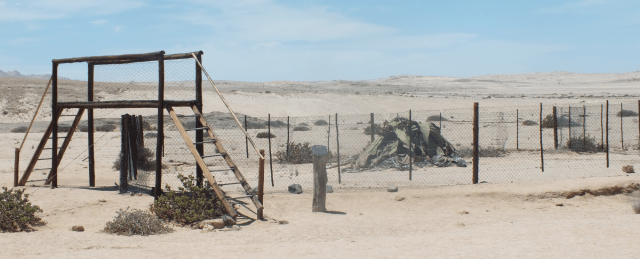
Actually bizarre is a bit of an understatement: how many plants do you know that only have two leaves, live on fog and sometimes have to be kept in a cage!

The caged welwitschia, David Marsh, Feb 2016

The caged Welwitschia, David Marsh, Feb 2016

OK I admit that’s a bit of a cheat because, like the Wollemi pine, it’s to protect the plant from humans rather than the other way around!

But why am I writing about Welwitschia on a blog about Britain’s parks and gardens? Read on to find out…

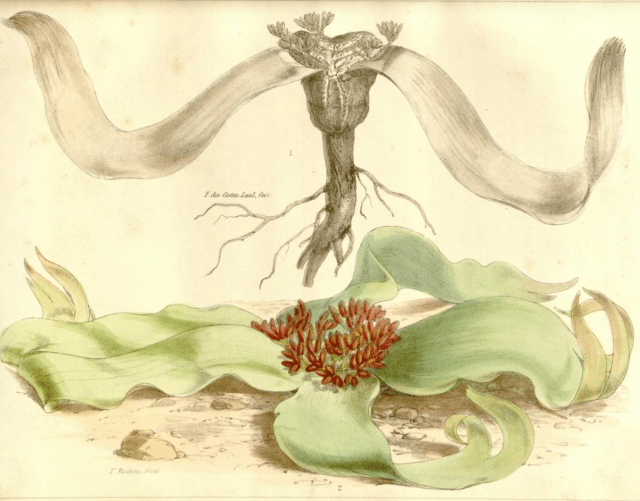
Weltwischia from a pianting by Baines, in Transactions of the Linnean Society, 1863

Welwitschia from a painting by Thomas Baines, in Transactions of the Linnean Society, 1863

Continue reading

Posted in Uncategorized | Tagged , , | Leave a comment