The catalogues of Robert Furber


deatil from March in RObert Furber's TwelveMonths of Flowers, 1730

detail from March in Robert Furber’s Twelve Months of Flowers, 1730

Growing ornamental plants for sale  really only emerged as a trade separate from other forms of commercial gardening towards the end of the 17th. A few of these early nurserymen issued catalogues, but the whole trade moved to a different level in the early 18thc when Robert Furber appeared on the scene.  Born in 1674 he was only in his 20s when he established his nursery business in Kensington near Hyde Park Gate and Kensington Gore. Despite this precociousness he would probably only have been a footnote in the history of gardening if it hadn’t been for the plant catalogues he issued later in life.

deatil from xxxx in Robert Frurber's Twelve months of Fruit, 1732

detail from Robert Furber’s Twelve months of Fruit, 1732
Continue reading

Posted in Uncategorized | Tagged , , , , , | 4 Comments

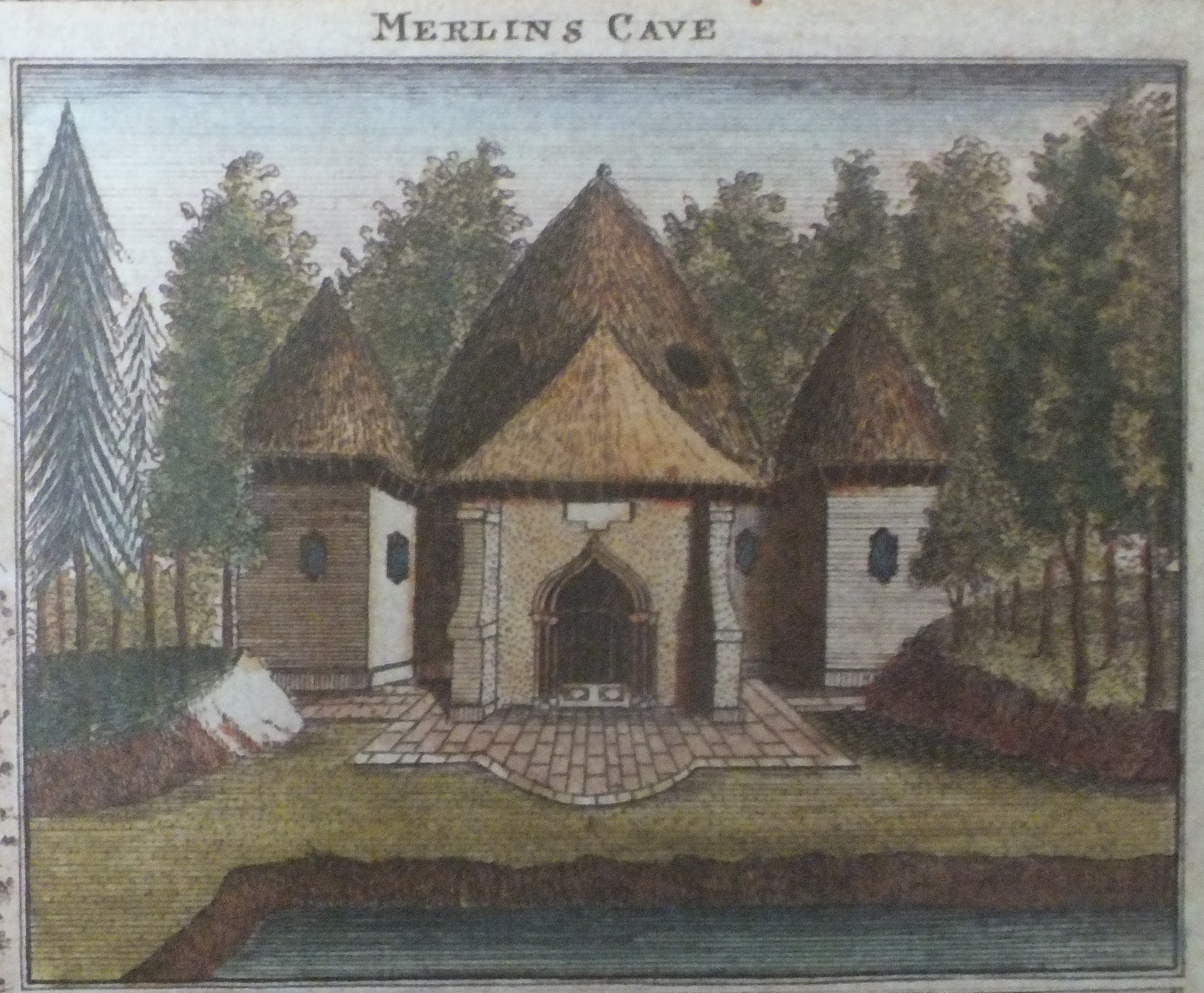
Queen Caroline & Merlin’s Cave

DSCF9630

Merlin’s Cave from John Rocque’s Plan of the Royal Gardens, 1754

In her 2010 book Courtiers: The Secret History of the Georgian Court, Lucy Worsley called Caroline  “the cleverest queen consort ever to sit on the throne of England”. Last week’s post about her Hermitage at Richmond was quite serious, dealing with religious and political controversy as much as garden architecture.  But there was another side to this intelligent and enlightened woman.

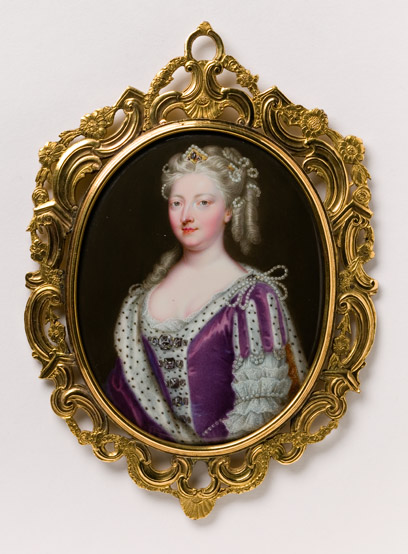
Queen Caroline Enamel on copper in gold frame with ivory backing Christian Friedrich Zincke (about 1683-1767) England About 1732, V&A

Queen Caroline
Christian Friedrich Zincke 
c.1732, V&A

Caroline’s next venture at Richmond was  altogether more amusing, although perhaps it was not meant to be. It shows not only William Kent in a playful mood but also that  the Queen was a well informed publicist of her own opinions.

This time it was not religion that set the tone but  patriotic fervour and the rediscovery of national history through ancient heroes and heroines,  and in particular the Whig association of the legendary King Arthur with England’s ancient liberty. And all to help embed the Hanoverians firmly in the national consciousness as English rather than German.

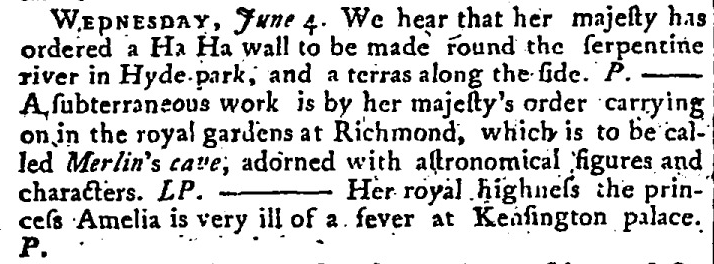
The unlikely story begins, on 5th June 1735, with a paragraph in several news-sheets:

Grub Street Journal  Thursday, June 5, 1735

Grub Street Journal 
Thursday, June 5, 1735


Read on to find out more about this early 18thc press release , just one of many snippets of news that appeared in contemporary newspapers and magazines about Queen Caroline’s strangest garden building: Merlin’s Cave. Continue reading

Posted in Uncategorized | Tagged , , , , | 2 Comments

Queen Caroline & her Hermitage

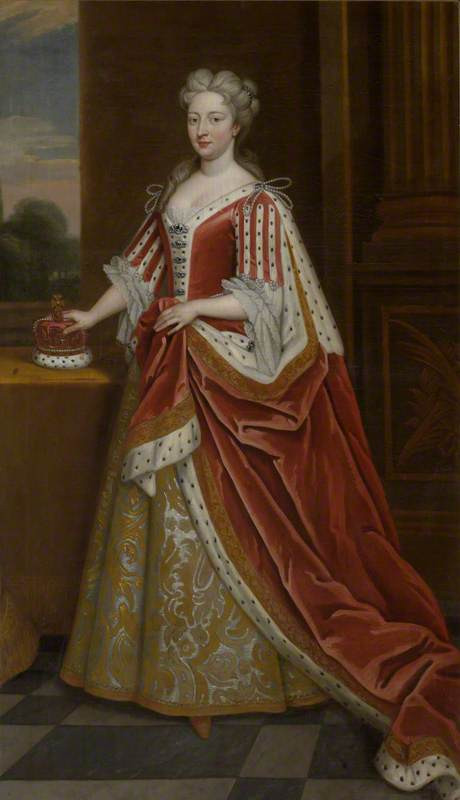
Queen Caroline of Brandenburg Ansbach (1683–1737), as Princess of Wales by Godfrey Kneller(c) National Trust, Oxburgh Hall; Supplied by The Public Catalogue Foundation

Caroline of Ansbach (1683–1737), as Princess of Wales
by Godfrey Kneller(c) National Trust, Oxburgh Hall;

In the 1720s and 1730s the gardens at Richmond Lodge (now part of Kew Gardens)were the “special domain” and “spiritual oasis” of a remarkable and underestimated woman who created a carefully staged landscape that was renowned throughout the country and indeed abroad.   Although much of her work was swept away by Capability Brown a few decades later her innovation in English garden making should not be overlooked. The woman was Caroline of Ansbach, wife of George II.

detail from Revised design for Queen Caroline's Hermitage in Richmond Gardens, William Kent Sir John Soane's Museum

detail from “Revised design for Queen Caroline’s Hermitage in Richmond Gardens”, by William Kent
Sir John Soane’s Museum


Read on to find out more about one of the garden buildings that she had constructed in the royal gardens there: the Hermitage  Continue reading

Posted in Uncategorized | Tagged , , , , , , , , | 3 Comments

Dr Stukeley & the Druids


'An Arch Druid in His Judicial Habit', from "The Costume of the Original Inhabitants of the British Islands" by S.R. Meyrick and C.H. Smith (1815)

‘An Arch Druid in His Judicial Habit’, from “The Costume of the Original Inhabitants of the British Islands” by S.R. Meyrick and C.H. Smith (1815)

HAPPY NEW YEAR!

Believe it or not this is my 100th post – and coincides nicely with the end of  my second year writing this blog. Suitably for the time of year  its the second one about mistletoe, following on from last week’s discussion about sacred groves, and this time exploring the Druid connection.

Despite images like this, or pagan festivals celebrating summer solstices at Stonehenge, or bards reciting at eisteddfods, the place of Druids in our national history is surprisingly recent.mistletoe

The link between mistletoe, sacred groves and the Druids actually begins in the 1stc AD with writings of Pliny the Elder, and Tacitus but it doesn’t really begin to affect our national consciousness until the 16thc.  After that the boundary between fact, conjecture and invention is blurred. Myth begins to pile upon myth and legend upon legend until eventually in the 18thc the story of the Druids develops a life of its own with the ‘discovery’ of archaeology.  From then on the story takes a romantic faux historical twist and becomes even more difficult to distinguish fact from fiction. But read on and I’ll try…. Continue reading

Posted in Uncategorized | Tagged , , , , | Leave a comment

Christmas & Birthday Quiz

mistletoeHappy Christmas!

It’s also two years since I started writing this blog, and I seem to have settled into a comfortable pattern of posting early on Saturday mornings. Some readers have obviously got used to that because I’ve had emails, if for any reason I’m a bit later than 9.00, enquiring what’s happened to their weekly garden history fix!  So the fact that its Boxing Day would not be considered an excuse for missing a week or even for being a minute or two late. mistletoe

Although there are only 105 ‘followers’ who receive each post in their email, readership is now running at around 500 a week with occasional spikes when a post gets picked up and circulated by other groups on Facebook or Twitter etc.  mistletoeOverall readership for 2015 should reach 25,000 ‘hits’ by the end of the year  [its 24,707 as I write] – compared with 6,900 for 2014.  That’s from just over 10,000 visitors compared with 2,890 in 2014.     So thank you to everyone who has been reading the posts, telling their friends and passing the blog on.  Please keep up the enthusiasm and the comments.

And now, in the post-Christmas lull, you can test your memory of things the blog has covered this year…

"My Mistletoe Memories." Illustrated London News [London, England] 20 Dec. 1851: n.p. Illustrated London News. Web. 23 Nov. 2015.

“My Mistletoe Memories.” Illustrated London News [London, England] 20 Dec. 1851: n.p. Illustrated London News. Web. 23 Nov. 2015.

Continue reading

Posted in Uncategorized | Leave a comment