The Golden Bough

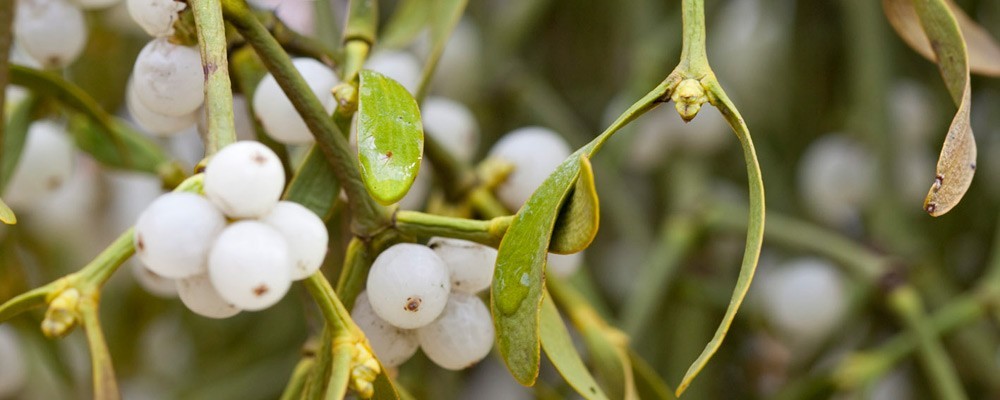
Week-51-10-viscum-album-1000px
mistletoeChristmas wouldn’t be Christmas without Mistletoe would it?

So this is the first of a couple of posts about this  mystical  plant and the traditions surrounding it which are, according to Richard Mabey, ” amongst Northern Europe’s last surviving remnants of Plant Magic”.  mistletoeWhen you see  mistletoe silhouetted against the fading light at the end of a long winter’s day it’s quite easy to imagine how it acquired this reputation.      mistletoe

It is a plant without any obvious source of food, without roots, that grows way above the Earth but is not blown away by the wind, that stays green when its hosts have lost their leaves, and that seems capable of spontaneous reproduction and continuing life. It must have been an extraordinary sight to those without our knowledge of its botany and ecology.

And it has a part to play in our parks and gardens.

Read on to find out more….Week-51-10-viscum-album-1000px Continue reading
Posted in Uncategorized | Tagged , , , , , , , , , , , , | Leave a comment

The colour of carrots

The Carrot, Willem Frederik van Royen, 1699, Märkisches Museum, Berlin

The Carrot,
Willem Frederik van Royen,1699,
Märkisches Museum, Berlin

Monty Don has done it again. I write a post about scything and lawns and he demonstrates how to do it on The Secret History of the British Garden, then I began writing a post on Eleanor Coade and before I had time to finish Monty talked about her in the next programme.  Paxton was on my list too but he covered him this week so I can only assume he has a spy in my office!

So instead a post about carrots….

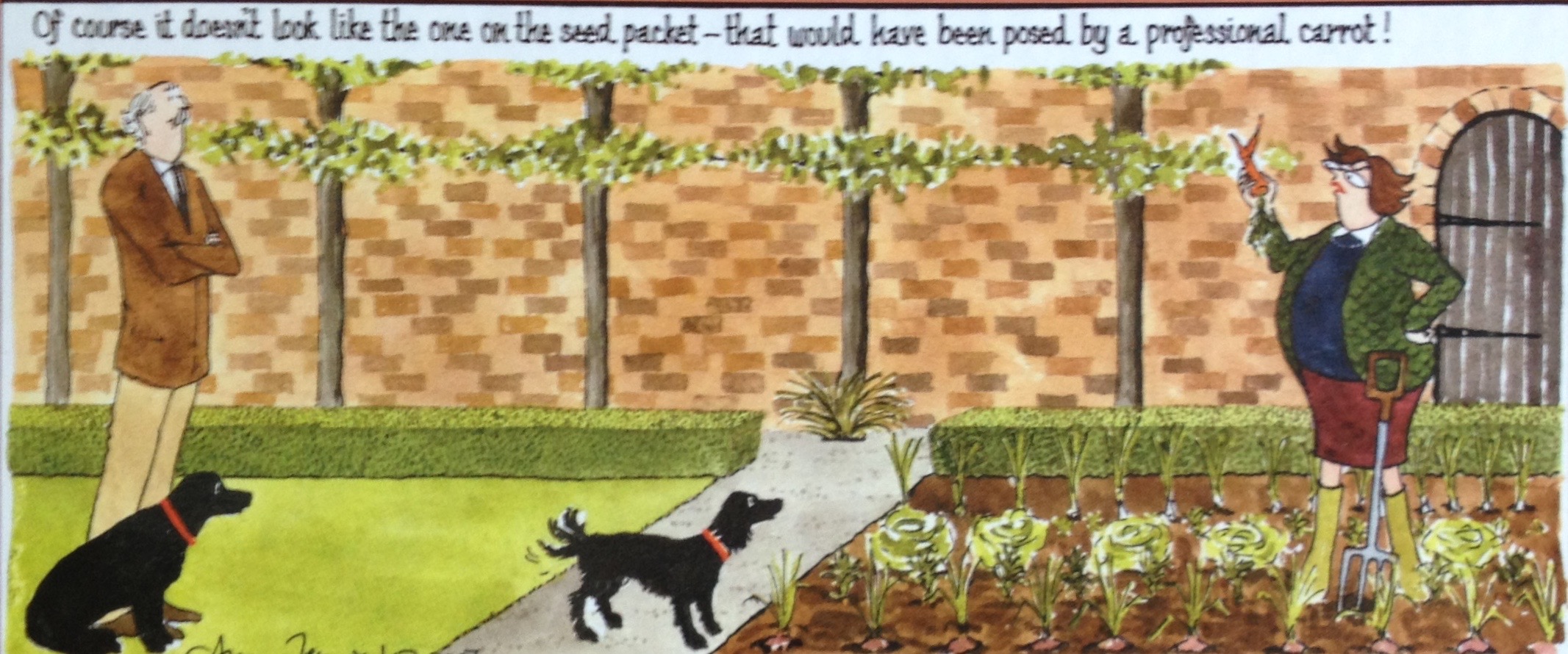
A whole post about those dull & tasteless orange roots? Why on earth would that be interesting? Well…. although it started as a bit of a joke, I discovered there’s a lot more  to the story of the carrot than you might imagine.  carrotsDo you know where they come from [apart from Sainsbury’s in a plastic bag], or how  and when they became  grown for food?  Or what colour they are naturally?  And did you know there is a carrot museum?  I certainly didn’t ….so to  get to the root of the colour of carrots… read on!

From Annie Tempest, In the Garden with the Totterings

From Annie Tempest, In the Garden with the Totterings

Continue reading

Posted in Uncategorized | Tagged , , , , , , , | 1 Comment

The faithful pencil of Mrs Withers

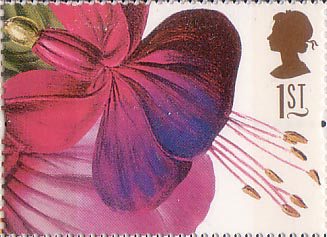
 Fuschia Princess of Wales (Augusta Withers) -http://www.collectgbstamps.co.uk

Fuchsia ‘Princess of Wales’, by Augusta Withers  one of the 1997 range of 19thc flower painting stamps                             http://www.collectgbstamps.co.uk

The more I explore botanic art the more I realise how underestimated it has been as an art form, and the more I realise how underestimated botanical artists have been.  Of course part of the reason for that may well have been that many, if not the overwhelming majority, have been women. 

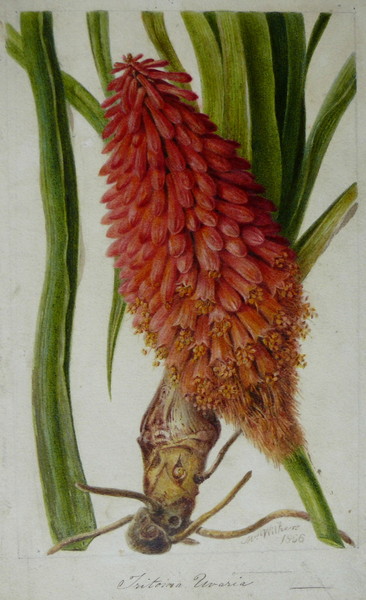
AUGUSTA INNES WITHERS (c.1793-1870) Tritoma Uvaria, Torch Lily or Red Hot Poker (1866English)

Tritoma uvaria, Torch Lily or Red Hot Poker (1866)

Our old friend John Claudius Loudon helps explain why: “to be able to draw Flowers botanically, and Fruit horticulturally, that is, with the characteristics by which varieties and sub varieties are distinguished, is one of the most useful accomplishments of young ladies of leisure, living in the country.” He then goes on: ” It is due to Mrs Withers of Grove Terrace, Lisson Grove, to state that her talents and teaching these objects are of the highest order.”   So who was this Mrs Withers?  What did she do to win Loudon’s praise? Why has she, like so many other  women artists of the time, virtually been forgotten?screenshot

Continue reading

Posted in Uncategorized | Tagged , , , , , , , , | 3 Comments

Snaths, nibs, chines & very sharp dengles…

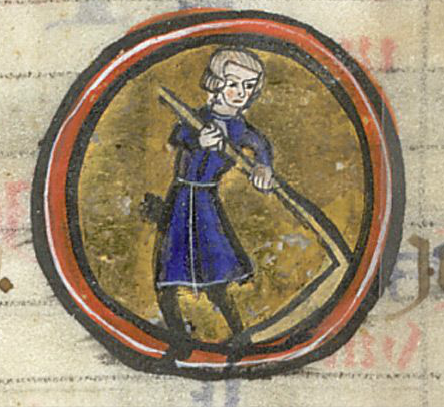
barthélemy l'anglais, de proprietatibus rerum 1480 BNF Ms Francais 9140

Barthelemy l’Anglais, de proprietatibus rerum 1480 BNF Ms Francais 9140

No, its not an extract from a Frankie Howard or Kenneth Williams script [giving my age away there] but something to do with the traditional centrepiece of most English gardens: the lawn.

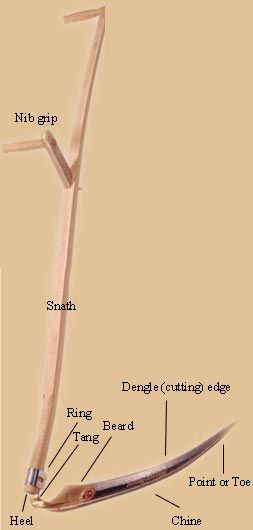
Nowadays its a relatively easy job to cut a lawn. We jump on our sit-on mower and ride up and down, or pull the rip-cord on the strimmer and stroll backwards and forwards until the job is done. But how were lawns managed in the days before such newfangled technology? The simple answer is either by grazing animals or by people holding nibs on the side of snaths [or sometimes sneads] which were fixed, by way of a tang, to a chine which had a very sharp dengle edge… or in plainer language… by scything.

You might assume that such a “primitive’ method of cutting meant lawns were relatively unkempt, with much longer grass compared with the close cropped stripey velvet look we are used to today. After all how surely a manually operated blade however sharp can’t compete with sophisticated machinery, but you’d probably be mistaken.

Where did the idea for having cut grass as part of the garden come from anyway? Read on to find out and to discover more about the ways in which the grass, lawns, turf, greensward and the sods in our gardens and parks were created and cared for in the past….

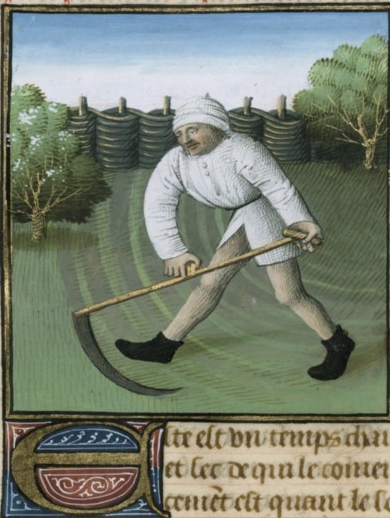
BNF Latin 12834, fol. 54v, Calendrier : juin

Bibliotheque National de France
Latin 12834, fol. 54v,


Continue reading

Posted in Uncategorized | Tagged , , , , , , , , , , | Leave a comment

Tyntesfield: the guano palace

A stylised Peruvian booby bird - one source of guano - froma window at Tyntesfield. [Lesley Kinsley, 2013 from http://animalhistorymuseum.org]

A stylised Peruvian booby bird – one source of guano – from a window at Tyntesfield.
http://animalhistorymuseum.org

My posts on nightsoil and guano [from July 2015,] got picked up by an article in the Guardian online – fame indeed! So here’s a postscript about the house paid for by the vast fortune made by William Gibbs, the owner of the monopoly on exporting these valuable bird droppings from Peru. As the ditty of the time had it:

William Gibbs made his dibs

From the turds of foreign birds

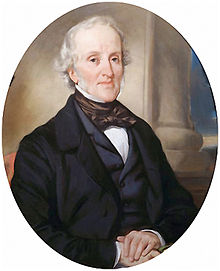
William Gibbs, by Eugene Deveria, 1850 Tyntesfiled, NT

William Gibbs, by Eugene Deveria, 1850
Tyntesfield, NT

Guano netted him an immense fortune and he was probably  the richest commoner in England. Like many self-made men he invested in landed property to establish himself in society, and in his case it was  an estate – Tyntes Place – just outside Bristol in 1843. Renamed Tyntesfield it was never his principal residence – the family lived mainly at Hyde Park Gate in London – but it served as his base when he came to Bristol on business, and for holidays.

Gibbs might have been super-rich but the  vast mansion  was expensive to maintain and within a hundred years was falling into disrepair, before eventually being bought by the National Trust at auction in 2002.  Read on to discover more…. Continue reading

Posted in Uncategorized | Tagged , , , , , | Leave a comment