John Soane, by Thomas Cooley, 1810 National Portrait Gallery
My favourite museum in the entire country is Sir John Soane’s in Lincolns Inn Fields in central London. Soane is amongst England’s greatest architects and his former home and museum, built between 1792 and 1824, is simply fabulous in the truest sense of the word.
Architectural historian Dan Cruikshank says: “It’s just tremendous – utterly individual and peculiar. It was shocking and inspirational. It is architecture of the highest genius. He reinvented the language of classical architecture.” [Independent, 14 February 2011].
Here is Soane himself presiding over the quirkiest collection of antiquities and paintings imaginable, housed in a sublime building that’s full of architectural innovations and surprises. So if you have never been GO NOW and become acquainted with Soane’s genius firsthand. But for all that praise I have never really associated Soane with gardens…. or rather, not until quite recently. Continue reading →
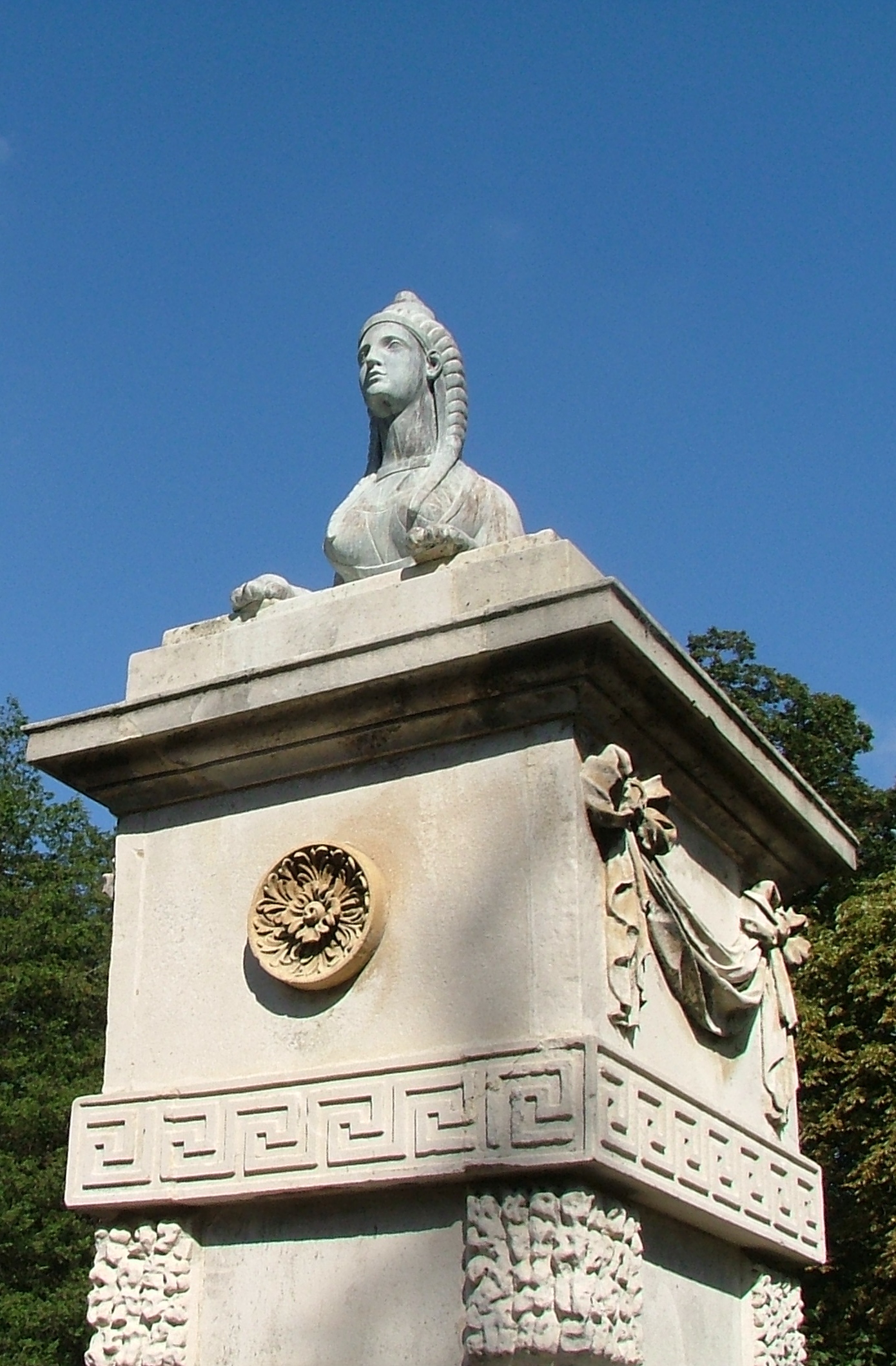
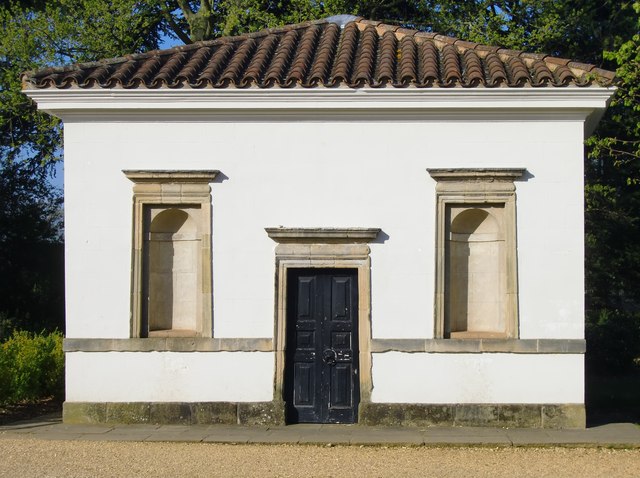
One of the important historic gardens in the world is at Chiswick House, Lord Burlington’s Palladian country retreat in west London. But while the house and grounds are extremely well-known I suspect most people still don’t know about the menagerie that was there in the early 19thc.
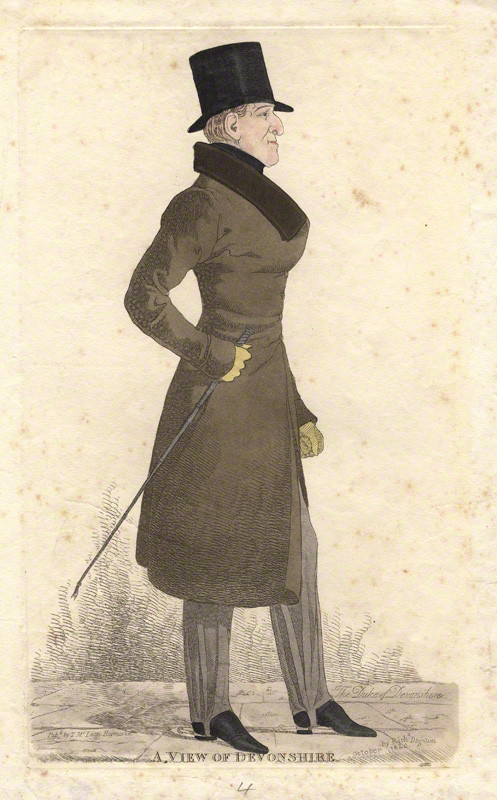
William Cavendish, 6th Duke of Devonshire by Richard Dighton, 1820, National Portrait Gallery
Lord Burlington may have exotic sphinx on his gateposts and designed a deer house, which is still there…
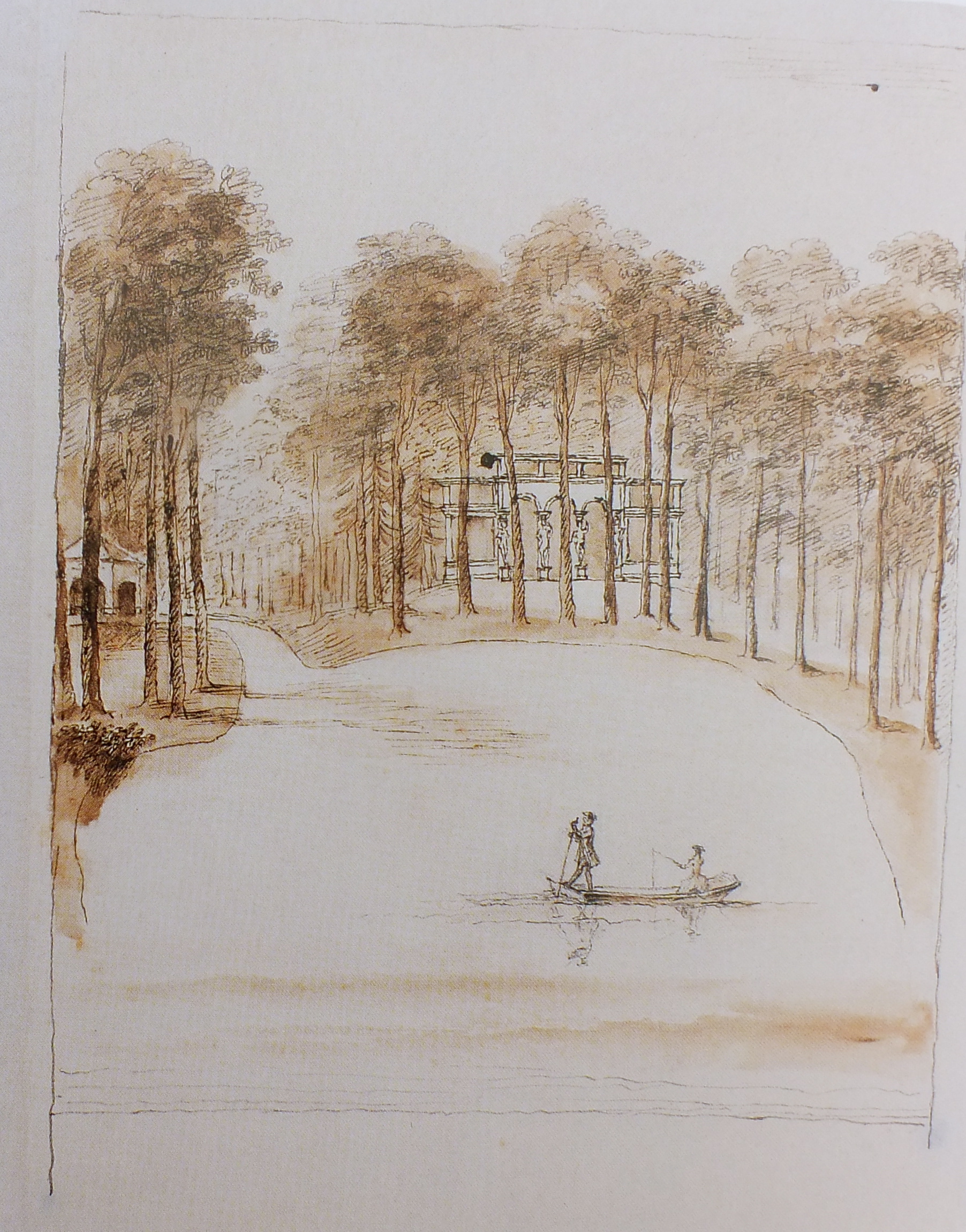
The Aviary at Chiswick, William Kent from John Harris, The Palladian Revival: Lord Burlington, his Villa and Garden at Chiswick (1994)
… and like many of his contemporaries he may also had an aviary full of exotic species, but his descendant, the 5th Duke of Devonshire went one better. He kept an elephant and four giraffes in his garden! Continue reading →
Roy Plomley, the creator/presenter of Desert Island Discs
What on earth is the connection between historic parks and gardens and Desert Island Discs? Until I starting researching Mr Middleton [see my last post] I wouldn’t have thought there was one BUT Mr Middleton was castaway by Roy Plomley on 16th November 1943, the first gardener to be exiled to the famous desert island.
So as it’s the summer silly season I thought I’d investigate horticultural Robinson Crusoes.
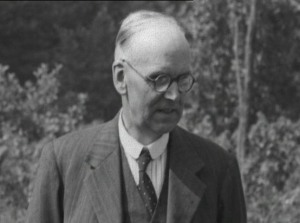
Cecil Henry Middleton, usually known as Mr Middleton, the first TV gardener, BBC
Sadly almost none of the earliest broadcasts of the programme were archived, and most of those that were recorded did not include the music, although the playlists are available. Mr Middleton’s choice of music was eclectic to put it mildly.
He chose the band of the Grenadier Guards playing “In a Monastery Garden” and Franz von Suppe’s Poet and Peasant Overture. There was the BBC symphony chorus singing “Dear Old Home Songs” which I can’t track down precisely [so if you think know then please tell me]. Then came the barcarolle from Offenbach’s The Tales of Hoffman and on a lighter note Malcolm McEachern singing “Drinking”
and his final choice was Albert Richardson’s comic song The Old Sow….
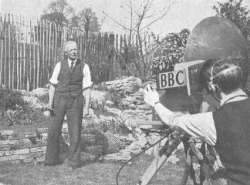
Fred Streeter in the demonstration garden at Alexandra Palace. BBC
So who else has been on Desert island Discs? And what are their musical tastes?
Surprsingly it was nearly 14 years before the next gardener, Fred Streeter, made it ashore after his shipwreck! In his interview he reminisced about his career on country estate gardens, including standing in one garden where he worked listening enthralled to Adelina Patti singing opera in the drawing room.
In 1926 Streeter was invited by Lord Leconfield to become head gardener at Petworth House and he continued to work there as a hands-on gardener whilst he also pursued his broadcasting career. Indeed he remained at Petworth for the rest of his life. It’s worth listening to the surviving audio clip of the programme, even without the musical choices, just for his comments about wages and staff levels there, and in the others gardens he had worked in, all delivered with a soft Sussex accent. And, of course, he mentions Mr Middleton who first invited him to broadcast. Streeter was later to take over many of Middleton’s roles on radio and TV. Most of his music choices were parlour and theatre songs including, like Middleton, In a Monastery Garden. His luxury was a greenhouse in order to grow orchids to make his fellow gardeners jealous. You can hear his interview at:
Roy Hay and Frances Perry “Picture Gallery.” Times [London, England] 28 July 1977: 16. The Times Digital Archive.
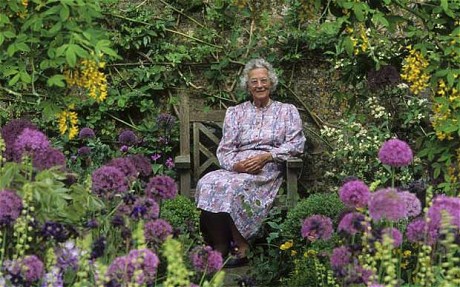
The 1960s saw five more gardeners ending up alone on the desert island, although sadly none of the recordings have survived. Roy Hay, broadcaster and gardening correspondent for The Times, chose more parlour songs as well as classical music such as Chopin. His wife, Frances Perry, who was castaway in 1980 had very different tastes, and included a recording of Galapagos Sea Lions. Born in Enfield on the northern edge of London she had been fascinated by plants and gardens ever since she was 18 months old and she “fell head first into a tub of liquid manure”. She became the protegee of the great plantsman E.A.Bowles who lived nearby at Middleton House. Nothing could be further from the rural idyll than Enfield now, but in Frances Perry’s childhood it was still a place of meadows and open spaces. She picked wild flowers there which Bowles helped her to identify. ‘I look upon you as one of my boys,’ he said. [Obituary, The Independent, 15th October 1993] After he died in 1954 and the gardens were transferred to the London School of Pharmacy she chaired the Garden Advisory Committee.
“Mrs Frances Perry on RHS council.” Times [London, England] 21 Feb. 1968: 12. The Times Digital Archive
Perry also took a great interest in Capel Manor which was near her Enfield home. She helped rescue the estate from neglect, and then supported the horticultural college from its foundation until her death in 1993. She was a prolific author, the first woman on the council of the RHS and their first woman vice-president. Her interview provides a good insight into the depths of the inbuilt gender stereotyping prevalent in horticulture of the time.
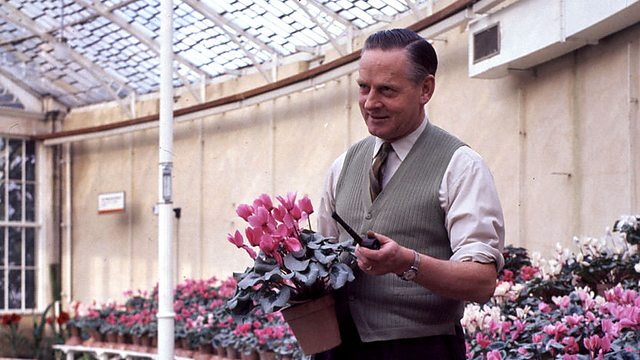
Percy Thrower BBC
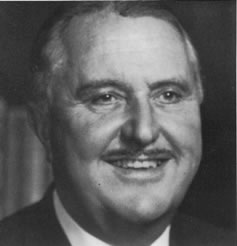
Other horticultural castaways in the 1960s included Percy Thrower whose favourite music was the Skaters Waltz, and Harry Wheatcroft, the flamboyant and mustachioed rose-grower. He chose well-known classical pieces & appropriately a song called “The English Rose”.
Next was Dr W.E.Shewell-Cooper, another prolific author, pioneer of no-digging gardening and founder of the Good Gardening Association. who included a nice piece of horticultural humour: Flanders and Swann’s song Misalliance about the love between the honeysuckle and the bindweed. Unfortunately it’s not possible for copyright reasons to include film footage of Flanders and Swann themselves but there is an amateur recording available if you want to know why the romance of the lonicera and the convulvulus was doomed from the start.
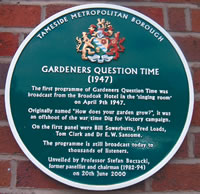
In 1967 it was the turn of Xenia Field, the gardening correspondent of the Daily Mirror, and in 1973 of Bill Sowerbutts who provided another link to Mr Middleton. Sowerbutts had started broadcasting in 1945 with twenty minutes talks usually about food crops, following in Middleton’s footsteps. In 1947 he went on to appear in the first edition of ‘How does your garden grow?’, soon to be renamed ‘Gardener’s Question Time’, which was another offshoot of the Dig for Victory campaign. Always introduced as “Bill Sowerbuuts of Ashton-under-Lyne” he remained a stalwart of the programme until 1983 when he retired. Asked about his favourite flower he replied: “the cauliflower because its the only that makes you any money”. Very little of his interview with Roy Plomley interview survives but in between a wide range of classical pieces he reminisced about his career and the decline of allotments and vegetable growing:
Tameside Council have put up a “Blue Plaque” in his honour on the Broadoak Hotel – however because of his gardening prowess it is green!
Graham Thomas followed with a wonderful range of early music in 1975 but his interview too has been lost. However, from then on full recordings of all the garden-related interviewees are available to download from the Desert Island Discs webpage.
There was a long gap of another 14 years before Rosemary Verey was shipwrecked in 1994, but within a few months she was joined by Penelope Hobhouse. Since then Geoffrey Smith, Christopher Lloyd, Susana Lloyd, Alan Titchmarsh, Anne Scott James and, last but not least, in 2006, Monty Don have been washed ashore. Incidentally it would appear that gardeners are fairly conservative musically since Monty was the only one to choose “pop” music.
You can find a full list of castaways – all 2992 of them at the last count – on the programme’s website, and it can be searched in all sorts of ways, including by occupation.
But the BBC’s decision about how to classify its interviewees isn’t always straightforward. Some famous gardeners like Germaine Greer, Beverley Nicholls, the Duchess of Devonshire, Peter Carrington, or Roy Strong are not listed as that although it’s true they probably more famous for doing other things, whereas they have included Anne Scott-James and Susana Walton. And aren’t there some great gardeners they have ignored? What about hearing from Beth Chatto? David Austin? Fergus Garrett? Nigel Colborn? Bob Flowerdew? Arabella Lennox-Boyd? Pippa Greenwood? Sarah Raven? Mary Keene? Ann Swithinbank? Robin Lane Fox? Noel Kingsbury? Mirabel Osler? Anna Pavord? or even the Chair of Parks and Gardens UK, Barbara Simms? The list is almost endless.
Rembrandt’s Hendrickje Bathing, National Gallery
And to finish on a questioning note.
Which gardening celebrity wanted to take The Education of a Gardener by Russell Page as their book?
Whose favourite track was of the dawn chorus?
Who chose Rembrandt’s painting of Hendrickje Bathing as their luxury item?
And finally who, perhaps more sensibly, asked for a bundle of prunings from a good vineyard so they could plant their own vines?
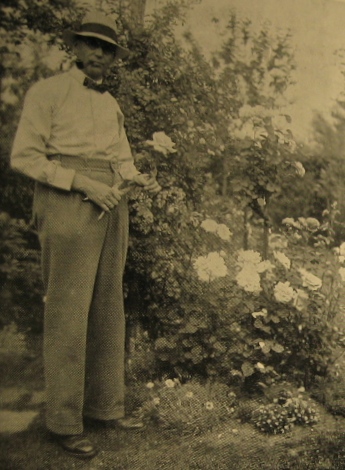
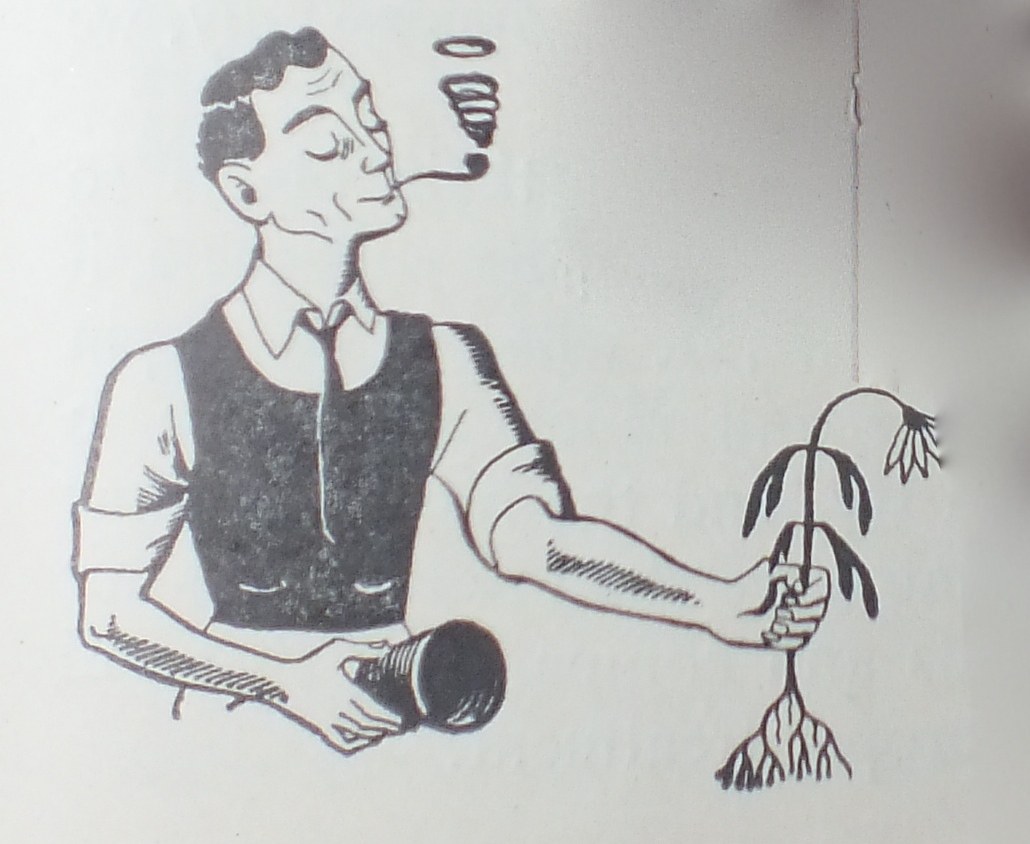
Mr Middleton in his garden, from “Mr Middleton Talks about Gardening”, 1935
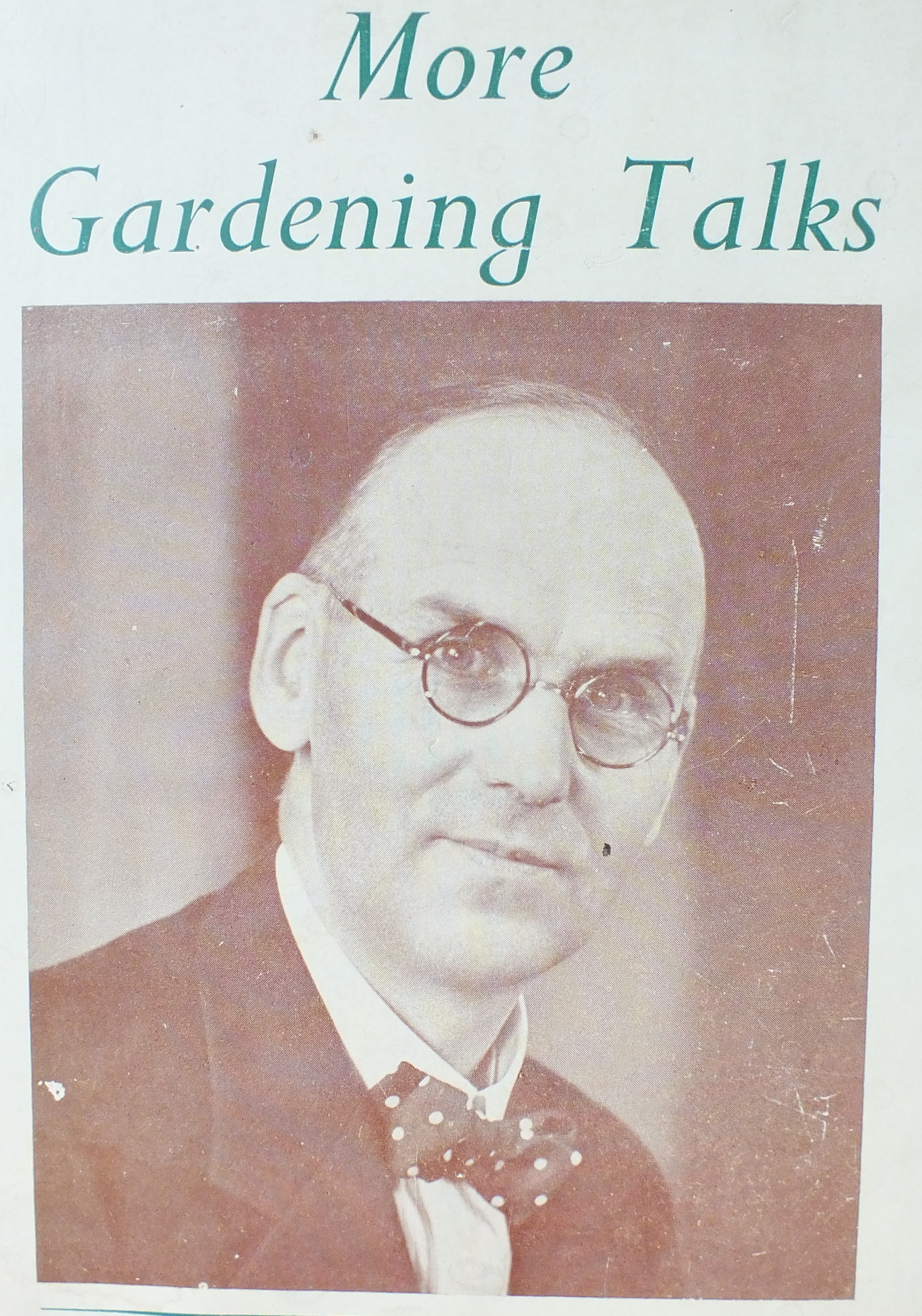
We’re all used to seeing gardening programmes on the TV these days, hosted by an array of “celebrity” TV gardeners but I bet most of us won’t know who the first TV gardener was. And even when I tell you, you probably won’t know much about him even if you have heard his name….. and no it’s not Percy Thrower which is what people seem to think but a man named Cecil Middleton, usually referred to as just “Mr Middleton”.
Cecil Henry Middleton was born in 1886 on the Weston Hall estate in Northamptonshire where his father was gardener to Sir George Sitwell, father of Osbert, Edith and Sachaverell.
According to the publishers blurb in his “Outlines of a Small Garden” published originally in 1934, he “spent his boyhood in greenhouses and potting sheds” until he was 17 when he enrolled as a student at Kew.
[Incidentally if anyone knows anything about the gardens of Weston Hall then do get in touch as we don’t have an entry for it in our database.]
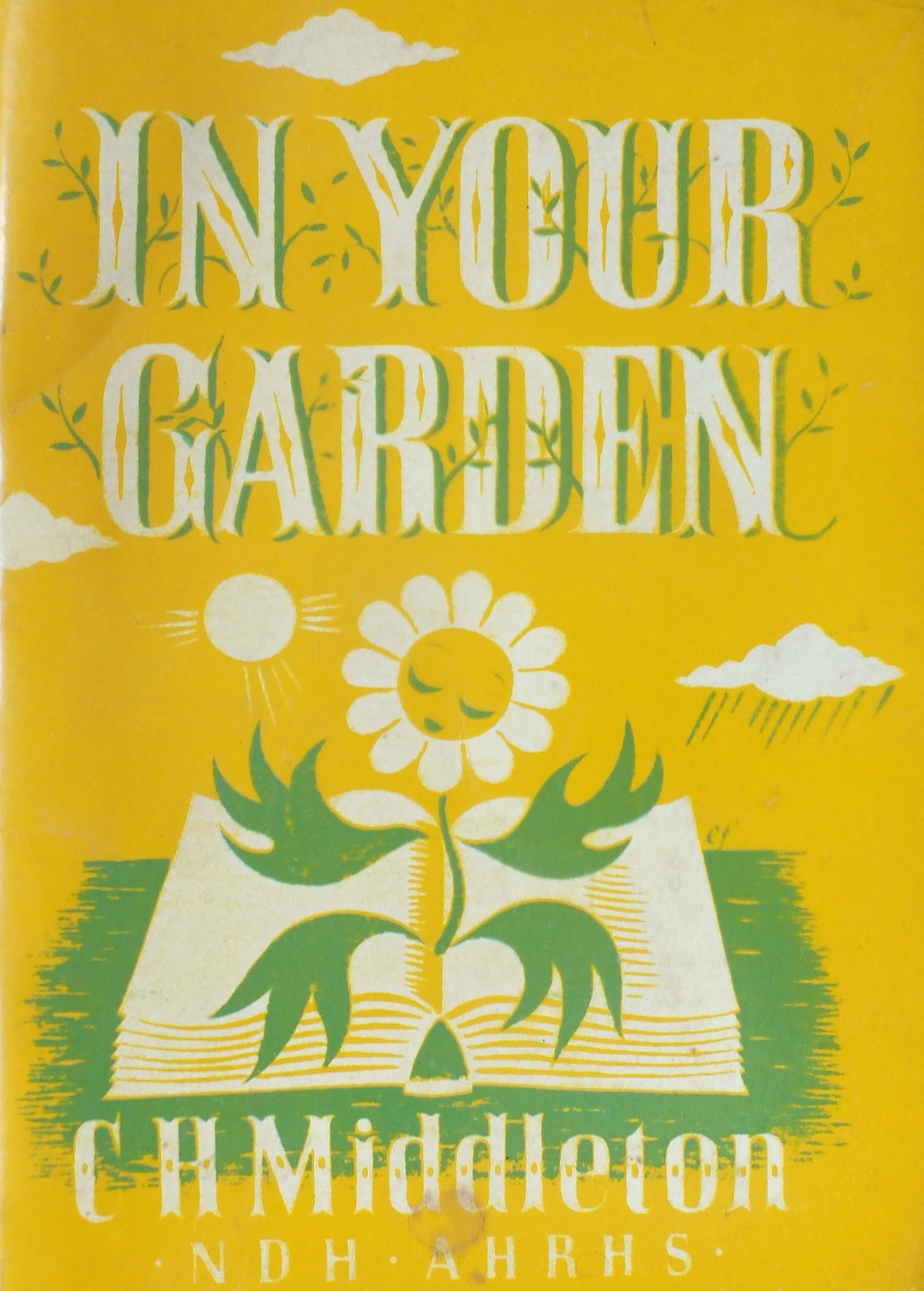
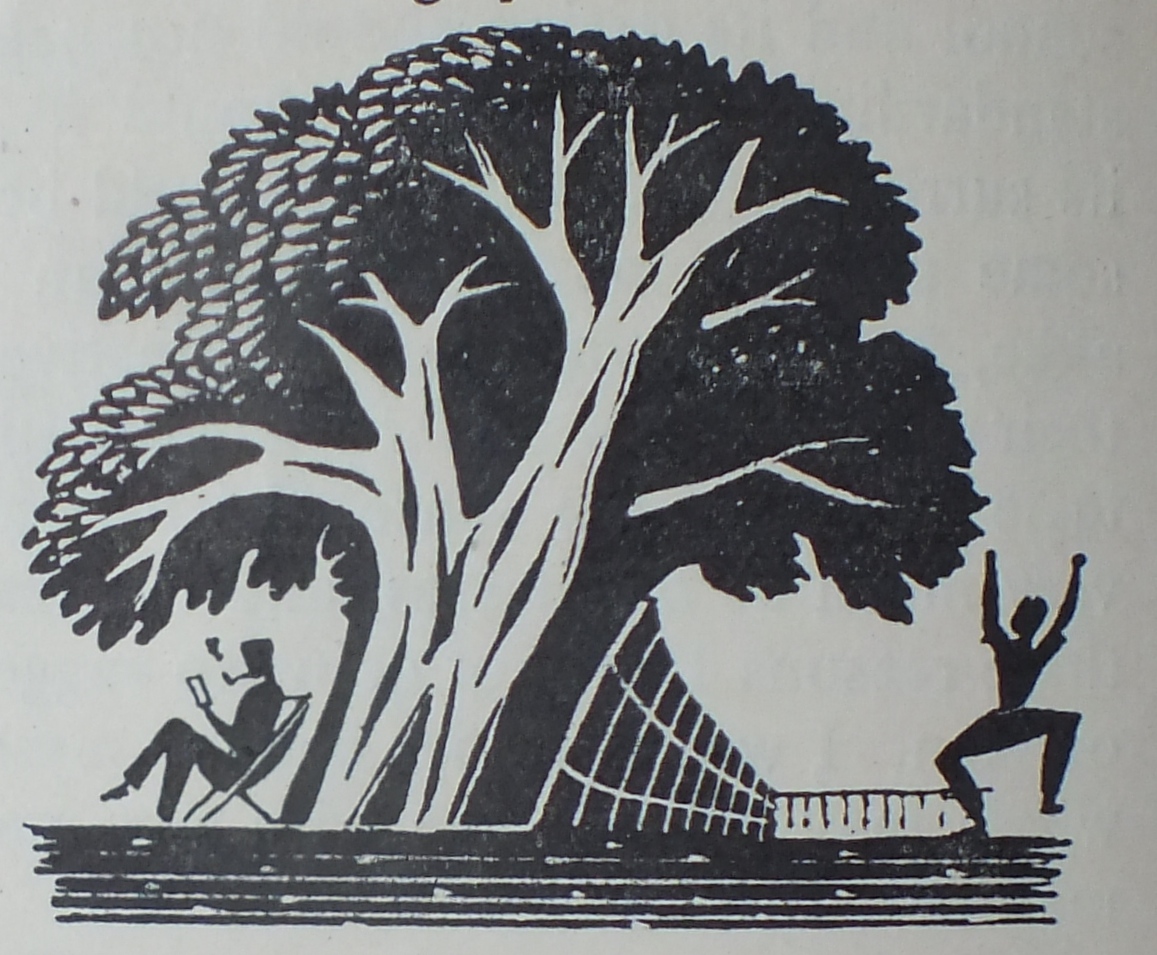
illustration by Eric Fraser, from C.H. Middleton In Your Garden, 1938
By 1914 when war broke out he was a horticultural instructor for Surrey County Council and “his expert knowledge was in demand” so he joined the Board of Agriculture as an advisor.
illustration by Eric Fraser, from C.H. Middleton In Your Garden, 1938
The BBC started gardening talks as early as 1922. A few of these were written by famous gardeners like Vita Sackville-West but mostly they were just a list of practical tips compiled by the Royal Hostriultural Society and read out by the announcer. As broadcasting grew more sophisticated the BBC asked the RHS for more contributors and C.H. Middleton was one of their suggestions, and he was eventually chosen as the presenter from a field that also included Sackville-West.
Middleton was a born broadcaster with a very conversational style, far removed from the normal rather stilted BBC presenter of the time, and began his first talk on 9 May 1931 with the words that soon became one of his catchphrases: ‘Good afternoon. Well, it’s not much of a day for gardening, is it?’
illustration by Eric Fraser, from C.H. Middleton In Your Garden, 1938
Three years later in 1934 he began his weekly Sunday afternoon talks called “In Your Garden”. These became immensely popular because “there was nothing brainy about them”and became a regular event over the next ten years. It was probably their success that established the BBC, rather than any newspaper or author, as the leading source of gardening information for the public. By 1938 he was able to resign his post as a horticultural instructor and concentrate on his new career as a broadcaster and writer.
Times [London, England] 30 May 1938: 21. The Times Digital Archive. Web. 2 Aug. 2014.
Mr Middleton’s success on radio put him a good position when television broadcasting began and on 21 November 1936 he presented in the first gardening program. Sadly there are no surviving recordings since the recording tape was expensive and so continually reused.
Times [London, England] 30 May 1938: 21. The Times Digital Archive. Web. 2 Aug. 2014.
I was also surprised to learn that he was the designer of the first demonstration garden laid out in the grounds of Alexandra Palace and which he used during his broadcasts.
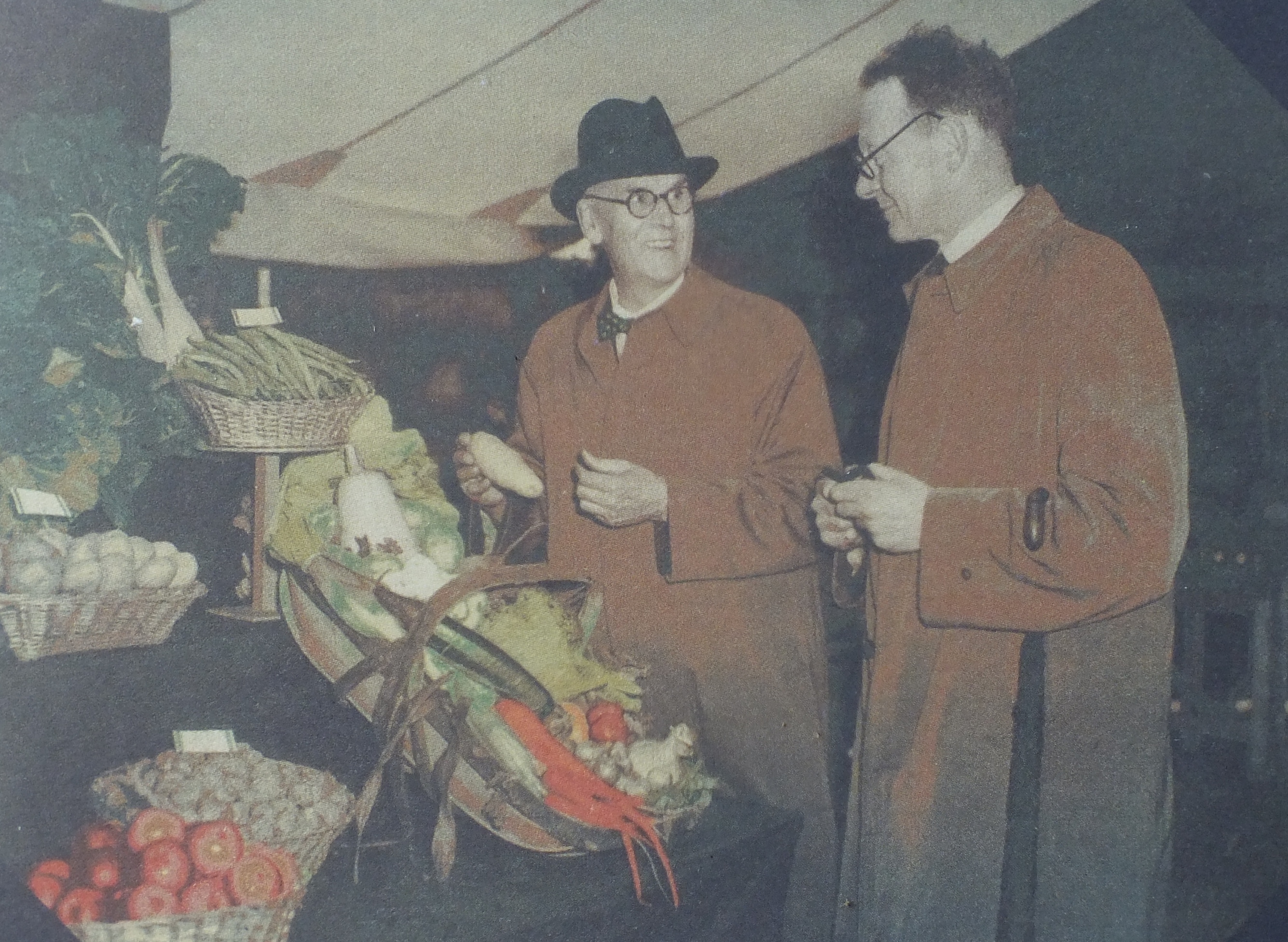
Not only that but in 1938 he also pioneered televised visits to the Chelsea Flower Show – so eat your heart out Mr Titchmarsh!
By this point his understated image and voice were instantly recognisable. Comic actor, Nelson Keys, was able to gently mimic and impersonate him on a variety show. Sadly there only a few seconds of this survive but you can still see how accurate it probably was.
Unfortunately his TV career did not last long because televised broadcasting stopped with the onset of war in 1939 and Middleton died before it was resumed in 1946. However his radio broadcasts went from strength to strength, and by 1940, about 3.5 million people were listening to “In Your Garden”, which was, because of the dispersal of the BBC during the war, broadcast from a studio at Evesham. By 1942 that number had risen to about 70% of those households with radio sets. In other words most of the country tuned in to listen to Middleton.
He spoke knowledgeably yet straightforwardly, appealing to both those who were experienced and the many novices pushed into productive gardening by wartime necessity, and who perhaps until then had “only dreamed of gardening”.
“Potatoes and beans are munitions of war as surely as bullets and shells.” from Your Garden in War-Time, 1941
He was a key figure too in the Dig for Victory Campaign: “There is no more peaceful spot on earth than an English garden, and for some years you and I have been building up our little flower gardens, making them more beautiful, more intimate and more than ever an essential part of our homes. But grim times are with us, and under the stress of circumstances we are now called onto reorganise those gardens and turn them into munitions factories…the gardeners of England can do much to help the nation in its hour of need.” [Preface to Your Garden in War-Time, 1941]
illustration by Eric Fraser, from C.H. Middleton In Your Garden, 1938
In one Ministry of Information campaign Mr Middleton was also seen as a cartoon character leaning on gate telling how the public how to go about making a compost heap or ‘plant canteen’. The short film was designed to promote the joys and benefits of compost making and urging people not to waste anything that could be recycled.
Middleton compiled many of his talks into a series of books. These were issued unillustrated and as cheaply as possibly during the war to promote vegetable growing, although he actually preferred growing flowers. He ended the preface of his most famous collection Your Garden in War Time in June 1941 saying “we must look forward to the time when tis nightmare will end – as end it must – and the morning will break with all our favourite flowers to greet us once more, and who nows, perhaps my next volume of talks will be of roses, mignonette, daffodils and lilies.”
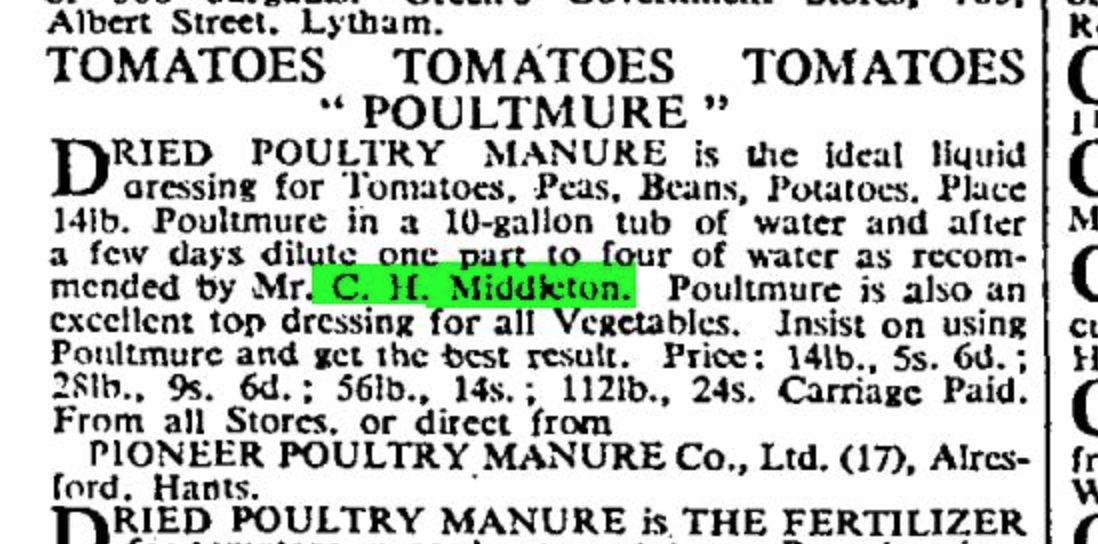
He became a celebrity by default. He broadcast on Children’s Hour, and worked for children’s charities; gave speeches and opened flower shows, wrote a regular column for the Daily Express, and even gave celebrity endorsement to gardening products.
“Obituary.” Times [London, England] 19 Sept. 1945: 4. The Times Digital Archive. Web. 2 Aug. 2014.
Then in September 1945, just as the war ended, Mr Midleton died suddenly outside his home in Surbiton. Pathe News recorded part of his funeral cortege and included the only known piece of film footage of him giving gardening advice.
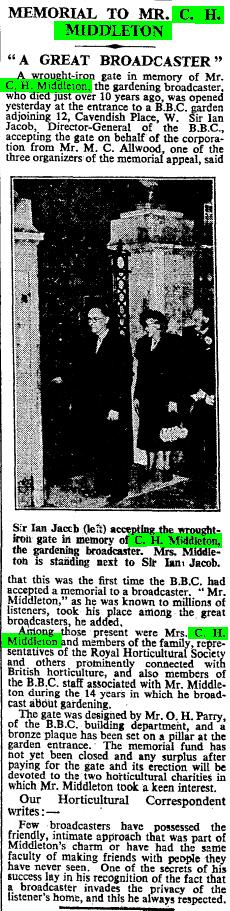
Ten years later there was a memorial appeal, and the BBC installed new gates in his honour on a garden behind the Langham Hotel in Cavendish Place.
The Queen of Flowers, illustration by Eric Fraser, from C.H. Middleton In Your Garden, 1938
One of the oldest gardens in the West End the Middleton Garden, as it has been known since 1961, has recently been revamped recently by the Langham group as “a rose garden” available for hire as a wedding venue. Sadly there aren’t many roses on show and Mr Middleton probably wouldn’t recognise the site of his former allotment!
His legacy was a strong base of practical gardening advice delivered in an unassuming and unpatronising way. And 50 years after the first broadcast this was still being celebrated by the BBC.
Kenneth Gosling. “Growing memories at the BBC.” Times [London, England] 15 July 1981: 14. The Times Digital Archive. Web. 2 Aug. 2014.
Kenneth Gosling. “Mr Middleton, the man who gave gardening its own voice.” Times [London, England] 19 June 1981: VIII. The Times Digital Archive. Web. 2 Aug. 2014.
Even in 2000, 55 years after his death, Mr Middleton was ranked 9th (immediately below Gertrude Jekyll and Prince Charles, although a long way behind Geoff Hamilton who had recently died) in a poll of readers of Amateur Gardening Magazine who voted for their “Gardener of the Millennium”: [[Vicky Bamforth, The Gardener’s Companion 2004]. Given that most of those voting would neither have seen or heard him broadcasting that seems a pretty good indication of his importance as a moving force in modern gardening and horticulture…and a good reason for celebrating his life.
illustration by Eric Fraser, from C.H. Middleton In Your Garden, 1938
I’ve just spent a couple of days visiting historic gardens around Cardiff, an area of the country that I did not know at all. One of them was Dyffryn, an Italianate mansion set in a splendid Edwardian garden designed by Thomas Mawson for the industrialist and coal magnate John Cory, and his plant-mad son Reginald.
But in this post I’m not going to rave about Dyffryn’s whole series of semi-secret small gardens, or the wonderful herbaceous borders, or the arboretum with its collection of champion trees, or even Reginald Cory’s plant hunting expeditions. Nor am I going to talk about the way the National Trust is involving the community in its plans for the house, or the enthusiasm of the garden team or even the delicious afternoon teas that are available. All that’s going to have to wait a little while…. and instead I’m going to talk about wisteria.
It’s not quite such a non-sequitur as you might think.
A few days before my visit I noticed that one of the many wisteria in my own garden has begun a second flush of flowers, and then wondered why I knew so little about them as a plant family, particularly as they play such a prominent role in many British gardens. Did you know, for example, that Chinese wisteria – Wisteria sinensis – twines its stems anti-clockwise, while Japanese wisteria – Wisteria floribunda – grows clockwise?
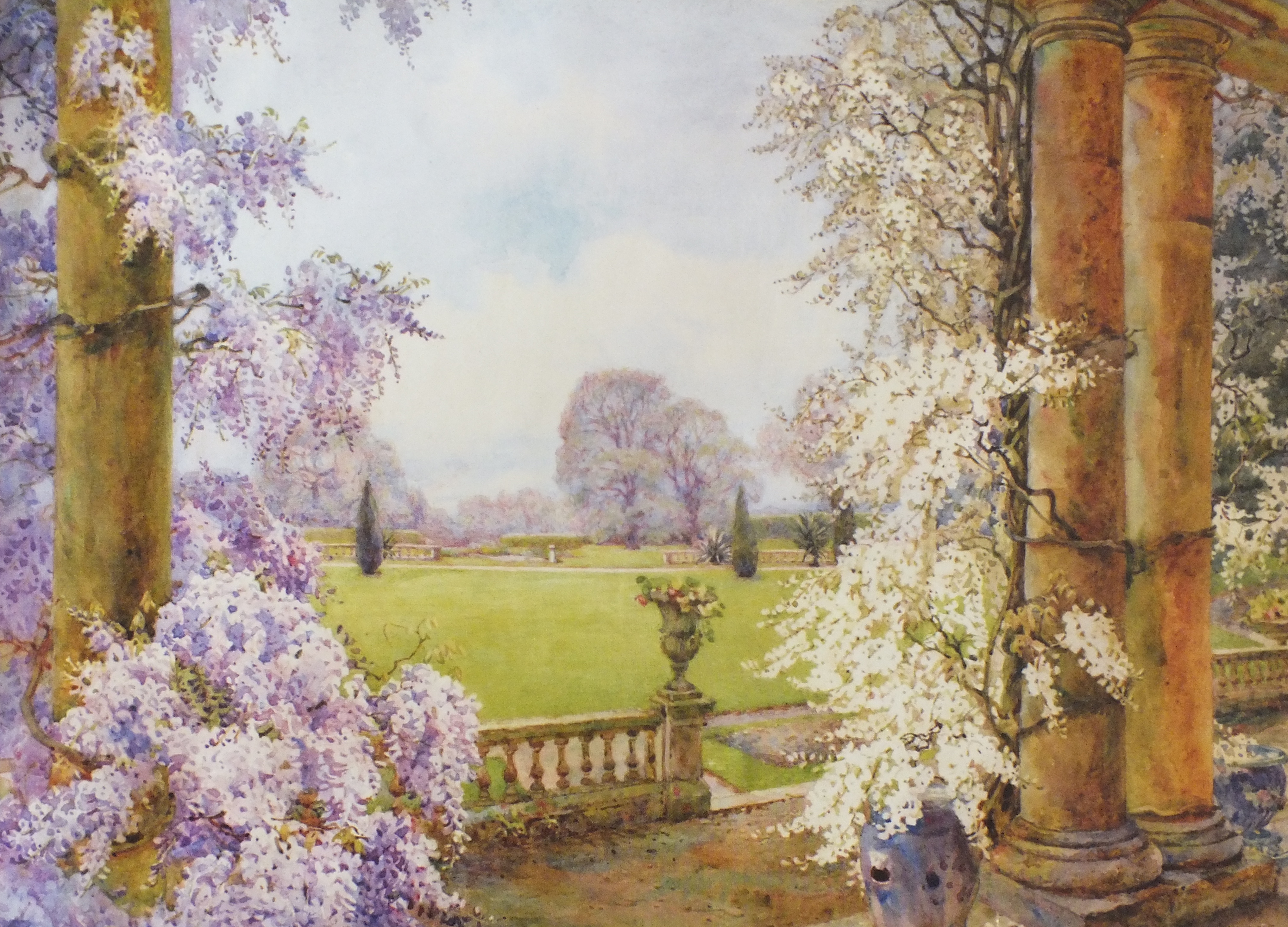
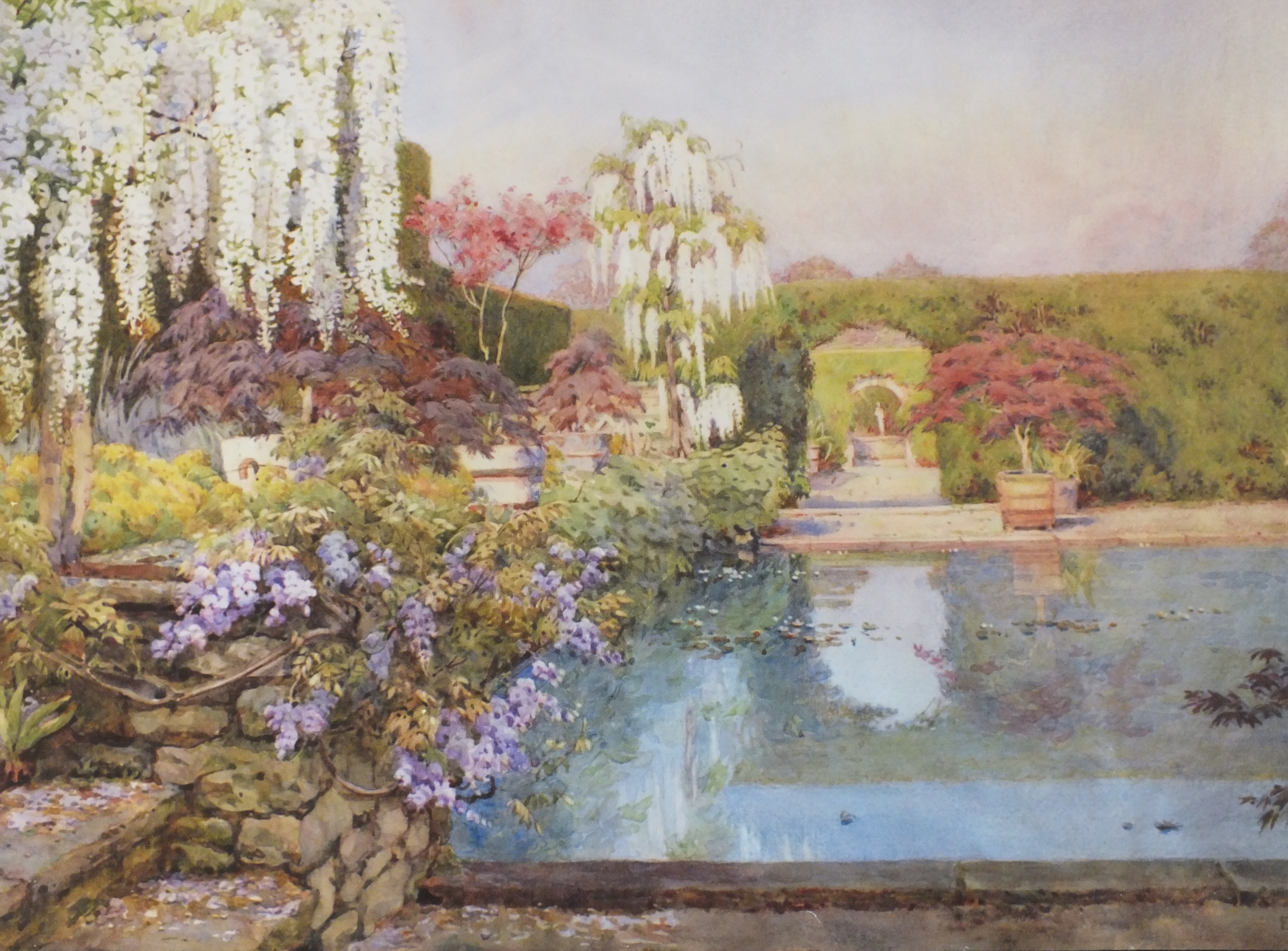
The mansion at Dyffryn has a colonnaded and balconied entrance on the garden front, planted with wisteria and it too had a few splashes of colour from repeat flowering. Cory’s bedroom opened directly onto the balcony and gave him long views down the main axis of the garden. Although the house is now almost completely empty, his former bedroom walls had series of paintings by Edith Adie of the gardens in their heyday in 1923…. and there were wisterias everywhere….. so what better excuse to do some research?
Wisteria by the Reflecting Pool, by Edith Adie, 1923 Royal Horticultural Society.
The wisteria has been around a long time. Fossils at least 7 million years old have been found in China [Wang, Q. et al, “Fruit and leaflets of Wisteria… from the Miocene”, International Journal of Plant Sciences, 2006 167:1061–1074.] but despite that they only came to European notice in the last 300 years.
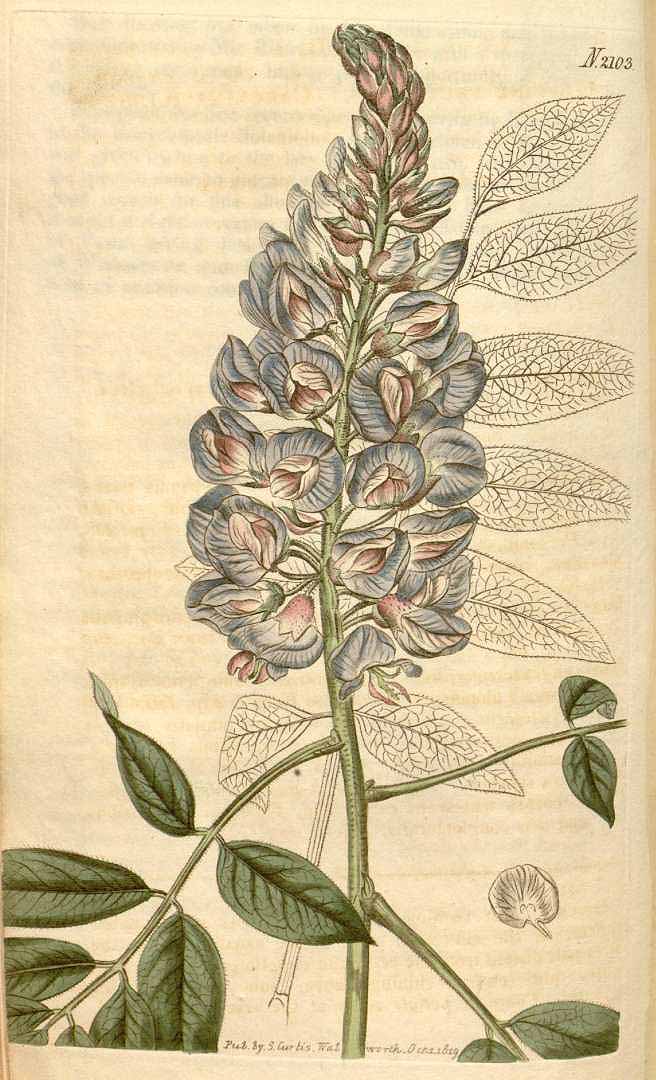
Wisteria frutescens Curtis’s Botanical Magazine, vol. 46: t. 2103 (1819)
Wisterias originated in 3 main locations in the world. The two more obvious ones are China and Japan but the first specimens to reach Europe came from Mark Catesby who was collecting plants in Carolina in 1724. Now known as Wisteria frutescens it was named Glycine frutescens by Linnaeus in Species Plantorum (1754), the starting point for modern botanical nomenclature. In many early nursery catalogues it was known as the Carolina Kidney Bean in because its spotted seeds were thought to resemble very small kidney beans. Wisteria frutescens doesn’t have the same widespread appeal as its Asiatic cousins, probably because its sprays of flowers – technically its racemes – are much smaller and less fragrant. This might be set to change as, with the trend to smaller and smaller gardens, breeders have developed a variety suitable for containers. This is now widely available as “Amethyst Falls”.
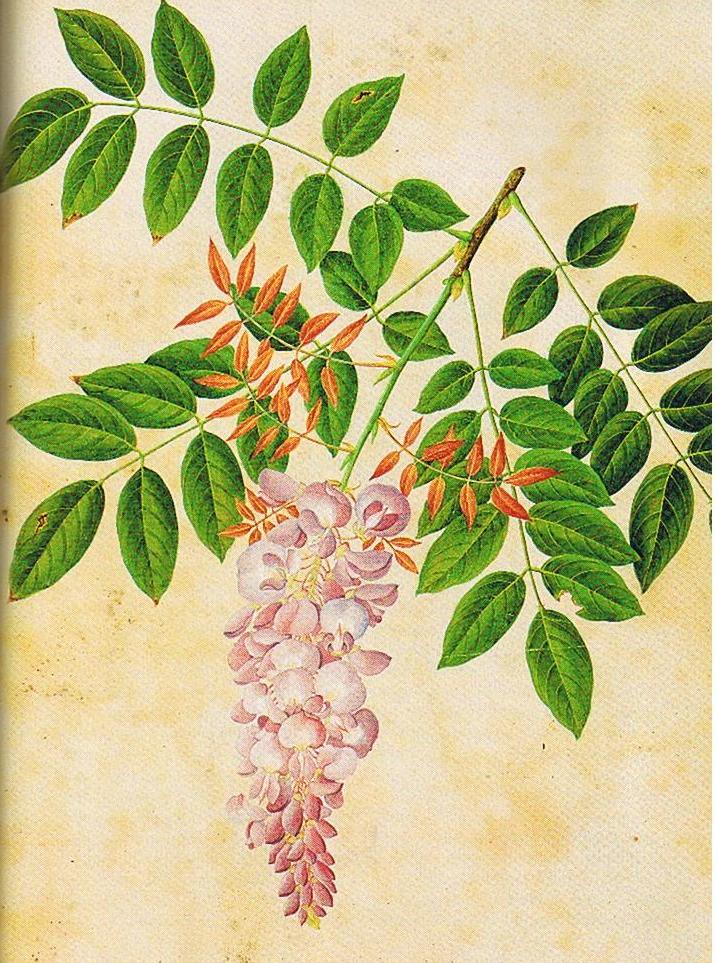
Wisteria sinensis by John Reeves, from the Reeves Colelction of Chinese drawings, vol.2 No.64, Lindley Library, RHS.
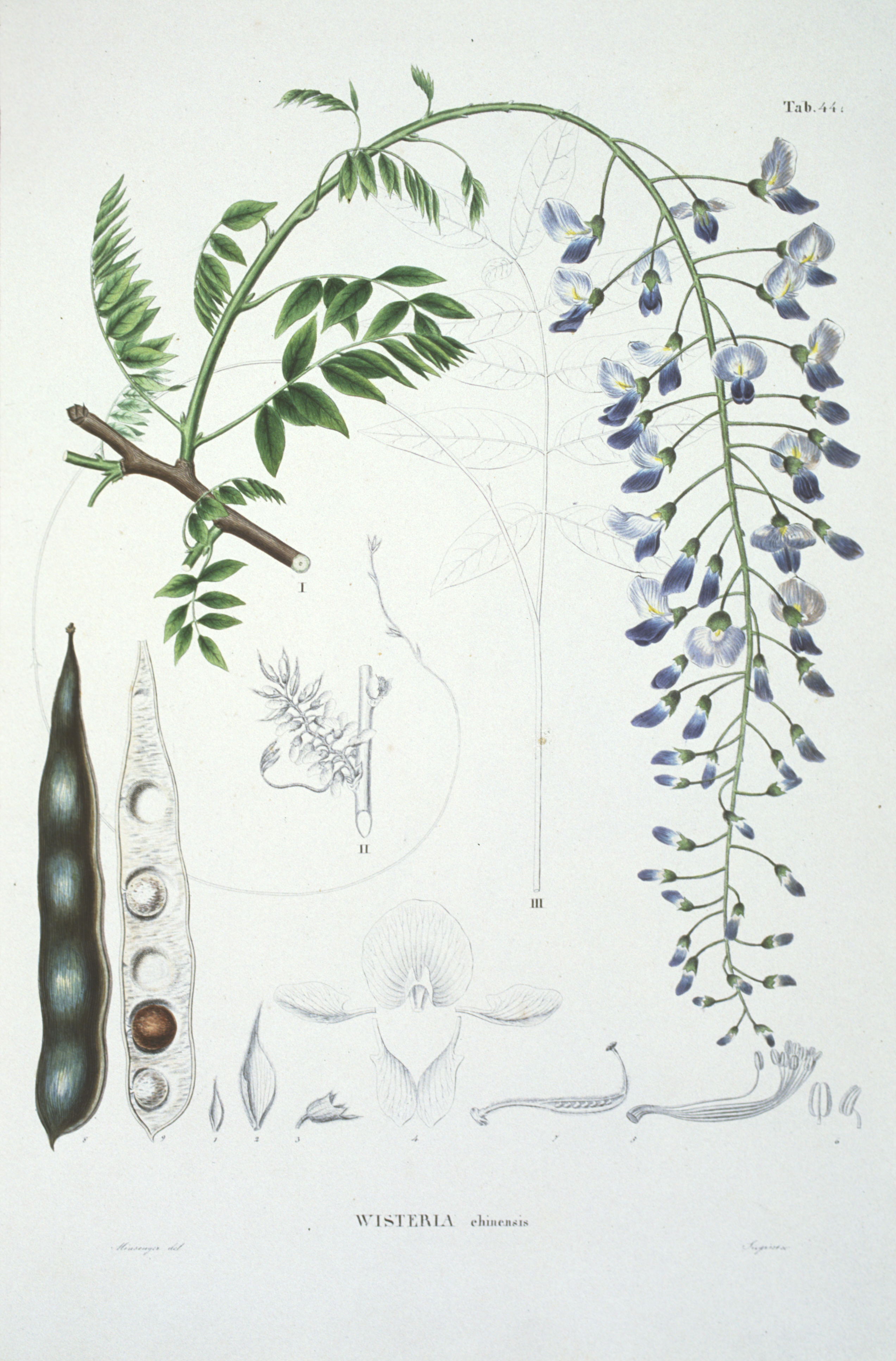
Much more popular is the chinese wisteria, wisteria sinensis. The first European to mention it was a French Jesuit missionary, Domenic Parennin in the early 18thc who described “the climbing plant teng lo with beautiful violet flowers hanging down in large bunches”. But it was not actually seen in Europe until 1816. It was probably sent by John Reeves who worked for the East India Company in their base near Canton who had acquired it from the garden of a local Chinese merchant whose anglicised name was Consequa. Another specimen, from the same garden source, arrived a few days later on another East Indiaman. This one was given to Thomas Palmer of Bromley.
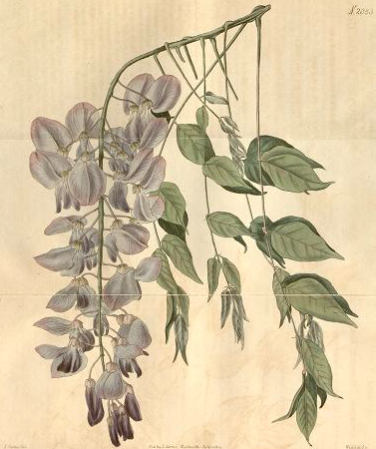
The authoritative Curtis’s Botanical Magazine has a long entry in 1819 discussing its classification before naming it Glycene sinensis, and then describing the plant and its arrival.The botanist Thomas Nuttall reclassified it as Wistaria after Caspar Wistar, a Philadelphia doctor, or just possibly after his friend Charles Jones Wister. In earlier texts it is usually spelled with an ‘a’ but more modern sources use an ‘e’. You pays your money and you takes your choice.
To be honest,tough though wisterias are, it’s amazing the first one survived given how it was treated!
from Curtis Botanical Magazine, vol.56, 1819, p.242
In 1826 the Transactions of the Horticultural Society included a detailed article by Joseph Sabine about the early history in cultivation. The first newly propagated plants had been given to the Horticultural Society, and to a Lady Long of Bromley, as well as to two commercial nurseries, Loddidges in Hackney and Lee’s in Hammersmith. Already the plant’s tough qualities were being noticed: “It does not require any nicety of management” and “it is impatient of the knife”. Although at least one of the specimens was being grown under glass it had survived harsh winters and was clearly ” a hardy shrub in our climate” and “among our best ornamental shrubs”. [Follow this link for Sabine’s article in full ]
Fullers Brewery in Chiswick, west London claims to have the oldest surviving specimen in Britain growing on their former head brewers cottage wall: see
By 1840 the Horticultural Society’s specimen “was an object of great attention” and John Lindley, the society’s secretary was obviously impressed.[or slightly crazy?] He used it as “as evidence…of the creative power of Nature”, calculating that “the number of branches was about 9000 and of flowers 675,000. Each flower consisting of 5 petals, the number of these parts was 3,375,000” and continued through ovaries, ovules and seeds to explain that the plant had 27 billion grains of pollen and “that all the petals been laid end to end they would have extended to a distance of more than thirty four miles.”
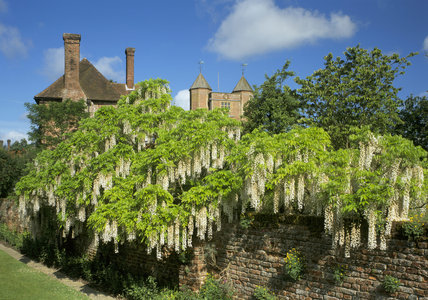
Wisteria sinensis alba, at Sissinghurst National Trust images
1844 saw the “discovery” of the white form – wisteria sinensis alba – in a garden by Robert Fortune, who was able to get permission to take layers from it, and by 1847 a specimen was growing in the Horticultural Society/’s garden in Chiswick.
Wisteria expert Peter Valder says that after this there were very few new introductions of wisterias from China, and that whereas Japanese nurserymen realised there was a market for their plants abroad and even produced catalogues, their Chinese counterparts showed no interest. The likelihood is therefore that until very recently most of the wisteria sinensis grown in Europe came from the same very limited genetic stock, but Valder notes that on plants he had seen in cultivation in several Chinese cities “no two plants appeared to be the same’ so that there is hope for a lot of further hybridization. [For more information see Peter Valder, Wisterias: A Comprehensive Guide, [Balmain, Australia, 1995]
Our third source for garden wisterias, Japan, is better appreciated and understood. There are two species indigenous to the Japanese archipelago: Wisteria brachybotrys and the better known Wisteria floribunda. They have both been esteemed, recorded and hybridized for centuries by the Japanese, even featuring in literature and poetry as early as the 8th century. Yet, even more than China, Japan was isolated, deliberately so, from the west. Indeed from 1638 until 1858 Japan was closed to foreigners and the Japanese themselves forbidden to travel overseas. Only a single tiny Dutch trading outpost was allowed, on an artificial island in the harbour of Nagasaki where the handful of inhabitants were closely monitored and all contact with the Japanese strictly regulated. There is a very readable fictional account of life there in David Mitchell’s The Thousand Autumns of Jacob de Zoet (20xx).
from Phillip von Siebold, Flora Japonica (1835-41)
It is only through the work of 3 physicians to the trading posts [all later remembered in the names of plant species] that any knowledge of Japanese plants and gardens reached Europe. Engelbert Kaempfer was there from 1690-92 and published his account of Japan including many plants in 1712 – amongst them the two species of wisteria or Too Fudsi and Jamma Fudsi as he called them. Nearly a century later Carl Thunberg became the trading post’s doctor, and on his return published Flora Japonica in 1794. Later still, in the 1820s, Phillip von Siebold managed to send back both herbarium and living specimens but the Japanese wisteria – Wisteria floribunda – was probably not introduced into cultivation until 1830 in America and probably even later in Europe. It was only after the enforced opening of Japan to western trade after Commodore Perry’s expedition that further introductions took place.
Wisteria floribunda multijuga , from Louis Houtte, Flore des Serres, vol.19 1873
The fact that the Chinese and Japanese wisterias did not reach England until the 19thc did not stop them quickly achieving a special place in the English garden. As early as 1872, writing in The Garden William Robinson described them as “among our most common and valued climbers”. The following year a full page illustration of Salt Hill hotel at Slough proved the point.
Salt Hill Hotel, from The Garden, August 3o, 1873
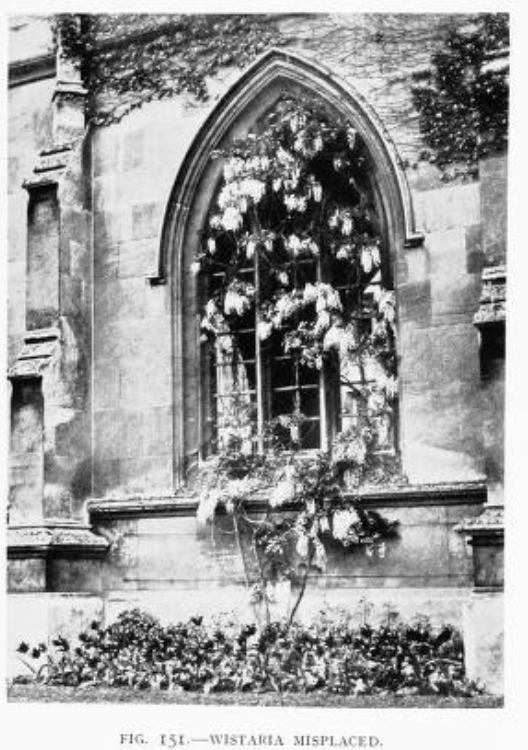
But because they were new introductions they were not always planted wisely. Gertrude Jekyll commented on this “odd misuse of a fine plant” in her book Gardens for Small Country Houses in 1913.
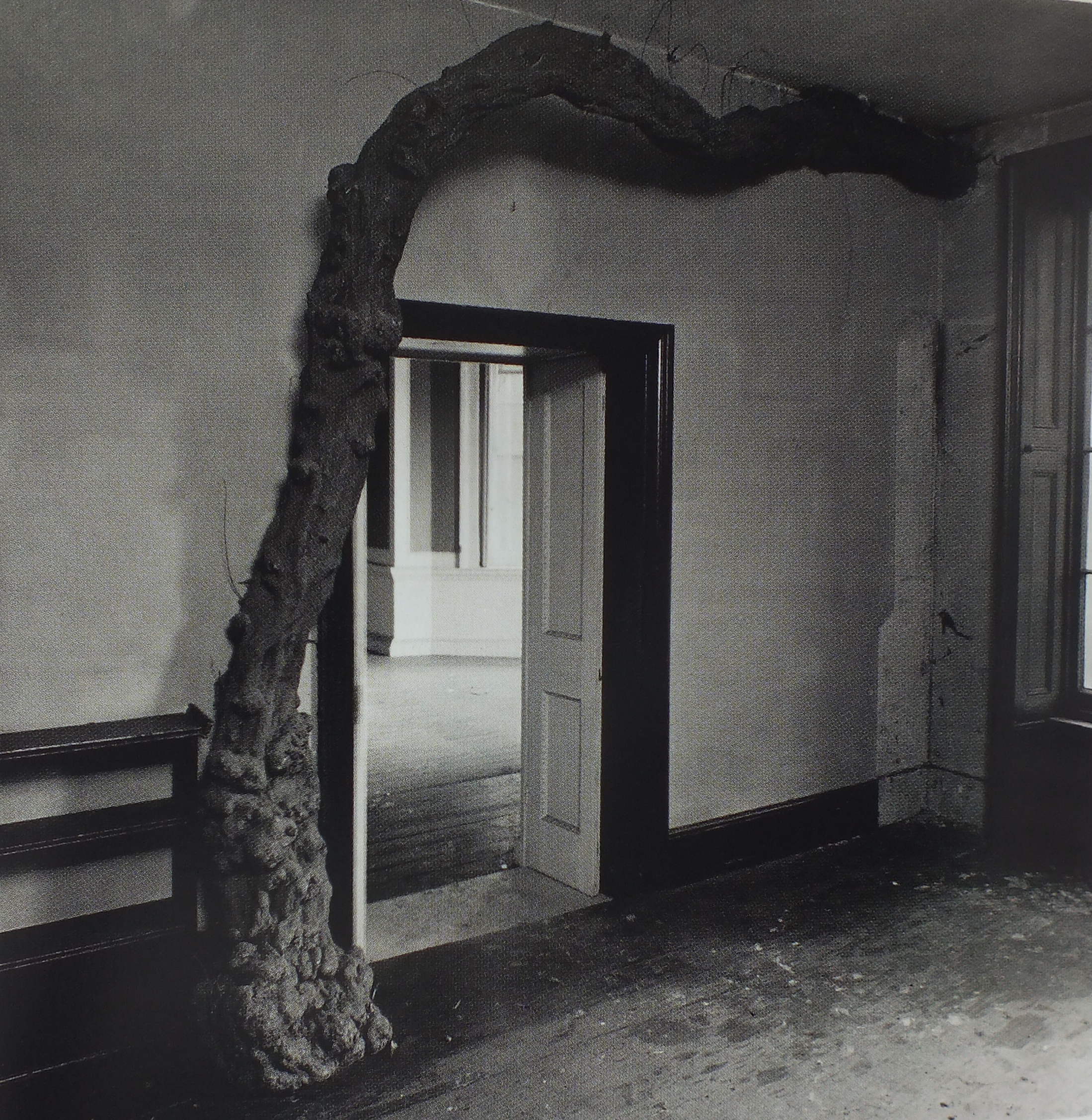
The wisteria at Carnwath House, Fulham which grew through the floor and departed through the wall! from Philip Davies, Lost London 1870-1945, English Heritage.
An even worse case was the wisteria planted at Carnwath House in Fulham. “This beautiful villa…commands a fine view of the Thames which flows within a few yards of the pleasure ground which are adorned with some fine cedars of Lebanon and other ornamental trees and shrubs [William Keane, The Beauties of Middlesex, 1850]. The house may have been the model for Sir Barnett Skittles villa in Dicken’s Dombey and Son….although I’m sure Sir Barnett did not have a wisteria planted quite so curiously as this one!
The wisteria in Lord Sackville’s private garden at Knole, National Gardens Scheme
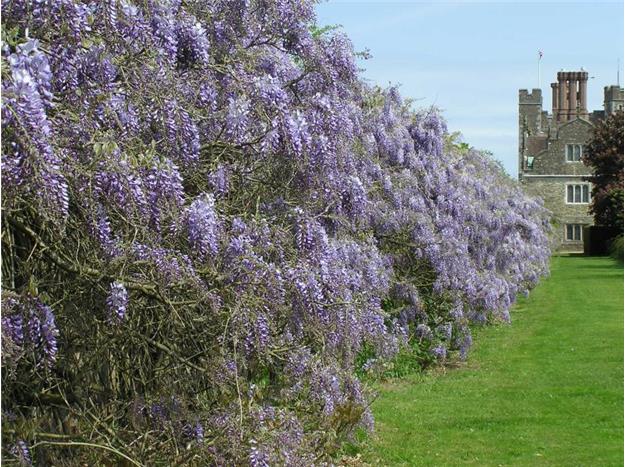
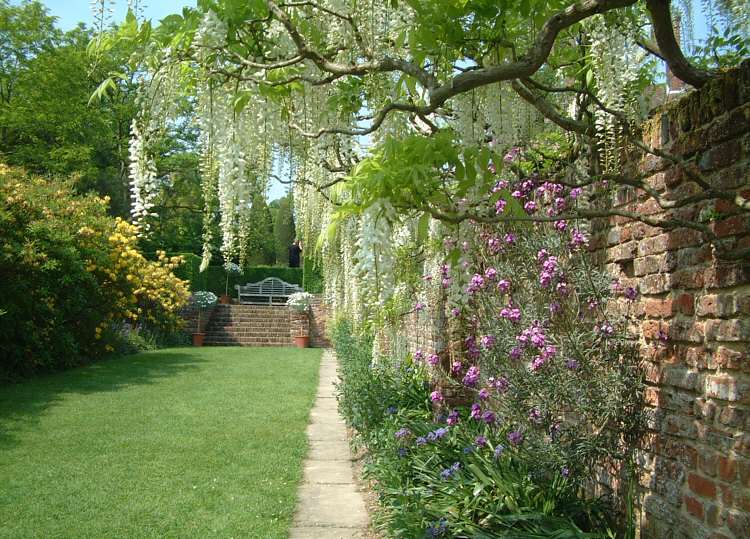
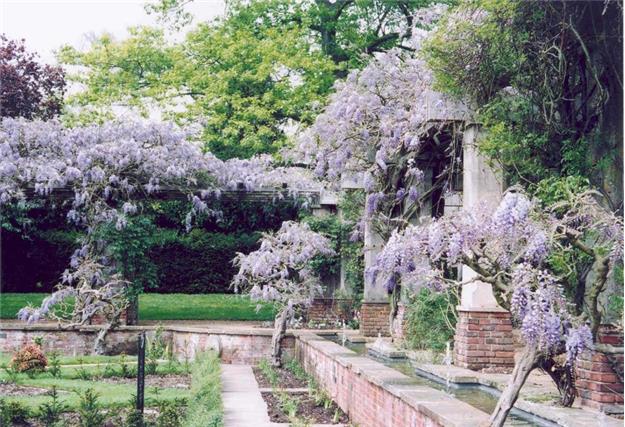
Wisterias are mentioned as specific features in 38 of the parks and gardens listed on our database, and over 60 of the gardens open under the National Gardens Scheme claim them as outstanding features, and while the main wisteria season is over there are still plenty of plants in flower to admire.





![Roy Hay and Frances Perry "Picture Gallery." Times [London, England] 28 July 1977: 16. The Times Digital Archive.](https://thegardenhistory.blog/wp-content/uploads/2014/08/fetch-11.jpeg)
!["Mrs Frances Perry on RHS council." Times [London, England] 21 Feb. 1968: 12. The Times Digital Archive](https://thegardenhistory.blog/wp-content/uploads/2014/08/fetch2.jpeg)






![Times [London, England] 30 May 1938: 21. The Times Digital Archive. Web. 2 Aug. 2014.](https://thegardenhistory.blog/wp-content/uploads/2014/08/times-tv-nov21-1936.png)
![Times [London, England] 30 May 1938: 21. The Times Digital Archive. Web. 2 Aug. 2014.](https://thegardenhistory.blog/wp-content/uploads/2014/08/times-chelsea.png)


!["Obituary." Times [London, England] 19 Sept. 1945: 4. The Times Digital Archive. Web. 2 Aug. 2014.](https://thegardenhistory.blog/wp-content/uploads/2014/08/fetch-5.jpeg)


![Kenneth Gosling. "Growing memories at the BBC." Times [London, England] 15 July 1981: 14. The Times Digital Archive. Web. 2 Aug. 2014.](https://thegardenhistory.blog/wp-content/uploads/2014/08/fetch-6.jpeg)
![Kenneth Gosling. "Mr Middleton, the man who gave gardening its own voice." Times [London, England] 19 June 1981: VIII. The Times Digital Archive. Web. 2 Aug. 2014.](https://thegardenhistory.blog/wp-content/uploads/2014/08/fetch-4.jpeg)





![Wisteria floribunda [then described as wisteria multijuga] from Louis Houtte, Flore des Serres, vol.19 1873](https://thegardenhistory.blog/wp-content/uploads/2014/07/wisteria.png)



 The Garden History Blog
You must be logged in to post a comment.