The Golden Apples of the Hesperides

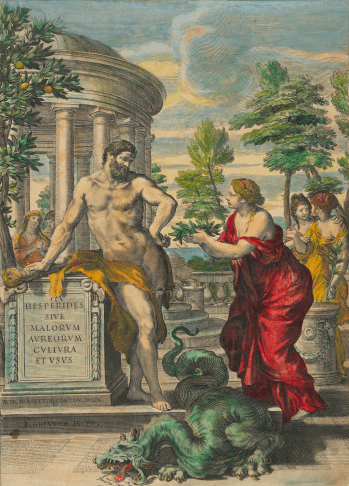
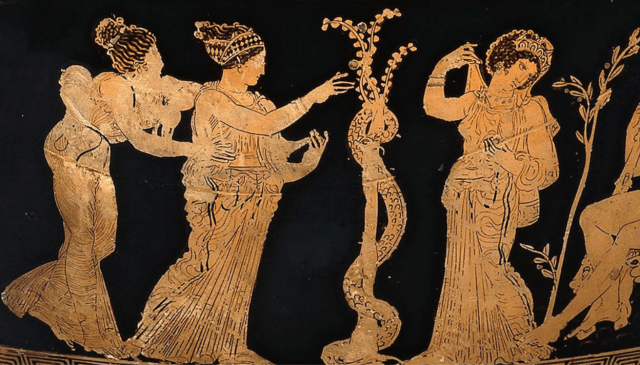
Greek myths are eternally popular, so after a recent post on the story behind aquilegias today I’m turning my attention to another garden-related classical legend , that of the Garden of the Hesperides.

The garden  belonged to the queen of the gods – Hera in Greek [Juno in the later Roman version], and lay somewhere at the western edge of the known Mediterranean world.   In it grew a tree [or maybe an orchard of trees] which bore golden apples said to give immortality to those who ate them.

The golden glow from these apples was also thought to be the source of sunsets. The job of looking after the garden was given to the Hesperides who were the nymphs of the sunset, but because Hera didn’t entirely trust them she installed another guardian as well – Ladon, the multi-headed dragon who somehow never needed to sleep.
The Garden of the Hesperides is the setting for several well known myths, before,  in the 17thc  it was picked up and reinvented by  artists and garden writers writing about “golden apples” of a different sort.
Continue reading

Posted in Uncategorized | Tagged , , , | Leave a comment

The Dunington-Grubbs

That’s an unusual title for a post unless you’re Canadian in which case you probably already know more than me.

“Miss Lorrie Dunington is well known as a designer of gardens. This sounds a delightful profession, and, indeed, it is, though there are very few women in England practising it at present.”

So begins an article about  Miss Dunington in The Girl’s Realm – not my usual reading matter – which I discovered while getting ready for a lecture about horticultural training for women a century or more ago.  Obviously I was intrigued and and decided to investigate further.


Continue reading

Posted in Uncategorized | Tagged , , , , , , | Leave a comment

Queen Elizabeth and the Flower Markets of Paris

Although lots of things have been named in honour of Queen Elizabeth you might be surprised to know that one of them is  the main flower market in Paris.  This occupies a small square and the adjacent riverside on  the Ile de la Cité,  close to Notre Dame.  Apparently it was visited by the queen early in her reign, and also on her  later trips to the city. When she went to Paris as part of the celebrations for the 70th anniversary of the D-Day landings it was renamed Marché aux Fleurs Reine Elizabeth II to reflect the “enormous affection” in which she was held by the French.

Continue reading

Posted in Uncategorized | Tagged , , , | Leave a comment

Aquilegia and other Greek flower myths

My aquilegias are looking amazing at the moment. I’ve encouraged them to seed everywhere they want, and the more I grow them the more I like them.  But why are they called aquilegia and why do my French friends and neighbours know them as ancolis, while my grandmother told me they were columbines or granny’s bonnets?

The naming of plants is a fascinating affair and you might be surprised to know that many of our common garden plants supposedly get their name from stories in classical mythology.  There are some  obvious ones  like Narcissus, Daphne and Iris, but there are plenty of others  including both Aquilegia and its French equivalent, ancolis.

But do you know the stories behind the names? Who did the naming?  Why? When?


Continue reading

Posted in Uncategorized | Tagged , , , , , , , , | Leave a comment

Acorns from the King: the rest of the story of Coronation Gardens

I know the excitement is over but…here’s the rest of the not-so-short history of Coronation Gardens which will bring it right up to date.

For the coronation of Edward VIII things were planned to be more organised horticulturally. In August 1936 the Marquis of Lothian chaired a meeting of  about thirty organisations interested in  trees  and gardens more generally who then joined forces to form the Coronation Planting Committee.  


 Edward’s sister-in-law, the Duchess of York, lent  her active support saying that she hoped their “proposals will be enthusiastically taken up, for now is the opportunity for our generation with the advice and good taste of the committee to add to the lasting beauty of our towns, villages and countryside.”   It was to be her last public speech as a Duchess because on December 10th Edward abdicated and she became Queen Elizabeth . 

Continue reading

Posted in Uncategorized | Tagged , | Leave a comment