Garden Open Today & Tomorrow

One of my favourite garden writers is Beverley Nichols, and the other day I discovered this wonderful quote about him and his work:  If Bertie Wooster and Gertrude Jekyll had a son, surely he would have been Beverley Nichols.  Today’s post is proof of that.

Nichols first published  Down the Garden Path which I wrote about some time ago in 1932. It was to be first of a dozen garden-related books. These were mainly centred around the various gardens he created, and were full of wonderful characters as well as much gardening advice and plant knowledge based on his own hands-on experience.

His last two books were to be different.


Continue reading

Posted in Uncategorized | Tagged , , | Leave a comment

The Annunciation and its Gardens

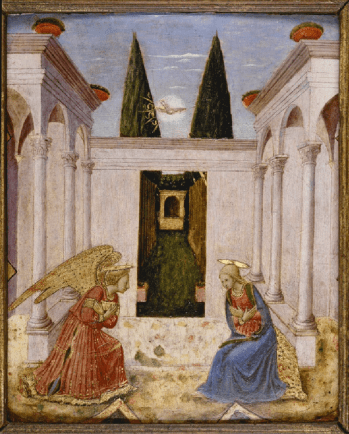
Today, March 25th, is the feast of the Annunciation which, according to the Gospel of St Luke, marks the visit of the angel Gabriel to the Virgin Mary, during which he tells her she has been chosen to  be the mother of Jesus Christ, the Son of God.

It has been a favourite artistic subject throughout  the Christian world,  and depictions of it can be found everywhere from the Roman catacombs  to books of hours, mosaics, sculptures and paintings, particularly during the Middle Ages and Renaissance. There are literally hundreds of Annunciation paintings  from this period and it figures in the repertoire of almost all of the great masters.

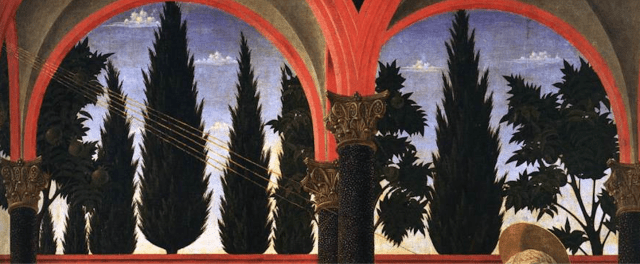
Many of these works of art set the scene in a garden or have landscapes in the background but I was surprised how little seems to have been written about them  as settings so, using just a tiny fraction of the paintings available as examples,  here goes….


Continue reading

Posted in Uncategorized | Tagged , , , | 5 Comments

Floriculture of the Toilet

What an extraordinary title for a blog post!  I hope it didn’t make you think  of plants that you might want to grow in the smallest room although I confess that was my first thought when I saw the title of an article in The Gardeners Magazine of Botany for 1851.

I remained a bit confused because it  starts off: “The floriculture of the toilet embraces the choice, culture and general knowledge of all those plants which are susceptible of ornamenting the human form.”

What on earth could they be talking about?  I certainly couldn’t have guessed because it’s the “science, if such it may be called, [which] forms the most important feature in  hairdressing” of all things, but it was also part of  “the complete requirement of a good education.”

Continue reading

Posted in Uncategorized | Tagged , , , , , , | Leave a comment

Heavens above! There’s a nun in the garden

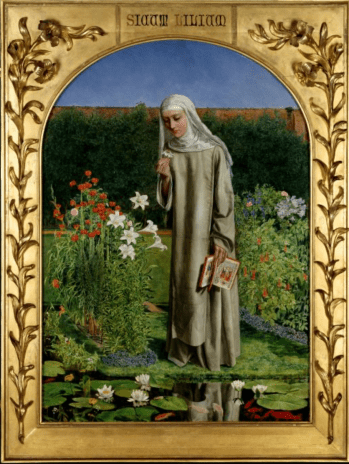
I’m sure lots of you are as familiar with this painting  by Charles Collins as I am. It’s one of those well known, if slightly unusual, pictures  that you wonder why anyone painted it.  What I hadn’t realised until I was researching a recent post on Eleanor Fortescue Brickdale and  saw her painting of St Clare  in  a convent garden that I began to realise there were in fact  several other paintings by Victorian artists on a similar theme.


Time perhaps to put two and two together and see if there was a reason why nuns, and particularly nuns in gardens, were  such an attractive subject for painters of the period.  So I’ve just spent an interesting day flicking through the websites of art galleries and the pages of academic journals trying to find out.

Continue reading

Posted in Uncategorized | Tagged , , , , , , , | Leave a comment

Paul Sandby and his “Real Views from Nature”

Every so often an artist comes along who manages to change the way people think about or record the world, and in the process help launch a new kind of art. It happened in the mid-18thc in Britain when a school of landscape painting emerged, unlike anything which had preceded it .  The man largely responsible was Paul Sandby.

He’s not exactly a household name but as the New York Times said about an exhibition of his work in 2010 “he comes out as the unlikely founding father of a dazzling school of European art.” 

It was Thomas Gainsborough himself no slouch at landscape painting who told a potential client  in 1764 that if he wanted “real Views from Nature in this Country”,  he should turn to Sandby, who was “the only Man of Genius … who has employ’d his pencil that way”

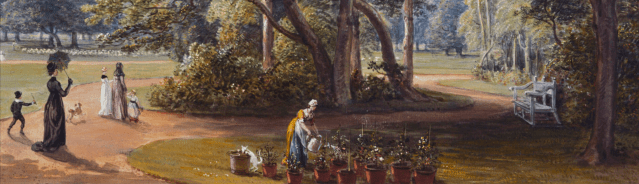
Sandby’s  images contributed to the emerging appreciation of British landscape, the development of domestic tourism and the way that landscapes and even gardens were appreciated and portrayed both then and today.

Continue reading

Posted in Uncategorized | Tagged , , , | Leave a comment