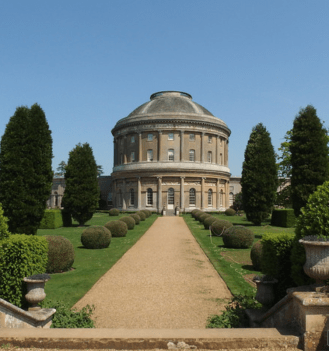
Ickworth

I was lecturing in  Suffolk recently and took the opportunity to call in at Ickworth, for the first time in many years. What a revelation that was. Not the grand rotunda of the house, splendid on the outside but  rather dark and dreary inside, despite its magnificent contents. Nor its grand wings, one now a hotel and the other, never properly finished, now the inevitable cafe.
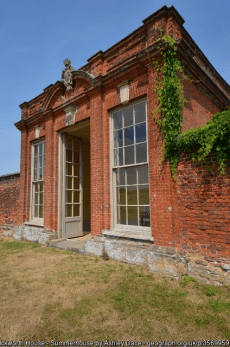
The 1st Earl of Bristol’s summer-house, ©Ashley Dace, 2012 


No: the revelation came outside in the grounds.  The grand sweep of lawn facing the building, and backed by a  woodland with specimen trees, and a splendid herbaceous border backing up against the terrace. The rather un-Italian Italian garden with its encircling terrace overlooking the parkland and its modern stumpery, now being extended through the Victorian shrubbery. And further away across the rolling parkland and woodland, and tucked down towards the lake  the magnificent walled kitchen garden which is slowly, slowly being restored by the garden team.

So it obviously merited a blog post...[photos by me unless otherwise stated]
Continue reading

Posted in Uncategorized | Tagged , , , , , , , , , , , , | 2 Comments

On a slow boat from China…

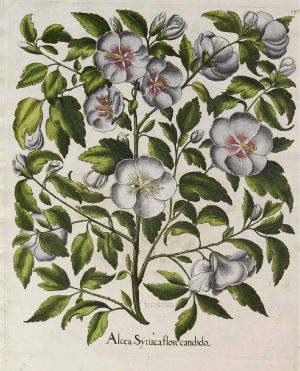
Hibiscus syriacus L. [as Alcea syriaca flore candido] from Besler’s Hortus Eystettensis, vol. 2:  (1613) 

China has one of the richest flora in the world but many of its plants remained unknown in the west until comparatively recently. While we all know about Chinoiserie as a fashion in  decor and in garden architecture particularly in the 18thc I suspect much less is known about the arrival of Chinese plants to complement them.

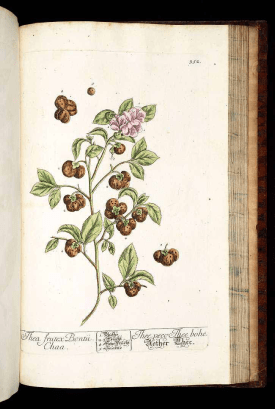
Tea – Camellia sinensis  [as Thea sinensis]
from Elizabeth Blackwell, Herbarium Blackwellianum, vol. 4: t. 352 (1760)

That’s partly becasue although there was a flourishing trade between China and western Europe from the 17thc onwards – albeit mainly one-way in China’s favour – the Chinese authorities gradually restricted western access to their ports and travel by Europeans around the country.  As a result would be early plant collectors, found it difficult to search and collect specimens.

It was, of course, at least equally hard to get them home.  Travelling was a slow business. Sailing between Britain and China was restricted by the trade and monsoon winds and the journey was at least 6 months, with a six month stay to wait for favourable winds  in the opposite direction and then another six month journey home. Its quite extraordinary that anything at all got back safe and sound. Continue reading

Posted in Uncategorized | Tagged , , , , , , , , , , , , , , | 3 Comments

Making Mountains and Music in Elysium…


frontispiece to the English translation of Abbe de Vallemont, Curiosities of nature and art in husbandry and gardening, London: 1707.

As I hope I showed in a recent post John Evelyn the 17thc diarist and garden writer spent much of his life designing the perfect garden: Elysium Britannicum.  It was to be an Eden encompassing a complete miniaturized version of the world including almost every kind of landscape feature that he could imagine.

But what was a garden owner to do if they didn’t have  natural waterfalls or cascades, mountains or “Groves and Wildernesses” in their back yard?


Quite simple said Evelyn:  “if in the originall disposure of the plott, we find them not already planted by Nature” they must, quite simply, “be contrived”. This insistence creates an artificiality that is the very opposite of the great 18thc cry of “the genius of the place”.  So how does Evelyn propose the gardener should go about it?

Continue reading

Posted in Uncategorized | Tagged , , , , , , , , , , , , , , , , , , , , , , | 1 Comment

The indefatigable John Fraser and his American Nursery

Companion to the Botanical Magazine, vol. 2, 1836

John Fraser was another one of those botanists and plant hunters who once set the horticultural word on fire with their discoveries but are now scarcely remembered.  Like so many of them he was Scottish,  born in Inverness-shire in 1750, and like so many others of his countrymen, especially gardeners, he took the high road to England.  He married and in the 177os opened a hosiery shop in Chelsea dangerously close to the Society of Apothecaries Physic Garden.   He began visiting and soon became friends with William Forsyth,the then curator, and it wasn’t long before he became besotted by botany that he gave up selling socks  and  became a plant hunter instead.

There are brief biographical articles by John Claudius Loudon [ in Arboretum et Fruiitcum, 1844] and Robert Hogg [The Cottage Gardener, July 22nd 1852] which suggests that from then on his life seems to have been one long adventure…

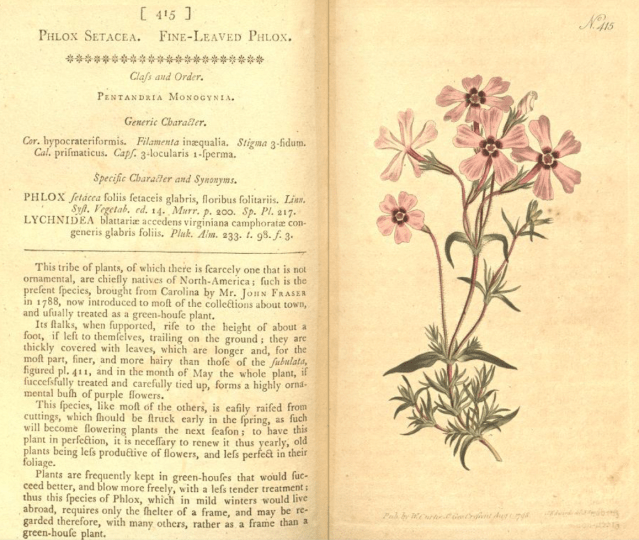
Phlox setacea one of more than 200 plants introduced by Fraser,                                                                from Curtis’s Botanical Magazine, 1797

Posted in Uncategorized | Tagged , , , , , , , , , , , | 1 Comment

Ada and her garden village

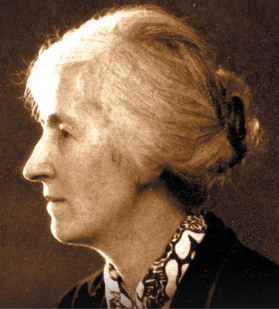
Ada Salter

It’s not often I’d guess that a local election manifesto gets taken that seriously, is implemented and referred to and read decades after it was written,  and even  talks about gardens. But an exception might be  the 1922 election address by Bermondsey Labour Party.  Leading lights in the local party then were Ada and Alfred Salter.

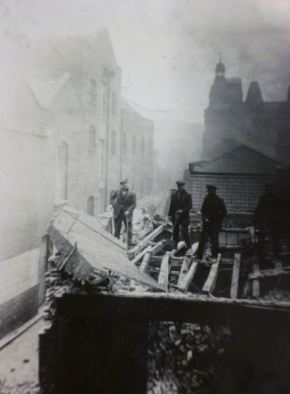
Salisbury Street clearance, 1926 © Southwark Local History Library and Archive

Almost a year ago I wrote about Ada and her campaign in the 1920s and 1930s to beautify Bermondsey, an inner London borough and one of the most deprived and overcrowded parts of Britain. But she did more than just plant trees and open parks.  Important though those ideas were they were just a part of a massive campaign to improve the living conditions and lives of people  just a stone’s throw from central London.  Ada, together with her husband Alfred, the doctor turned MP, led campaigns to improve public health – remember this is pre-NHS –  and clear the borough’s slums.And the slums were to be replaced not with high-rise  blocks but with garden villages.

I am indebted to the research behind John Boughton’s blog Municipal Dreams, which I used for the starting point for this post. Continue reading

Posted in Uncategorized | Tagged , , , , , | 1 Comment