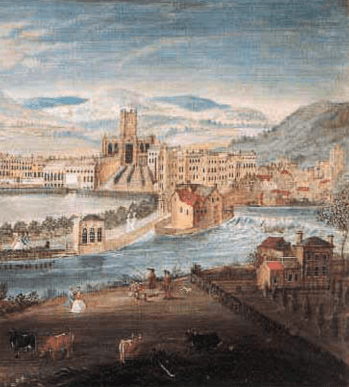
Recording the Rococo : Thomas Robins

detail from A View of Bath

Sometimes one gets a real surprise from a book. I did a few weeks ago in the British Library… and I don’t mean when I started to read it, but literally when it was brought to the counter. There were two slim volumes, one large  the other enormous, in brown slip cases. Hardly a standard work. This was my first introduction to John Harris’s Gardens of Delight, his 1978 book on the landscape paintings of Thomas Robins the Elder.  The contents were even more  surprising than the outward presentation and opened my eyes to a world now largely long gone, but magically bought back to life in this lavishly produced publication.  Although a few of Robins’ paintings  of Rococo gardens mainly arround his native Gloucestershire and Bath are well-known, I wasn’t prepared for what I found either in the images or Harris’s scholarly accompanying commentary.
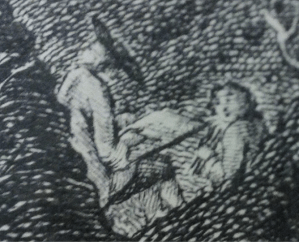
Self portrait of Robins from his Prospect of Bath 1757

Read on to find out more about this enigmatic and singular artist who was only “rediscovered” in the late 1960s and whose work is not just enchanting but significant. He captured a garden fashion whose exemplars have almost entirely disappeared,  together with some of the plants and wildlife you might have found in them, using techniques that are unconventional but with a liveliness and lightness of touch that is rarely matched. Continue reading

Posted in Uncategorized | Tagged , , , , , , , , , , , , , | Leave a comment

Castles for Cows…

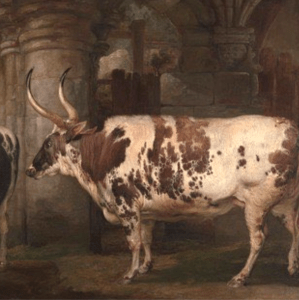
Detail from “Portraits of two extraordinary oxen, the property of the Earl of Powis,” by James Ward,  1814, Yale Center for British Art,  and just look at where the oxen are living!

The recent post on chickens and their houses provoked a lot interest and laughs and since many of the sites which had eccentric or extravagant buildings for poultry also had them for other domestic or farmyard beasts  I thought I’d follow it up with looking at some of the more unusual ways of housing cows.  You might have thought it was all pretty basic stuff but even the greatest architects turned their hand to the subject, especially in the late 18thc when asked to design model farms as part of an estate.

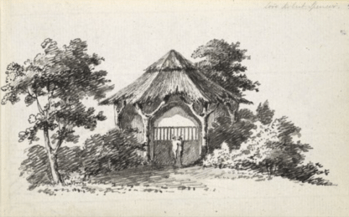
A rustic cowshed at Woolbeding, Nr Midhurst, by George Stanley Repton, 1800, RIBA Library

And if you couldn’t afford Robert Adam, John Soane, Jeffrey Wyattville or even Humphry Repton’s son, George,  to design a château for your cattle then  there were plenty of pattern books available with suitable designs  if you wanted to build your own.

And why all this fuss?  After all we’re only talking about cows.  We’re used nowadays to intensive breeding programmes to develop particular blood lines and qualities, but this had started in the 18thc as part of the Agricultural Revolution. It became almost an obsession to many landowners with several beasts becoming famous, touring the country and  having their portraits painted. And the top quality desired then was size.

The Newbus Ox, Thomas Weaver, 1812, Yale Centre for British Art

Continue reading

Posted in Uncategorized | Tagged , , , , , , , , , , , , , | Leave a comment

Repton, movement and the double page spread…

I looked a few weeks ago at the techniques that Repton used in his Red Books, particularly his  trademark flap or overlay to show his proposed improvements. This week I  want to turn  to another aspect of the Red Books and his printed works which rarely attracts much comment… and that is only marginally to do with flaps and slides. It’s the way that Repton uses the double-page spread  to show the full extent of a landscape.   Is that significant? Why did he do it?

from the Red Book for Endsleigh, 1814

Continue reading

Posted in Uncategorized | Tagged , , , , , , , | Leave a comment

Edward Adveno Brooke and “The Gardens of England”

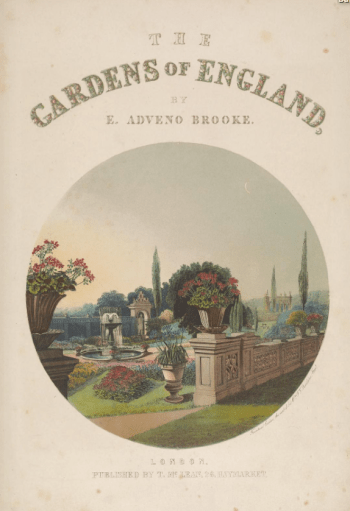
One of my favourite places to work and take students is the Lindley Library, part of the Royal Horticultural Society. It’s  interesting when taking groups there noticing how different things attract and appeal to different people. One book however always causes an intake of breath and a look of amazement: The Gardens of England by Edward Adveno Brooke.

Published in 1856 it’s a large format account of 19 of the grandest gardens in the country at the time. But it’s not the text that creates the wow factor, although when you read it it’s certainly  not merely  drily documentary, it is the images. These are based on Brooke’s own paintings and they show an innate sense of place, coupled with a romantic, even theatrical streak.  It’s no wonder they’re regarded as some of, if not, the best evocations of the spirit of great Victorian gardens.

So I thought Brooke would obviously be well documented and researched. But like other  “minor” artists,  including some like Beatrice Parsons who I have written about here  – I soon realised I was mistaken. Although his name crops up  occasionally in art or garden history books  it is almost always only in connection with The Gardens of England  his only published work. So this really isn’t a post about Brooke, as I’d intended, but instead one about his magnum opus which is what will keep his name alive.  Continue reading

Posted in Uncategorized | Tagged , , , , , , , , , , | Leave a comment

The Picturesque Traveller discovers Wales

The Bard, by John Martin 1778, Yale Centre for British Art

A few months ago I wrote about the change in attitudes to ‘wilderness’ and ‘untamed’ landscapes in the 18thc in a post concentrating on the Lake District.  This week  I want to turn  to Wales which became another 18thc scenic landscape ‘discovery’.

In the main, up until the mid-18thc, the principality had largely been considered remote and inaccessible to travellers, especially English ones.  No-one was interested in, or  went to,  ‘wild places’ so why should they go to Wales?   The answer was provided by Thomas Gray in his poem The Bard written in 1757  about the conquest of Wales by Edward I  in the 13thc whch effetively extinguished Welsh independence.  Gray  researched medieval history and literature and consequently The Bard – albeit rather long-winded and flowery to modern ears – helped overturn ignorance and  formed one of the foundations of both the Romantic movement and the Celtic Revival  in Britain.

The Bard, by Thomas Jones, 1774  National Museum Wales

This  new appreciation of landscape was part of the  revival of interest in both British and specifically Welsh history.  Just as the British ‘discovered’ their Saxon roots so the Welsh ‘discovered’ their supposed links to the ancient Britons. It led in 1751 to the foundation of The Honourable Society of Cymmrodorion [from ‘cyn-frodorion’ or ‘earliest natives’].  Antiquarians began seeking out historic sites and ruins, whilst ‘tourists’ sought out ‘sublime’ experiences  in Snowdonia and other mountainous areas, to rival those of the Alps. It all helped ensure that Wales became part of the itinerary of many British landscape painters.

Continue reading

Posted in Uncategorized | Tagged , , , , , , , , , , | 1 Comment