
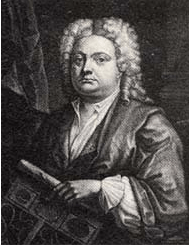
mezzotint portrait by J Carwitham published in 1741, Twickenham Museum
The wonderfully named Batty Langley was a gardener’s son who followed in his fathers footsteps and then turned surveyor, landscape gardener, artificial stone maker, would-be architect and garden designer, as well as prolific author. Well he had to do something to earn money to feed his wife and 14 children! Batty was a man of many talents and trades but probably master of none.
Although often ridiculed, even during his lifetime, Langley is a significant figure because he was one of the earliest writers to promote and popularise both the Gothic style of architecture and the “irregular” garden, that halfway stage between the formal geometric gardens of the baroque and the later more naturalistic landscape movement. He first summed up his ideas in his New Principles of Gardening in 1728.
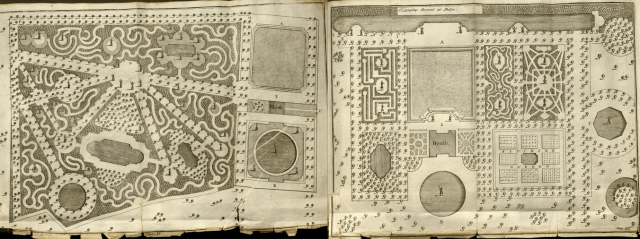
Two Garden Designs from New Principles of Gardening, 1728
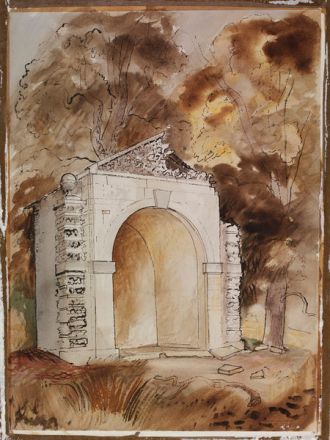



 Sometimes you visit a historic house or garden and think to yourself…. I could live here. Sometimes you have second thoughts and add …if only it wasn’t so remote or inhospitable a setting. That was certainly my reactions on visiting Hulne Priory in Northumberland. It was a bright summer’s day and the site was glorious but it was pretty obvious that would be bleak and windswept in the midst of a Northumbrian winter. That would have suited its founders down to the ground becasue they were Carmelite Friars who deliberately sought out isolated locations for their communities. Now, along with the rest of Hulne Park, it is part of the Duke of Northumberland’s Alnwick estate and still used by the Duke as a base for shooting, and inevitably as a wedding venue!
 Gertrude Jekyll and Edwin Lutyens are one of the great combos of design history. Their names automically trip off the tongue in the same breath, and they created a whole series of magificant houses and gardens all across the Britain. Yet they made just one joint foray working together on a house and garden abroad.


 The Garden History Blog
You must be logged in to post a comment.