

Thomas Fairchild (c.1667-1729); Department of Plant Sciences; http://www.artuk.org/artworks/thomas-fairchild-c-16671729-220972
Thomas Fairchild was one of the greatest horticulturists of the 18thc. But his contribution was not confined to his own age but extends right up to today. That might sound a bit over the top – and perhaps it is – but as you will soon discover I’m a great fan of this humble Hoxton nurseryman. Professional to his fingertips not only did his tiny nursery ground overflow with unusual plants, he fought to raise the profile and status of horticulture through the Worshipful Company of Gardeners, was the first person known to have deliberately hybridized plants, and the first to write about the pleasures and pitfalls of gardening in London in his book, The City Gardener.
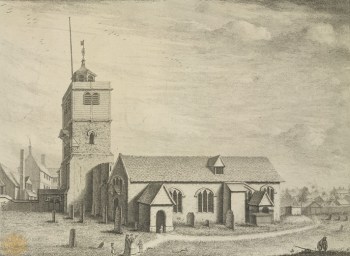
Old St Leonard’s Church, Shoreditch which would have been the church Fairchild knew. Part of the tower collapsed during a service in 1716 & the church was not rebuilt until 1736-40 W. H. Toms, 1734 British Library
When Fairchild died in 1729 he endowed an annual sermon at his local parish church of St Leonard’s in Shoreditch where he lies buried in the furthest corner of the churchyard. On the first Tuesday in Pentecost the preacher is asked to speak about either “The wonderful works of God in Creation” or “On the certainty of the resurrection of the dead, proved by certain changes of the animal and vegetable parts of Creation.”

from “Londons Armoury accurately delineated in a Graphical display…” Richard Wallis, , 1677.
Image courtesy of David Gollin, Worshipful Company of Gardeners.
The sermon is now organized by The Worshipful Company of Gardeners, and this year, he says humbly, I’ve been asked to give it. It will be given from the pulpit of St Giles Cripplegate this coming Tuesday 6th June in a service starting at 5.30. Although it is officially a private company affair, visitors are welcome.
Unlike politician’s speeches which are usually trailed well in advance no details of my sermon will be released in advance in this week’s post but will be summarized in next week’s.
So, after such a long introduction, as your starter for ten, here’s some more background on the ingenious Thomas Fairchild.
 After last week’s post about the early history of strawberries its time to look at how the various wild species were transformed into garden and commercial varieties by an 18thc botanist and a handful of 19thc nurserymen.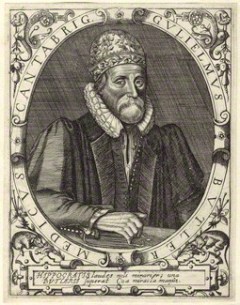

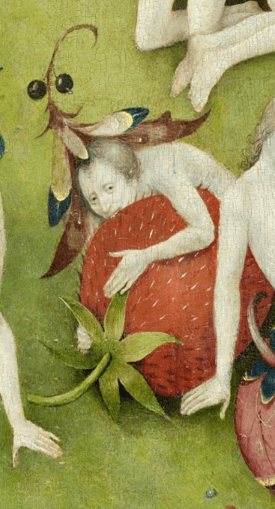

 But strawberries have always had more than just food appeal. In the Middle Ages they were one of the more revered symbols of the Virgin Mary but they also had another more erotic and voluptuous side to them as well.




 The Garden History Blog
You must be logged in to post a comment.