Adrian Berg

The Four Seasons of Glyndebourne, Christies.com

We’re used to seeing paintings of gardens in an historical context and using them as evidence, but I don’t think we take as much notice of contemporary representations of gardens as perhaps we should. I was reminded of this the other day when I saw a notice for an exhibition at Hall Place, a beautiful Tudor house in Bexley which I’d written about on here.

Stourhead, 2001
adrianberg.com

It was for a retrospective of the work of Adrian Berg an artist whose work I didn’t know, but I liked the image used on the poster so looked for some more information about him. In the process I  bought myself a book about contemporary artists whose work involves the garden. Flicking through and finding Adrian Berg there I also realised I had written on here about Ivor Abrahams, one of the other 21 painters covered by the book. I also realised that I recognized only a couple of other names and just one or two particular paintings. I’ve certainly missed out…

Gloucester Gate, Regent’s Park, Night, Autumn;                                                                                 Government Art  Collection

Continue reading

Posted in Uncategorized | Tagged , , , , , | 2 Comments

Broughton Castle

Tucked away in beautiful countryside just a couple of miles from Banbury is one of the most perfect houses in the country: Broughton Castle.  The Historic England site description does nothing to convey the surprise the visitor gets when they turn into the park and gradually the house comes into view. It’s not an obvious statement of power,  more a natural assumption of it.  It is “olde England” at its best.

That feeling persists in every aspect of the house and grounds, and rightly so.  The last time it was sold was 1377 when it was bought by William of Wykeham, the Bishop of Winchester.  It eventually passed by inheritance to the Fiennes family who have lived there since 1447.   But don’t just take my word for the fact that Broughton is rather special. Commentators as diverse as Henry James, Alan Bennett, Simon Jenkins  and Patrick Taylor all think it one of the “best” houses in the country… and the gardens aren’t bad either. Read on to find out why…

The Gatehouse and part of the border       David Marsh, August 2016

Continue reading

Posted in Uncategorized | Tagged , , , , , | Leave a comment

Lilac Time…

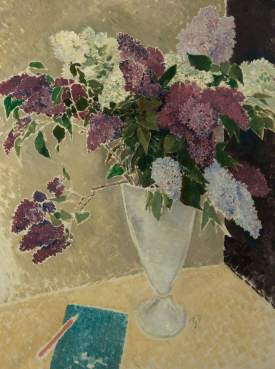
Glyn Philpott, Lilacs, Gallery Oldham  http://www.artuk.org/artworks/lilacs-90798

The spring has caught up with my garden and the lilacs are beginning to bloom. The first I knew was as I opened the doors into the garden the other morning and caught the scent well before I could see the biggest bush which stands just out of sight on the corner of the house.

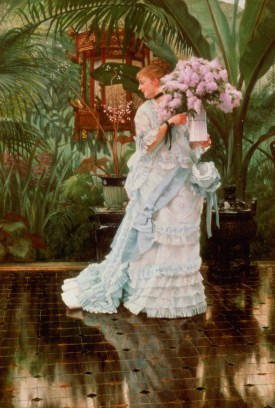
For some reason I always think of Lilac as an old-fashioned plant – with overtones of the perfume loved by little old ladies like my grandma – which flourish in overgrown vicarage gardens, rather romantic but also rather chocolate-boxy. I wonder if that’s anything to do with memories of paintings like this Tissot or poems and songs like Lilac Time?

The Bunch of Lilacs, c.1875 by James Tissot,  Photo © Christie’s

Come down to Kew in lilac time, in lilac time, in lilac time,

Come down to Kew in lilac-time (It isn’t far from London!)

And you shall wander hand in hand with love in summer’s wonderland,

Come down to Kew in Lilac time (It isn’t far from London!)

from The Barrel Organ, by Alfred Noyes (1906) and turned into a song…[click on the link above to listen to it sung by Carmen Hill in 1923]

So…. the other day I did just that and went to Kew thinking  this would be a good opportunity to investigate the history of lilac, in our gardens and even as a cut flower, and  maybe even change my preconceptions…

Continue reading

Posted in Uncategorized | Tagged , , , , , , , | 3 Comments

Kip and Knyff : Part 2 Kip

from The history of nature, in two parts : emblematically express’d in near a hundred folio copper-plates , 1720  https://archive.org/details/historyofnaturei00kipj

For someone whose work is so well known it’s surprising how little biographical information is recorded  about Johannes Kip,  the topographical engraver. He is  best known for Britannia Illustrata, his work with Leonard Knyff, which has illustrations of the estates of late 17thc and early 18thc England,  but he was also a prolific book illustrator with a sideline in selling prints  from a shop in his house at Westminster.

detail from View and Perspective of London, Westminster and St James’s Park c.1727
https://www.royalcollection.org.uk

Today’s post is a quick look at the range of his work, and then a closer look at his enormous engraving of St James Park in London first published in 1720.  Continue reading

Posted in Uncategorized | Tagged , , , , | 2 Comments

KIP & KNYFF: Part 1: Knyff

To most people “Kip & Knyff”  sounds like a bit like a Victorian music hall act, but say “Kip and Knyff” to a garden or architectural historian and they will instantly  picture a bird’s eye view of a great English house and estate from the late 17th or early 18thc.
“Kip and Knyff” always seem to “go together like a horse and carriage” as the song would have it, but although they had much in common and are often spoken of in the same breath they were not in fact a regular business partnership or even usual working companions and seem to have had little to do with each other apart from their most famous collaboration, Britannia Illustrata Or Views of Several of the Queens Palaces, as Also of the Principal seats of the Nobility and Gentry of Great Britain, Curiously Engraven on 80 Copper Plates  the first volume of which was published 1707.

The only obvious ‘joint’ biographical facts are their Dutch origins and the fact that they were also of a similar age and longevity, Knyff being born in 1650 and Kip 3 years later, and both were to die in London in 1721.

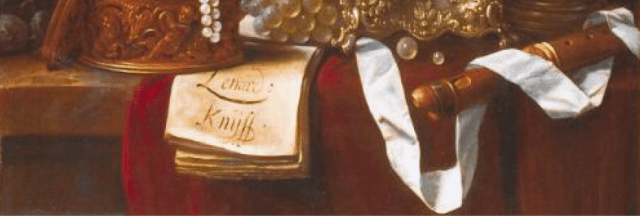
Knyff’s signature on a still life painting in a private collection from https://rkd.nl/en/explore/images/record?filters%5Bkunstenaar%5D=Knijff%2C+Leonard&query=&start=1

So, as a result I’m writing two separate posts about them – one each! And this week its the turn of Leonard Knyff…

Continue reading

Posted in Uncategorized | Tagged , , , , , , , , , , , | 2 Comments