Saints, Sinners, Sex and Strawberries…

Strawberries are quintessentially English. Or so you’d think. But actually they’re not. Although there are indigenous European strawberries the ones we eat are hybrids derived from a species from New England and another from Chile  introduced surreptitiously into France in the early 18thc. This species didn’t really reach Britain until the mid-18thc  and really didn’t become common in gardens until the 19th.  

Why? Because at first they didn’t fruit. Why not? Because no-one realised that strawberries had sex – let me rephrase that – that most strawberry plants were either male or female.  But once they did that’s when British gardeners and nurserymen took over and led the world in developing better and better domestic and commercial – hermaphrodite – varieties.

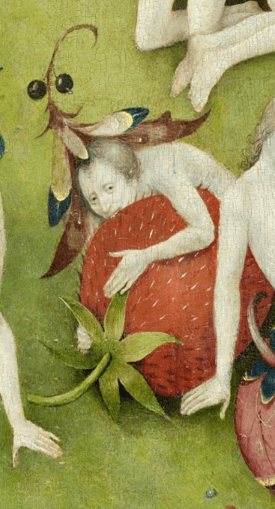
But strawberries have always had more than just food appeal. In the Middle Ages they were one of the more revered symbols of the Virgin Mary but they also had another more erotic and voluptuous side to them as well.

As a result although this post started out as a ‘normal’ piece of horticultural history I got diverted along the way with other strawberry-related stuff so its ended up becoming two posts instead!

So read on to find out more about the early history and imagery of our favourite fruit…

detail from Histoires de Troyes Ms Francais 59, fol. 153,c1470, Biblioteque National de France

Continue reading

Posted in Uncategorized | Tagged , , , , , , , , , | 1 Comment

Nun Appleton

Andrew Marvell
after unknown artist
line engraving, published 1681, NPG

Nun Appleton House is a sad place these days in every sense. The Yorkshire estate was once the home of Thomas Fairfax, the great Parliamentary general, and  also for a short while to Andrew Marvell, the poet, who acted as tutor to Fairfax’s daughter Mary.  Marvell wrote extensively about the house, landscape and garden in a series of famous poems, and yet there is now no access of any sort, and  the landscape has been effectively rendered a no-go area to all but the most determined.

I only realised the plight of the house when I was researching a lecture about philosophy and politics in the 17thc garden, [don’t ask but it wasn’t as boring as it sounds!] and wanted to include some illustrations to accompany  some extracts from Marvell’s verse.

The parkland of the estate has been registered Grade II by Historic England but the whole Nun Appleton site has significant importance because of its association with Marvell and given its present inaccessibility and apparent neglect it certainly deserves better treatment.   Continue reading

Posted in Uncategorized | Tagged , , , , | 3 Comments

The Strange Case of Doctor Ward…

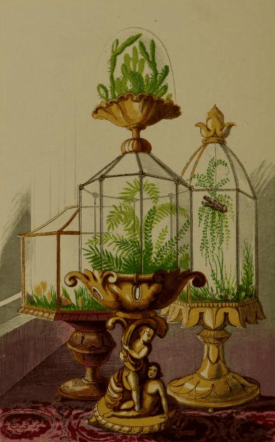
“Wardian Cases”  from Shirley Hibberd’s Rustic Adornments, 1870

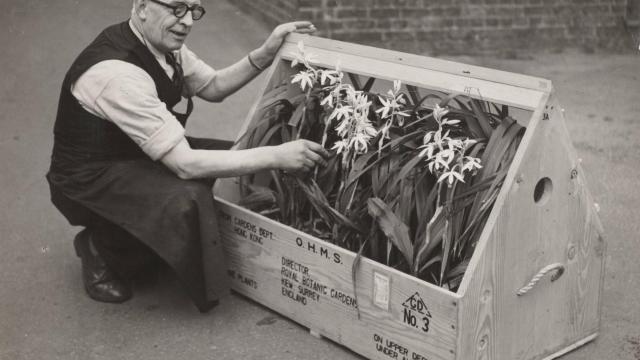
Most readers of this blog will be familiar with the Wardian case, the method of transporting plants that transformed the world’s gardens and hothouses from the mid-19thc onwards and which were in regular use by Kew for the international transportation of plants right up until the 1960s.

Many will also be familiar with the story of how it came to be invented but what else do we know about the man supposed to have discovered the principles behind it Nathaniel Bagshaw Ward?  Why was he interested, then inspired, by what he found?

Read on to find out if  there more to Dr Ward than finding a fern in a sealed bottle just by chance…

Wardian case of orchids received by Kew from Hong Kong, Royal Botanic Gardens, Kew

Continue reading

Posted in Uncategorized | Tagged , , , , , , , , , , , | Leave a comment

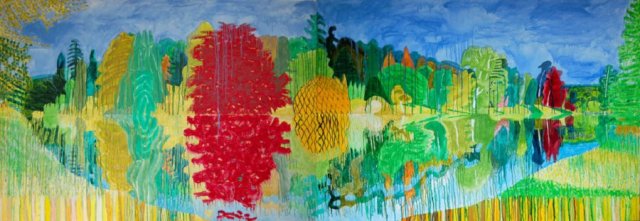
Adrian Berg

The Four Seasons of Glyndebourne, Christies.com

We’re used to seeing paintings of gardens in an historical context and using them as evidence, but I don’t think we take as much notice of contemporary representations of gardens as perhaps we should. I was reminded of this the other day when I saw a notice for an exhibition at Hall Place, a beautiful Tudor house in Bexley which I’d written about on here.

Stourhead, 2001
adrianberg.com

It was for a retrospective of the work of Adrian Berg an artist whose work I didn’t know, but I liked the image used on the poster so looked for some more information about him. In the process I  bought myself a book about contemporary artists whose work involves the garden. Flicking through and finding Adrian Berg there I also realised I had written on here about Ivor Abrahams, one of the other 21 painters covered by the book. I also realised that I recognized only a couple of other names and just one or two particular paintings. I’ve certainly missed out…

Gloucester Gate, Regent’s Park, Night, Autumn;                                                                                 Government Art  Collection

Continue reading

Posted in Uncategorized | Tagged , , , , , | 2 Comments

Broughton Castle

Tucked away in beautiful countryside just a couple of miles from Banbury is one of the most perfect houses in the country: Broughton Castle.  The Historic England site description does nothing to convey the surprise the visitor gets when they turn into the park and gradually the house comes into view. It’s not an obvious statement of power,  more a natural assumption of it.  It is “olde England” at its best.

That feeling persists in every aspect of the house and grounds, and rightly so.  The last time it was sold was 1377 when it was bought by William of Wykeham, the Bishop of Winchester.  It eventually passed by inheritance to the Fiennes family who have lived there since 1447.   But don’t just take my word for the fact that Broughton is rather special. Commentators as diverse as Henry James, Alan Bennett, Simon Jenkins  and Patrick Taylor all think it one of the “best” houses in the country… and the gardens aren’t bad either. Read on to find out why…

The Gatehouse and part of the border       David Marsh, August 2016

Continue reading

Posted in Uncategorized | Tagged , , , , , | Leave a comment