Lilac Time…

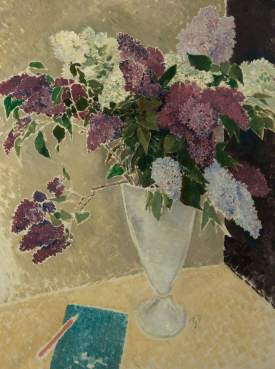
Glyn Philpott, Lilacs, Gallery Oldham  http://www.artuk.org/artworks/lilacs-90798

The spring has caught up with my garden and the lilacs are beginning to bloom. The first I knew was as I opened the doors into the garden the other morning and caught the scent well before I could see the biggest bush which stands just out of sight on the corner of the house.

For some reason I always think of Lilac as an old-fashioned plant – with overtones of the perfume loved by little old ladies like my grandma – which flourish in overgrown vicarage gardens, rather romantic but also rather chocolate-boxy. I wonder if that’s anything to do with memories of paintings like this Tissot or poems and songs like Lilac Time?
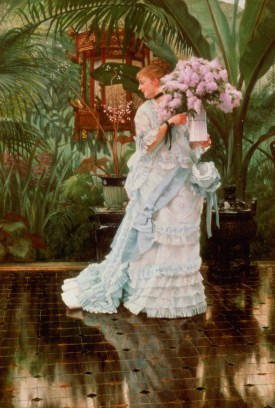
The Bunch of Lilacs, c.1875 by James Tissot,  Photo © Christie’s

Come down to Kew in lilac time, in lilac time, in lilac time,

Come down to Kew in lilac-time (It isn’t far from London!)

And you shall wander hand in hand with love in summer’s wonderland,

Come down to Kew in Lilac time (It isn’t far from London!)

from The Barrel Organ, by Alfred Noyes (1906) and turned into a song…[click on the link above to listen to it sung by Carmen Hill in 1923]

So…. the other day I did just that and went to Kew thinking  this would be a good opportunity to investigate the history of lilac, in our gardens and even as a cut flower, and  maybe even change my preconceptions…

Continue reading

Posted in Uncategorized | Tagged , , , , , , , | 3 Comments

Kip and Knyff : Part 2 Kip

from The history of nature, in two parts : emblematically express’d in near a hundred folio copper-plates , 1720  https://archive.org/details/historyofnaturei00kipj

For someone whose work is so well known it’s surprising how little biographical information is recorded  about Johannes Kip,  the topographical engraver. He is  best known for Britannia Illustrata, his work with Leonard Knyff, which has illustrations of the estates of late 17thc and early 18thc England,  but he was also a prolific book illustrator with a sideline in selling prints  from a shop in his house at Westminster.

detail from View and Perspective of London, Westminster and St James’s Park c.1727
https://www.royalcollection.org.uk

Today’s post is a quick look at the range of his work, and then a closer look at his enormous engraving of St James Park in London first published in 1720.  Continue reading

Posted in Uncategorized | Tagged , , , , | 2 Comments

KIP & KNYFF: Part 1: Knyff

To most people “Kip & Knyff”  sounds like a bit like a Victorian music hall act, but say “Kip and Knyff” to a garden or architectural historian and they will instantly  picture a bird’s eye view of a great English house and estate from the late 17th or early 18thc.
“Kip and Knyff” always seem to “go together like a horse and carriage” as the song would have it, but although they had much in common and are often spoken of in the same breath they were not in fact a regular business partnership or even usual working companions and seem to have had little to do with each other apart from their most famous collaboration, Britannia Illustrata Or Views of Several of the Queens Palaces, as Also of the Principal seats of the Nobility and Gentry of Great Britain, Curiously Engraven on 80 Copper Plates  the first volume of which was published 1707.

The only obvious ‘joint’ biographical facts are their Dutch origins and the fact that they were also of a similar age and longevity, Knyff being born in 1650 and Kip 3 years later, and both were to die in London in 1721.

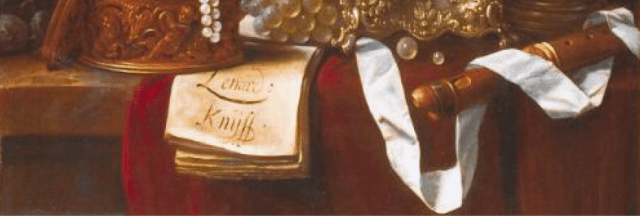
Knyff’s signature on a still life painting in a private collection from https://rkd.nl/en/explore/images/record?filters%5Bkunstenaar%5D=Knijff%2C+Leonard&query=&start=1

So, as a result I’m writing two separate posts about them – one each! And this week its the turn of Leonard Knyff…

Continue reading

Posted in Uncategorized | Tagged , , , , , , , , , , , | 2 Comments

Hyacinths

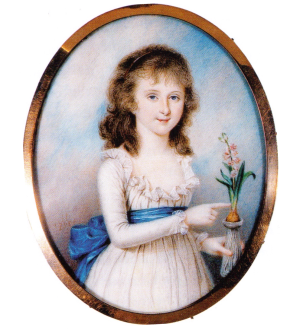
Portrait of Mary Mitchell, by James Peake. Image from Catherine Horwood’s Potted History, p.53

At this time of year my favourite smell is hyacinths. Close packed into every conceivable sort of container they made ideal presents for Christmas,  but they are still be available for sale everywhere to bring a wonderful touch of spring scent and colour whatever the weather. I love to have them all over the house so that when I come home I get an instant uplift as I open the door.

Hyacinthus orientalis L. [as Hyacinthus orientalis caeruleo] Passe, C. van de, Hortus floridus (coloured plates), fasicle 1. vernalis, t. 10, fig. 1 (1614)

Hyacinthus orientalis L. [as Hyacinthus orientalis caeruleo]
from Crispin de Passe, Hortus floridus  (1614)

But do you know where the name comes from? And who first discovered that they could be ‘forced’ to flower early, and how this was best done?  And although we’ve all heard of tulip mania in the 17thc did you know there was an almost equally wild passion for hyacinths in the 18th and 19th centuries? And at the end of the post there’s a link to info about Britains only commercial hyacinth grower.  Read on to find out more… Continue reading

Posted in Uncategorized | Tagged , , , , , , , , , , | Leave a comment

Clarence Elliott: garden writer and alpine specialist

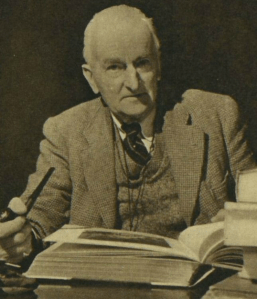
Clarence Elliott from Illustrated London News xxxx

Clarence Elliott                                          from Illustrated London News,                 Jan 11th 1958

This post was inspired by an information board in the Alpine Garden area of Wisley. But unless you’re an alpine plant aficionado  or a fan of gardening columns in long-defunct magazines, you probably haven’t heard of  the person mentioned on it: Clarence Elliott.  He was a founder member of the Alpine Garden Society and began the popularisation of sink and trough gardens. If you hadn’t heard of him you may well have heard of the nursery he founded, and in particular one or two of the plants he introduced to cultivation.

Information board in the Alpine Garden at Wisley, Januray 2016

Information board in the Alpine Garden at Wisley, January 2016

But Clarence Elliott wasn’t just a gardener but a naturalist and plant hunter too. He collected for both Kew and Edinburgh botanic gardens.

And after he ‘retired’ he began contributing a weekly column to Illustrated London News which he continued to write until well into his 80s.

Read on to find out more about this influential and far-sighted horticulturist ….

Continue reading

Posted in Uncategorized | Tagged , , , , , , , | 5 Comments