
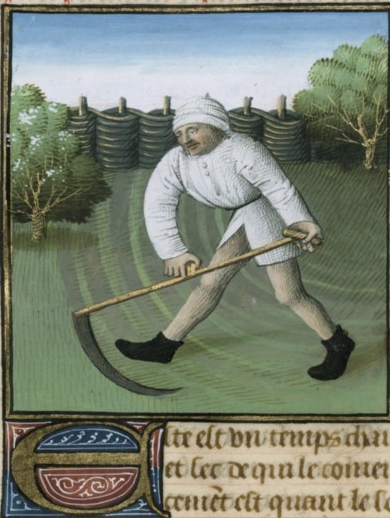
Barthelemy l’Anglais, de proprietatibus rerum 1480 BNF Ms Francais 9140
No, its not an extract from a Frankie Howard or Kenneth Williams script [giving my age away there] but something to do with the traditional centrepiece of most English gardens: the lawn.
Nowadays its a relatively easy job to cut a lawn. We jump on our sit-on mower and ride up and down, or pull the rip-cord on the strimmer and stroll backwards and forwards until the job is done. But how were lawns managed in the days before such newfangled technology? The simple answer is either by grazing animals or by people holding nibs on the side of snaths [or sometimes sneads] which were fixed, by way of a tang, to a chine which had a very sharp dengle edge… or in plainer language… by scything.
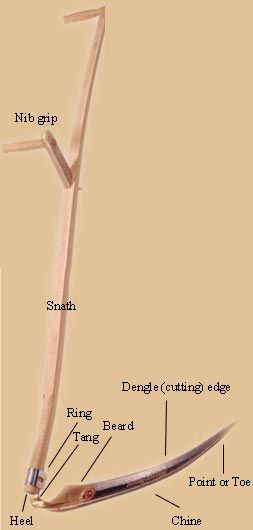
Diagram of a mowing scythe by Elliot Fishbein
http://www.motherearthnews.com/homesteading-and-livestock/mowing-with-a-scythe-zmaz02fmzgoe.aspx
You might assume that such a “primitive’ method of cutting meant lawns were relatively unkempt, with much longer grass compared with the close cropped stripey velvet look we are used to today. After all how surely a manually operated blade however sharp can’t compete with sophisticated machinery, but you’d probably be mistaken.
Where did the idea for having cut grass as part of the garden come from anyway? Read on to find out and to discover more about the ways in which the grass, lawns, turf, greensward and the sods in our gardens and parks were created and cared for in the past….
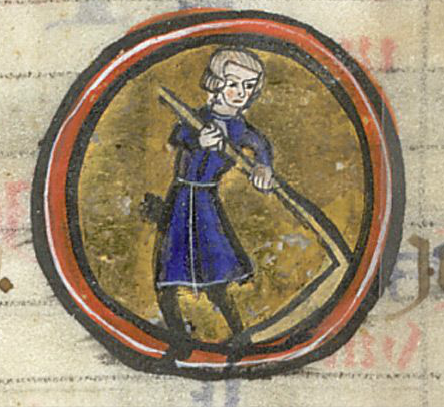
Bibliotheque National de France
Latin 12834, fol. 54v,
![A stylised Peruvian booby bird - one source of guano - froma window at Tyntesfield. [Lesley Kinsley, 2013 from http://animalhistorymuseum.org]](https://thegardenhistory.blog/wp-content/uploads/2015/06/screenshot13.png)




 The Garden History Blog
You must be logged in to post a comment.