Visiting a Duke 18thc style…

At the end of last year I wrote  about the travel journals of John Byng, 5th Viscount Torrington. His diaries are, unlike most 18thc published writing, quite informal in style , probably because he  had no intention of putting his thoughts into print.  Whereas most of his contemporaries write of  the almost constant wars that form the background to this period or the political situation of the days, Byng  virtually  ignores such mundane matters.
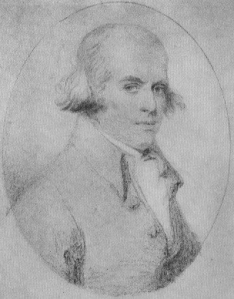
John Byng by Ozias Humphry, 1796 from The Torrington Diaries

Instead he concentrates on  the English countryside and its people, enjoying himself as an interested observer of little details.  He describes the buildings, gardens  and landscapes he visited, and the people of all kinds  he met, and not always in the most flattering way.   Take for example his visits on what he called “A Tour in the Midlands” in 1789….


Continue reading

Posted in Uncategorized | Tagged , , , , , , , , , , , | Leave a comment

Arundel Castle and the Collector Earl’s Garden

DM June 2018

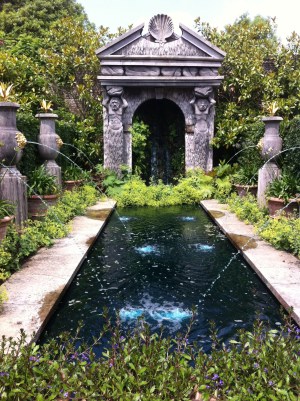
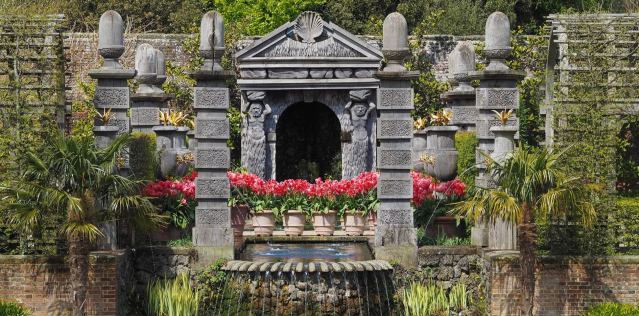
I’ve been meaning to write about the gardens of Arundel Castle since I visited last summer with friends from  the Birkbeck Garden History Group and discovered the new[ish] Collector Earl’s Garden with [amongst other things]   Oberon’s Palace, a floating crown, and an amazing stumpery. I added it to the long list of possible future posts but something else always got in the way.  However, my memory was jogged sharply when I discovered an account of the castle’s grounds – rather less than flattering – by John Claudius Loudon in 1829.

The main question now is whether to start with the good or the bad review…

Continue reading

Posted in Uncategorized | Tagged , , , , , , , , , , | Leave a comment

Austin & Seeley

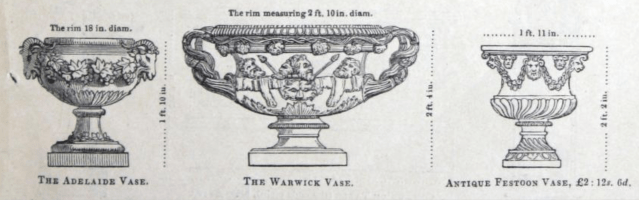
Many months ago I posted several pieces tracing the story of  Eleanor Coade and her artificial stone,  which ornamented  elite buildings and gardens in the later 18thc. A later post looked at the work of Mark Blanchard and John Blashfield  two of her successor companies, and today is a look at yet another: Felix Austin, who was much admired by John Claudius Loudon.

As is so often the case very little is accurately known about Austin or his story, but what is clear is that after an independent start  he went  into partnership with John Seeley and their company, Austin & Seeley, became one of the leaders in the field of architectural and garden ornaments by the mid-19th century supplying every one from the middle classes to Queen Victoria herself.

from Select Specimens of Austin and Seeley’s Works in Artificial Stone, June 1841

Continue reading

Posted in Uncategorized | Tagged , , , , , , , , , , , , , , , , | Leave a comment

Gardens through the letterbox…

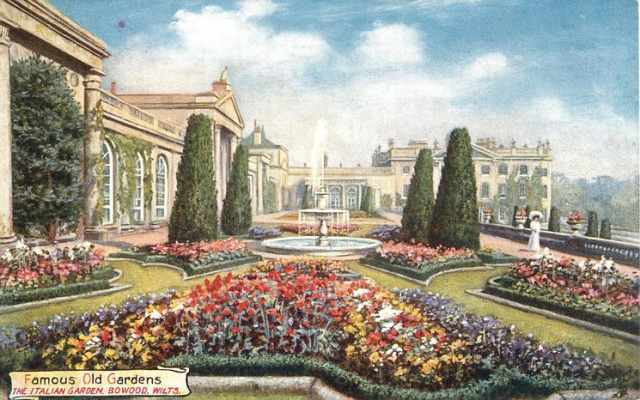
A brightly coloured old postcard on a market stall caught my eye the other day , and it turned out to be one of a series of “Famous Old Gardens” produced sometime in the very early 20thc by the firm of Raphael Tuck.

detail from a card of Drummond Castle

This series of cards are all in a very distinctive style, so I decided to track down Mr Tuck and more of his garden postcards to see if  they’d make some light reading for the Saturday morning breakfast table, and indeed they do!

Continue reading

Posted in Uncategorized | Tagged , , , , , , , , , , , , | 2 Comments

Anglesey Abbey

Anglesey Abbey Gardens with a Lady in White on a Grass Path holding a Parasol, by Edward Seago, 1949. National Trust

Just under a century ago two wealthy Anglo-American brothers, fanatical about horse racing bought a stud farm near Bury St Edmunds in Suffolk. They also  wanted to enjoy the life of the huntin’ shootin’ and fishin’ set in the English countryside, and so looked for a suitable country house within relatively easy travel of Newmarket racecourse. In 1926 they ended up buying Anglesey Abbey a few miles north east of Cambridge for use during the summer months. They also agreed that whoever married first should sell his share in the estate to the other.

The brothers, Huttleston and Henry Broughton began an immediate and very sympathetic restoration of the house, and later extending it further. By 1966 when Huttleston died Anglesey Abbey also had a garden that was inspirational. Graham Thomas, then the Garden Adviser to the National Trust which had just been bequeathed the estate wrote:      “In these islands I have not seen any garden which resembles this huge layout. Its conception owes much to the gentle magnificence of the English landscape school of the 18thc but with its numerous formal vistas, often terminated or enhanced by valuable and ancient statuary, vases, urns and the like, it strikes an earlier note. At the same time the more intimate gardens around the house are modern in treatment [Gardeners Chronicle 23rd August 1967].  John Sales, Thomas’s successor at the Trust says it is the only post-modern garden he knows.”

The South Front, DM 2013

Read on to find out why…

Continue reading

Posted in Uncategorized | Tagged , , , , , , , , , , , , , , , , , , , , | Leave a comment