William Caparne : painter and plantsman

Mrs Pinchney’s garden                          Guernsey

The love of plants runs in the blood, or so it might appear from the life of William Caparne  teacher, painter, plantsman and iris fanatic.  

A very private man, but who travelled widely in Europe and met and was befriended by Monet,  he eventually gave up teaching and moved to Guernsey to paint landscapes, gardens and the flowers which he grew and bred in his nursery there: above all botanical paintings of his beloved iris. Despite his horticultural achievements he and his work were soon forgotten, and have really only been bought back to their deserved place in the pantheon in the last 20 or so years.
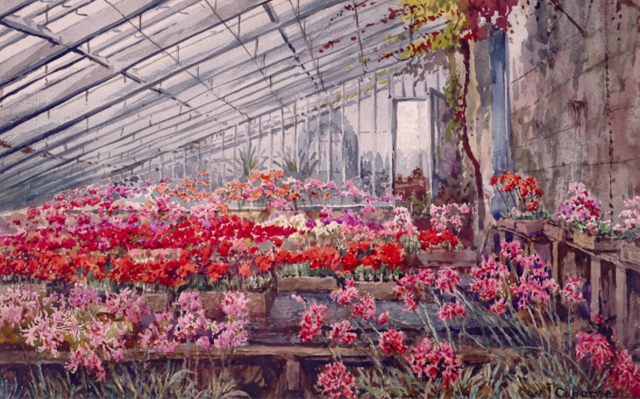
A House of Nerines, Guernsey

Continue reading

Posted in Uncategorized | Tagged , , , , , , , , , , , , , | 1 Comment

The Darlys: Chinoiserie and big hair

Mary and Matthias Darly were designers, engravers and printsellers in late 18thc London, who were particularly well-known for their caricatures and satires on contemporary politics and fashion.

Matthias Darley, c.1775
British Museum

Matthias [sometimes refererred to as Matthew] illustrated books of designs for ‘ornament’,  furniture and architecture, particularly garden buildings, with a particular focus on the fashionable taste for Chinoiserie. He  was good at spotting trends and keeping up with fashion and  according to his biographer, Timothy Clayton,  became “a central figure at a time when English craftsmen were struggling for a distinct identity and for preference over foreign rivals”. Mary, on the other hand had no pretensions of grandeur, called herself “The Mistress of Fun” and specialised in sharply observed caricatures.

Darly’s Trade Card, British Museum

Continue reading

Posted in Uncategorized | Tagged , , , | 2 Comments

Bolsover: a Mannerist Masterpiece

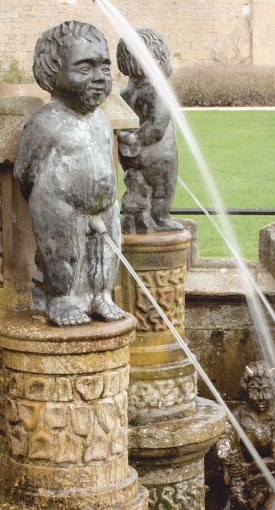
detail of the Venus Fountain, photo by Edward Moss

If you’ve ever driven on the M1 between Nottingham  and Sheffield you can’t have missed the  large castle perched high on a steep promontory overlooking and commanding the wide valley below. This is  Bolsover Castle, visible for miles around, and enjoying one of  most magnificent settings of any historic building in Britain. Having said that it’s also quite likely you’ll have carried on driving and not turned off to investigate further. If that’s the case you’ve missed a treat, and doubly so since English Heritage completed their restoration and improvement works.

But Bolsover isn’t just any old  castle, indeed its only a castle in form and outward appearance. It’s actually an early 17thc mannerist  pleasure palace and a masterpiece of design. You can tell from that description that I quite liked it! [My photos, Nov 2017] unless otherwise stated] Read on to find out exactly why…

Continue reading

Posted in Uncategorized | Tagged , , , , , , , | Leave a comment

More than just a knotty problem…

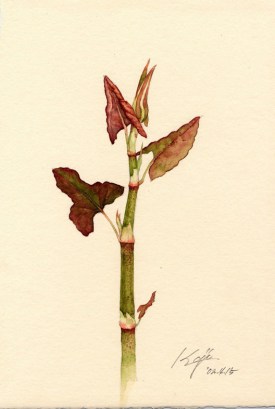
There are plenty of choices for plants that are a nuisance and  almost as many for those that are a damned nuisance or worse. Depending on your location and circumstances it could Brambles, Nettles, Docks, Ground Elder, Marestail, Hogweed …the list is almost endless. But to name a plant  that can stop you getting your house insured or that is powerful enough to break through tarmac or concrete doesn’t leave you much choice. It has to be Japanese Knotweed.

no it’s not asparagus!

But you can see why Knotweed – botanically Fallopia japonica – was a smash hit with gardeners when it was first introduced in the 19thc. It is an imposing plant, with sprays of beautiful white flowers, strong architectural form and lush foliage.  Of course what they didn’t know initially, although it didn’t take that long to find out the hard way,  is that is rampantly invasive and virtually impossible to eradicate. It’s no wonder its been declared a public nuisance and was proscribed from being planted in 1981.  Yet I’ve seen the same plant growing under controlled circumstances in historic gardens so just maybe, potentially, perhaps, it is remotely possible to have the best of both worlds.

Fallopia japonica .  Alex Hyde photography

Continue reading

Posted in Uncategorized | Tagged , , , , , , , , , , , , , , , | 1 Comment

Repton and his business

HAPPY NEW YEAR!  If you hadn’t already realised 2018 is Repton Year, when we’re commemorating the life and work of the last great landscape designer of the eighteenth century.  Unlike the Festival for his ‘predecessor’ Capability Brown there is no great central nationally funded organization. Instead Celebrating Humphry Repton  will be a collaborative effort, which, even though although it can’t match the funding of CB300,  looks certain to match the enthusiasm and spread of interest nationally.  County Gardens Trusts and other groups will be arranging events around the country throughout the year to celebrate Repton’s work. You can find a list – continually being updated – at this dedicated webpage on  The Gardens Trust website.  If you would like to get involved or receive updates email repton@thegardenstrust.org. The more people who join in, the better the celebration!

And of course the blog is going to play its small part.  Repton has already been the subject of two posts  way back in April 2104  [ A general one about his life and another on his work at Ashridge] but during the course of this year I’m going to look at aspects of Repton’s approach to garden and landscape design, in what I hope is a less conventional way so that I [and you the reader] don’t get Humphed-out by the end of the year and wish that he’d never been born!


But where to start?

The more I read the more complicated Repton becomes, until  I asked myself what’s the one thing that everyone knows about Repton? He made Red Books.  But the how and why he did isn’t quite so obvious.  It isn’t even clear why he became a landscape gardener in the first place.  So lets start there…. Continue reading

Posted in Uncategorized | Tagged , , , , , , , , , | 3 Comments